arrow left

Holding the Light: Teaching an AI to Lock and Tune our Quantum Computer’s Lasers

calender icon
August 27, 2026
clock icon
min read
Technology
Share

QuEra's quantum computers run on lasers held at exact frequencies, a precision no eye can see and only the atoms can distinguish. Keeping a laser there is a continuous act: temperature, vibration, and pressure push it off target all day, and layered feedback pushes it back. When the feedback loop fails, the lock breaks and the machine stops. Bringing it back has historically taken one specific expert: someone who knows the lasers intuitively and has experience with the exact recovery sequence required to return it to the right state. If the lock broke in the middle of the night, that person had to drive to the lab and fix it.

This is not a new problem, and QuEra has built automatic relocking for common disturbances. Aquila, our production QPU available through Amazon Braket, already runs with excellent uptime exceeding 99%. But the team knew that the level of human involvement in relocking, particularly for the less frequent but more severe disturbances, was not scalable. As a result, this spring QuEra deployed the Model Hardware Standard (MHS), a standard that started as a collaboration between Anthropic and HHMI Janelia Research Campus. A cross-functional task force took relocking to another level: the level that scalable deployment of logical QPUs will demand. Working through MHS on a dedicated testbed, with an AI agent in operational control of roughly $0.7M of precision hardware inside human-set safety bounds, the lock now comes back in seconds: verified, on target, with no one in the building. And then the same approach went one step further. It tuned the lock itself, to a quality level it can prove, and carried that new ability to a second operating wavelength in a single run.
The results are promising and are just the tip of the iceberg when it comes to QuEra's plans for layering AI, at a foundational level, across our quantum computers.

The Laser Locking Problem

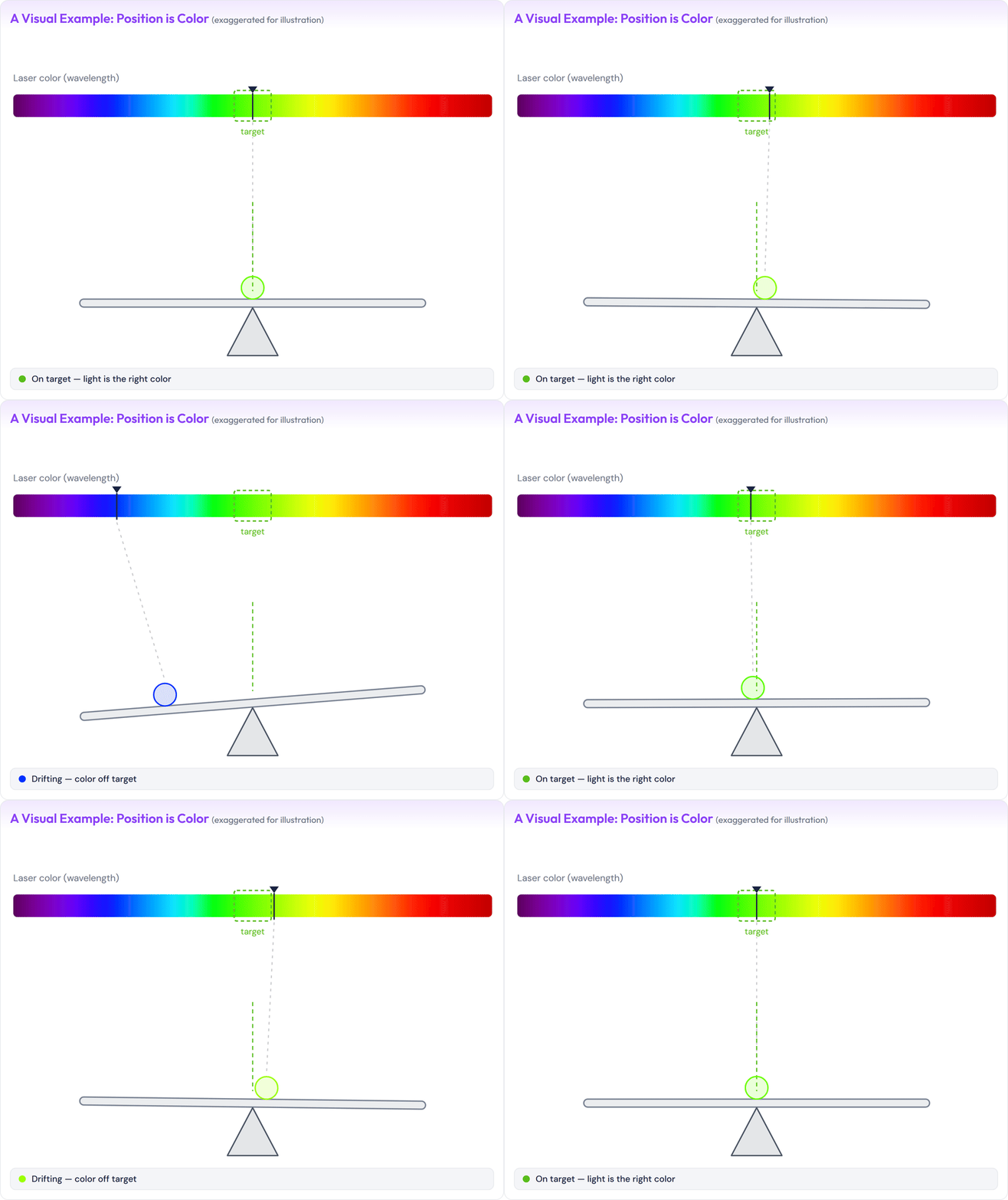
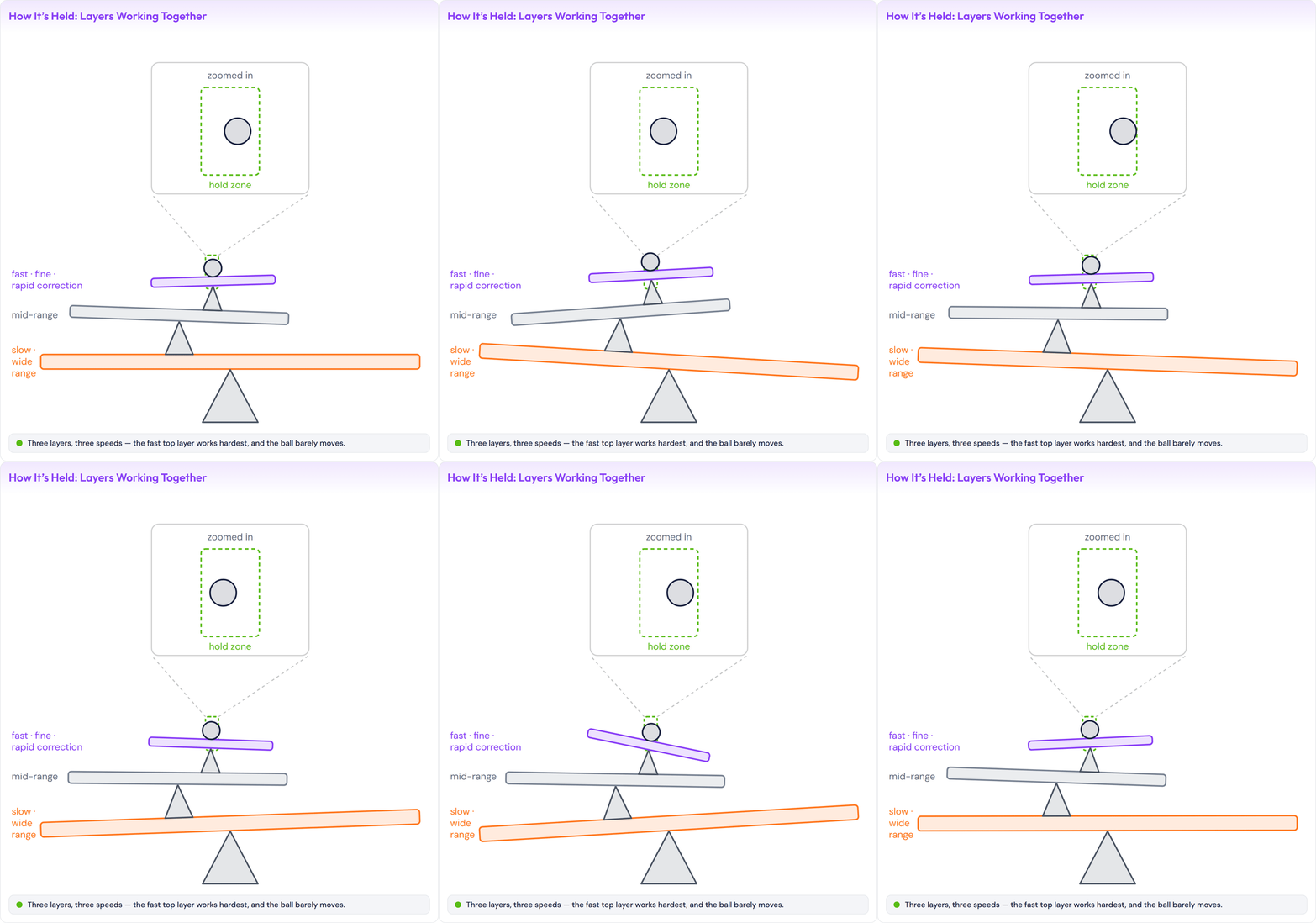
Picturing a ball on a see-saw is a useful visual analogy for the problem our AI agent was solving. In this simplified analogy, the ball's position is the laser's frequency. If we can hold it in a specific location (in this example, inside the green region), we can successfully control the atomic qubits.
In QuEra's systems, the lasers that drive logical qubits must hold within ±1 kHz or better, about ±0.000000001 nm (illustrative values, for education). The infrared laser here is invisible to the eye, shown in false color. The ball swings; no eye could ever tell. Only atoms can tell the difference.
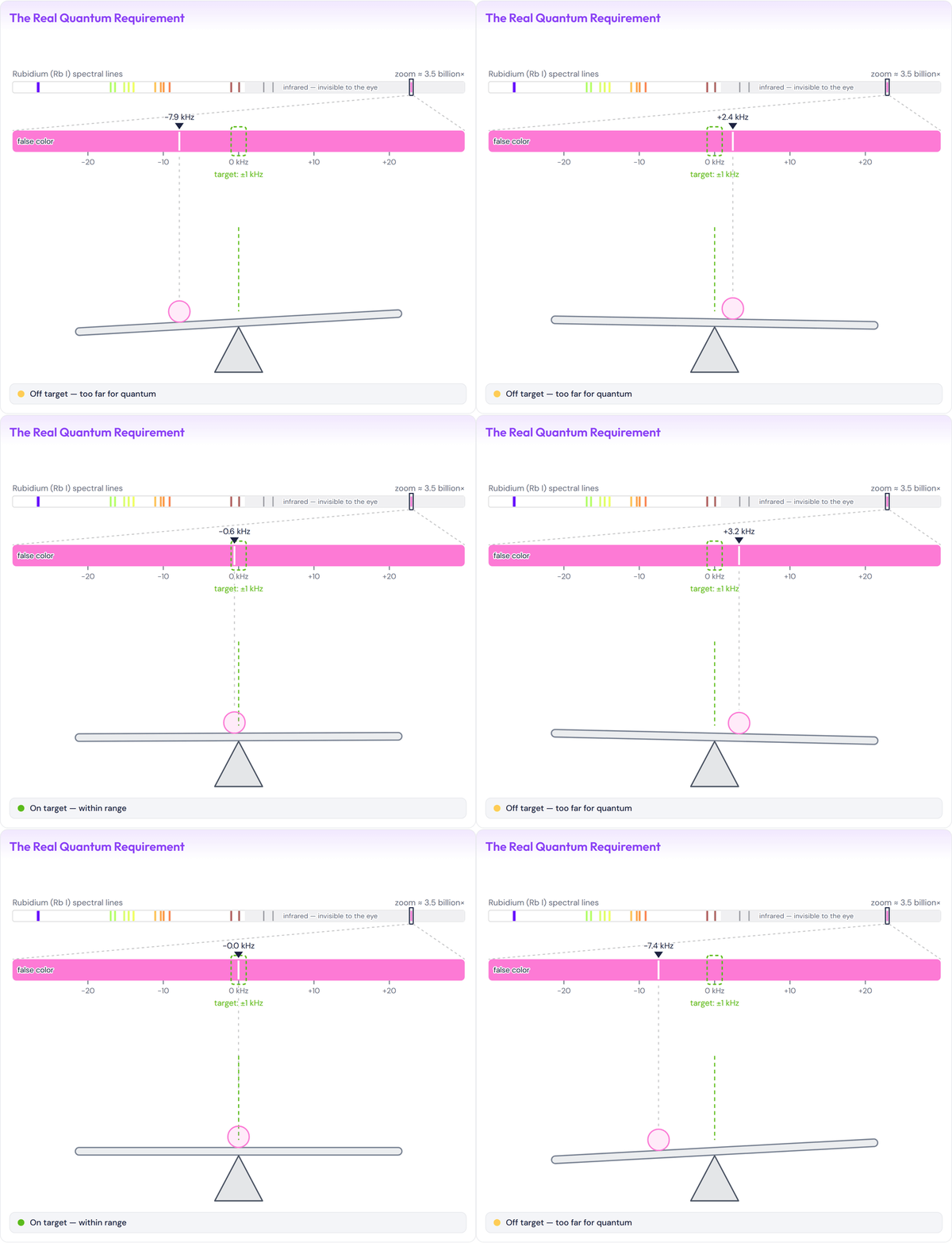
The see-saws in the diagram are analogous to actuators within our system. But the challenge is that the required precision is so high that no single actuator can do it alone. Multiple actuators are stacked together. A big, slow layer takes the wide drift; progressively faster layers take the finer jitter. Together, the ball never leaves the zone.
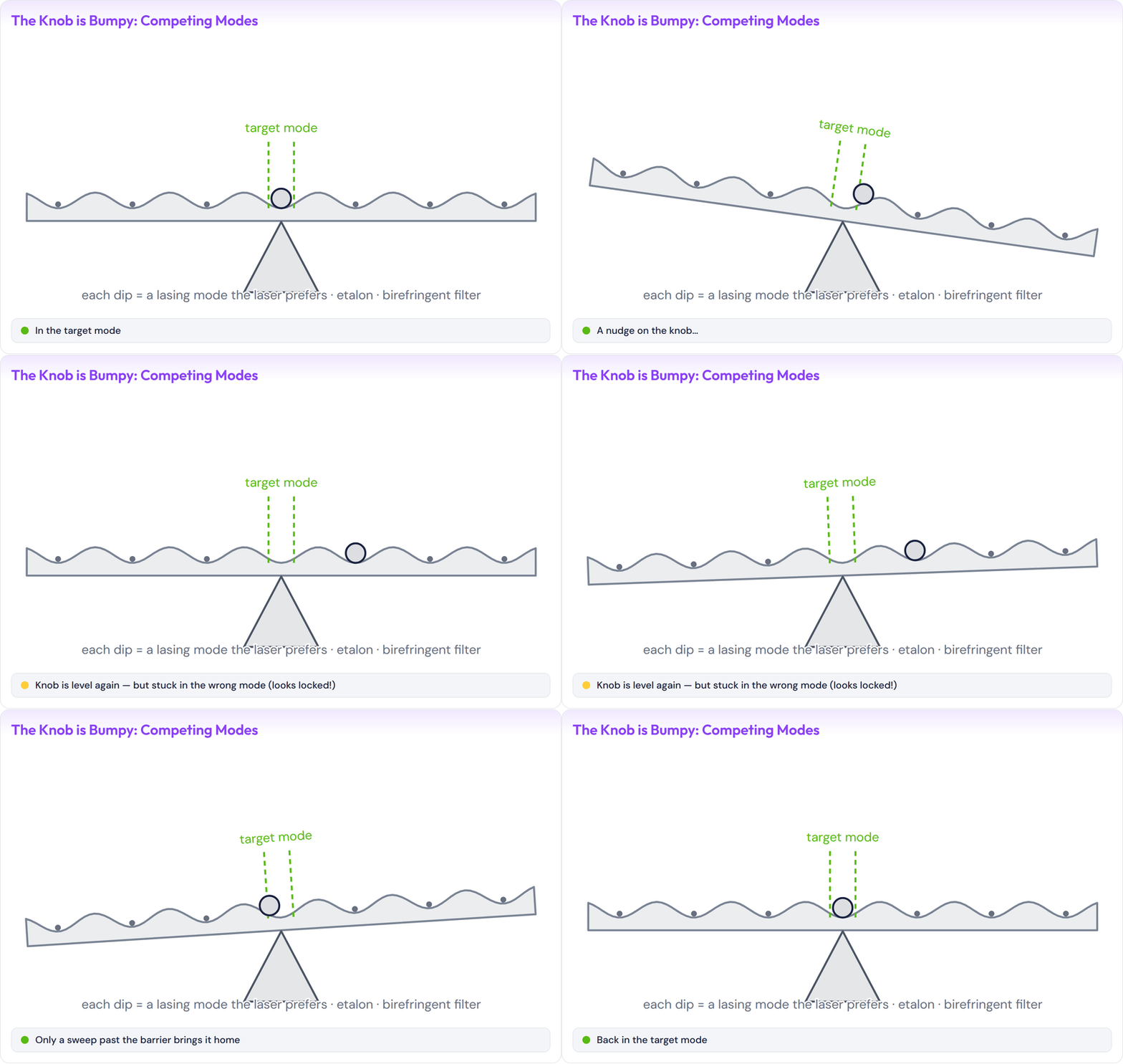
But there is a twist. A real tuning knob is not smooth. The laser prefers certain wavelengths, shaped by its internal filters (etalon, birefringent filter). In this example, each dip is a fixed mode the ball can settle into. And here is the trap: after a disturbance, bringing the knob back to level does not bring the ball home. It sits stably in the wrong mode, looking locked.
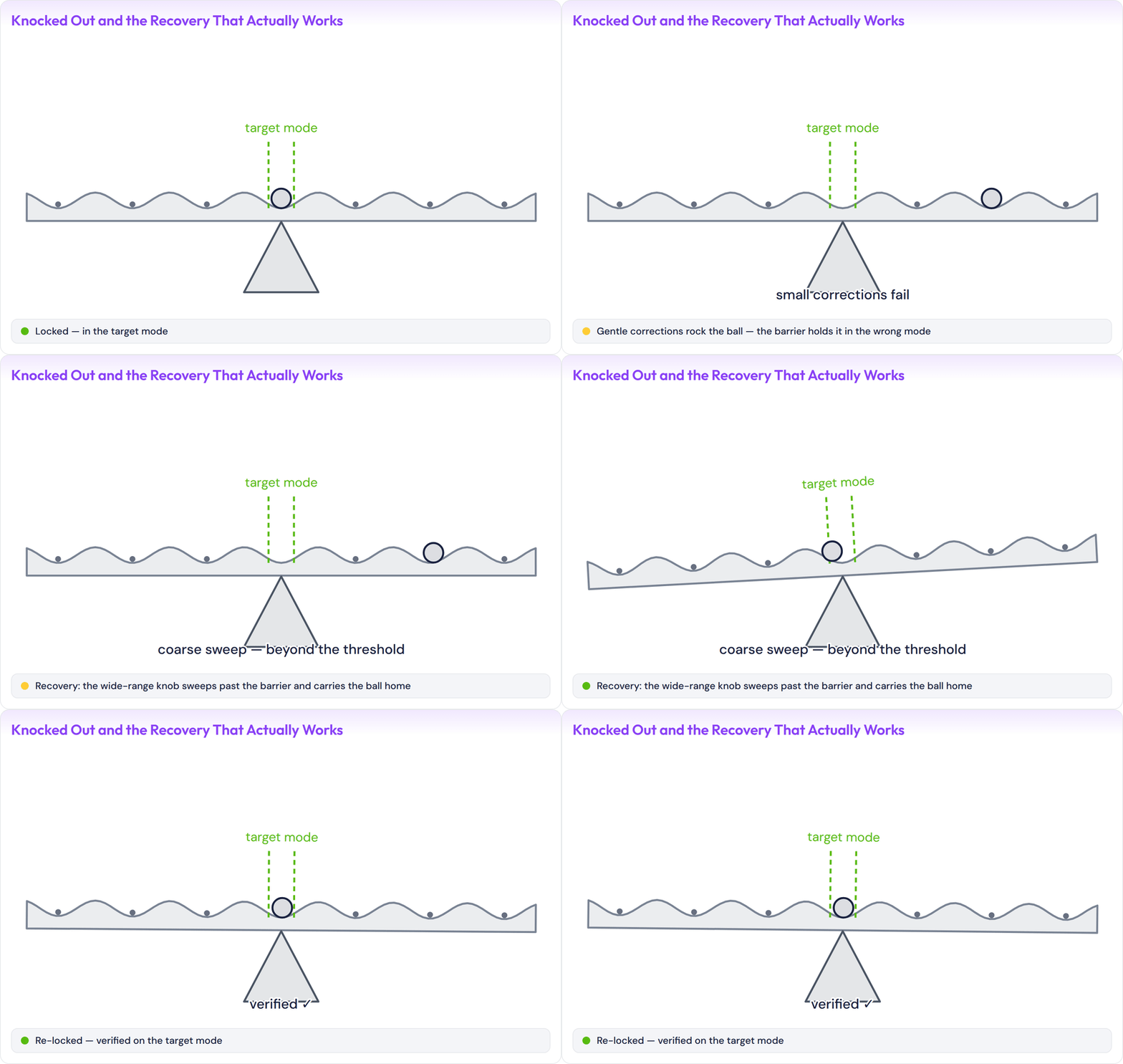
A big enough perturbation throws the ball clear out of the fine layers' reach, into a competing mode. No matter how far you tune the smaller layer, the ball remains stuck in the wrong lock. The recovery requires a sweep of the coarse, wide-range knob beyond the threshold to carry the ball home and then quickly ease off to capture the target mode. Finally, the lock has to be verified against an absolute wavelength reference so a wrong mode is never mistaken for success. This process is known as a Ti:sapphire mode-hop recovery. This is the judgment the MHS auto-relock controller was built to perform on its own.
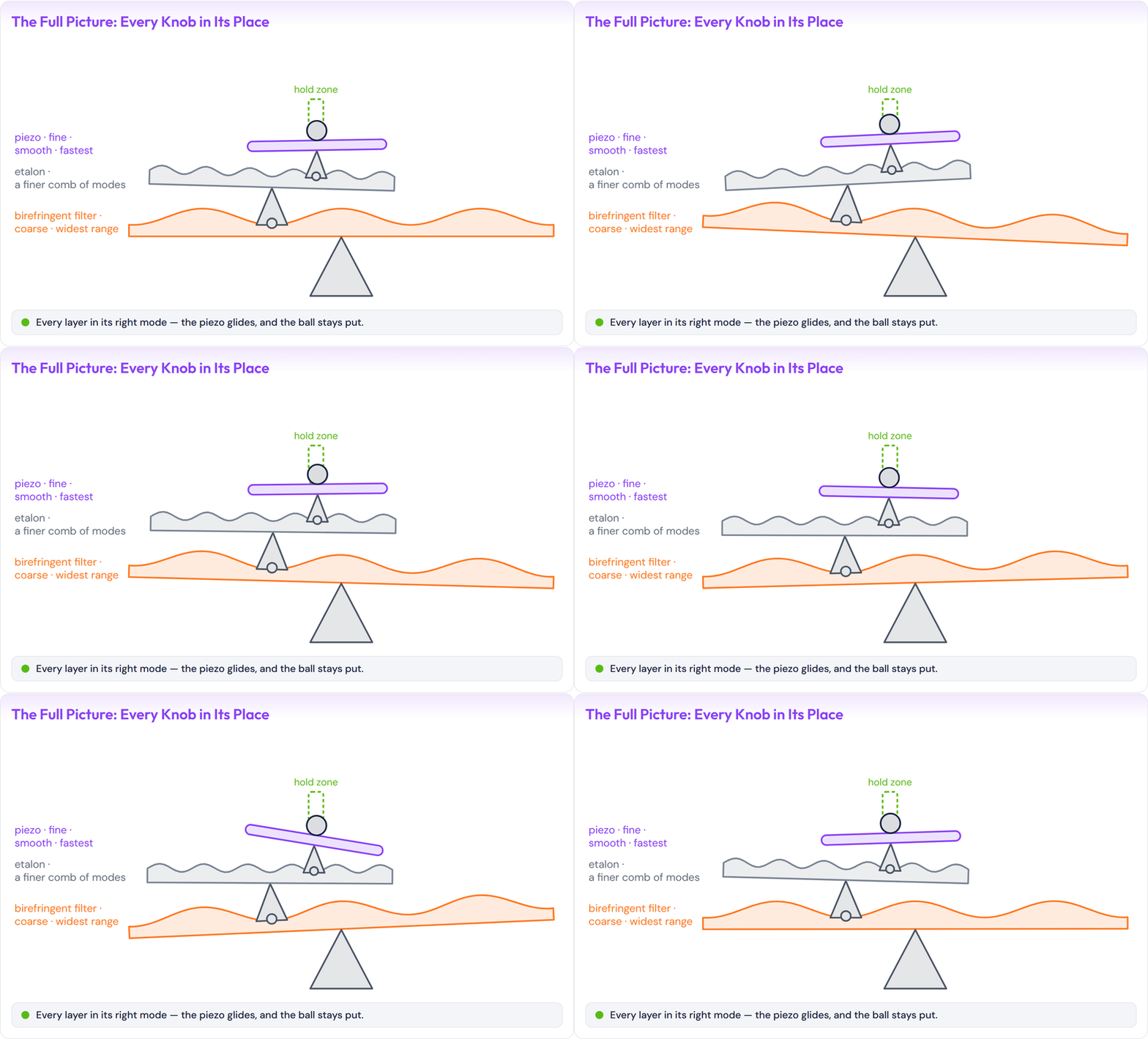
In the real laser system, all of the layers coexist. The birefringent filter is the coarse, widest-range layer: its landscape has a few widely spaced modes. The etalon sits on it with a finer comb. And the piezo (smooth, continuous, fastest) rides on top doing the rapid final trim. Working gracefully means each coarse element stays seated in the right dip of its own landscape while the fine one glides, and the ball never leaves the zone.
Building an AI Agent to Relock the Laser System

The recovery process described above traditionally has been the craft of a small team of highly skilled experts. Automating it is not a one-person job either: it takes a laser-systems engineer who understands how and why the lock fails, a software engineer to command the instruments, an algorithms designer for the recovery logic, and a tester to pit that logic against the many ways a real lock breaks. A QuEra team of exactly that shape spent roughly two to three weeks building our earlier hand-written recovery script, and its limits were the limits of any fixed script: it could only handle the failures its authors thought to enumerate.

The task force then handed the same problem to a single AI agent, Claude, working through MHS against the live testbed. MHS let the agent run its own experiments: propose a recovery, try it on the hardware, read what happened, refine. It is the same loop the human team runs, but continuously, at machine speed, and overnight. The agent did nothing a person fundamentally could not do; it watched the same instruments and learned only what they revealed. The difference was scale: enumerating and hardening against hundreds of edge cases, every neighboring mode the laser can fall into, every stale calibration, every wrong-mode grab, is unreasonable by hand, and the agent reached corners of the problem no team would have the bandwidth to. The humans stayed in the orchestrator's seat: setting scope, reviewing every step, deciding what counts as proof. That role became more important, not less. Tight oversight from Evgeny Ostroumov, the laser-side technical champion, provided the physical reality check, more than once catching the agent before it spent its effort on things that looked right and were not.

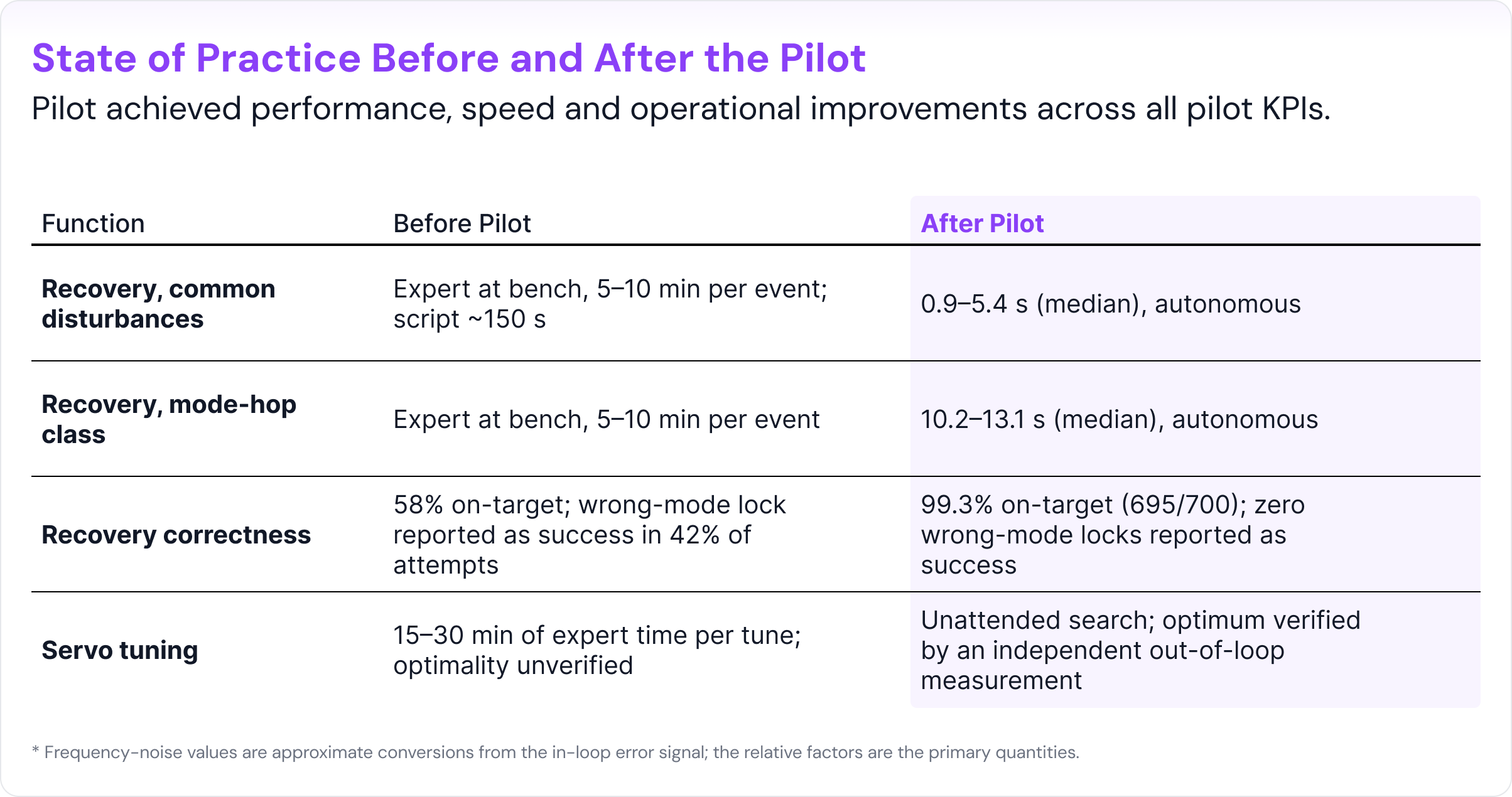
Given no information about what disturbed the lock (a blocked beam, mechanical vibration, electrical noise that disrupts the tuning configuration, a frequency hop small or large), the controller reads the live instrument state, classifies the disturbance, runs the correct recovery, and declares success only when the cavity signal confirms a lock and the absolute wavelength matches the target. The agent's code runs at native speed and supervises from above the microsecond servo loop, rather than within it. In validation it recovered on target 695 of 700 times: 99.3% across seven disturbance classes, one hundred timed trials each. Recovery took 0.9 to 5.4 seconds for wavelength-preserving faults and roughly 10 to 14 seconds for the hardest ones, where the laser's color has hopped far away, against 5 to 10 minutes for a human expert. Four qualities were proven together: correctness (never a wrong-mode lock reported as success), autonomy (no operator, no fault information), speed (seconds, not minutes), and predictability (tight, repeatable recovery times, which for unattended operation matters as much as the average). The five misses shared one rig-condition cause, not a control-logic one; in each the controller correctly declined to claim success, and the lock was back on target before the next trial. No failure left the system dark.

The validation was not confined to injected faults. The testbed lives in a working lab with realistic foot traffic, a deliberate choice, and over the weeks of the pilot the laser hopped modes on its own 43 times. All 43 were caught and recovered automatically.

One distinction matters and we will keep making it: MHS is the environment in which Claude designed, wrote, and validated this controller. What runs on the bench is a deterministic, fully inspectable program: AI-driven in development, human-orchestrated, autonomous in operation. And that autonomy is bounded by design: MHS enforces device-declared bounds, interlocks, and emergency stops at the hardware interface, independent of the model.

Tuning the Lock Autonomously

So the team pointed the same approach at the quality of the lock itself. That quality is set by a tuning process: twelve interdependent feedback parameters, adjusted within a continuously running control loop. Done well, tuning removes residual noise from the lock, which directly improves the performance of the computer's quantum gates and makes the lock drop less often. There is no closed-form optimum: a specialist tunes by eye, and can quiet the band they are watching while missing a resonance somewhere else. The agent instead recomputed the full noise spectrum after every adjustment, thousands of times, across far more of the space than a person could reach. Working inside a hard safety envelope (every candidate setting that dropped the lock was detected and reverted, and not one of roughly 12,500 evaluations caused the laser to hop modes), it mapped which parameters matter, searched the space, and converged on a configuration it then confirmed by running unattended overnight. The result was residual frequency noise cut by a factor of five, and a lock that simply stopped dropping: zero unattended lock drops in a roughly 19-hour soak test, against 1.6 per hour before.

Then came the test that matters most: an independent, out-of-loop measurement, the noise the qubits actually see, on an instrument the optimization could not touch. It compared the agent's configuration against a manual tune by an experienced specialist. Across the measured band, the two were indistinguishable: the agent matched the expert everywhere the expert was right. But the manual tune had left behind a hidden resonance near 220 kHz, invisible on the instruments a human tune normally watches, where the loop was quietly adding noise, worse than no lock at all. The agent's configuration suppressed it roughly a thousandfold, and a linewidth-type metric improved from 58 to 21 kHz. The point is not that the specialist erred; it is that the automated procedure scores the entire spectrum on every tune, so it cannot overlook a defect the way a hand tune can. It delivers its optimum every single time.
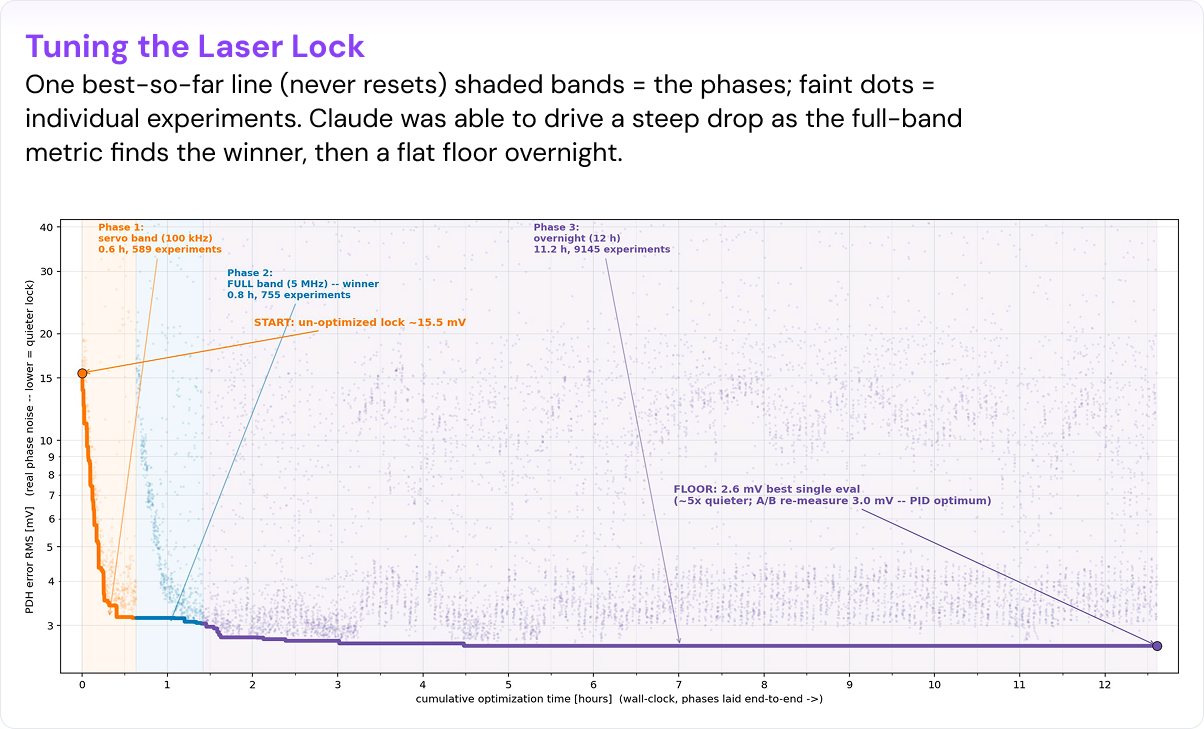
And the capability travels. Pointed at a second operating wavelength, one directly relevant to the gates our machines run, the agent worked out the new operating parameters from scratch in a single unattended overnight run, leaving that lock roughly ten times quieter than it was found and passing every acceptance test. It took weeks to bring up the pilot, and one night to bring it up at a new wavelength. That is what it looks like when the understanding gained in one campaign carries to the next: the sensitivity maps, the safety envelope, the calibrations.

One status distinction, for precision: the auto-relock controller is a standalone production script, with the AI out of the loop at runtime. The tuning workflow still runs with the AI in the loop, and packaging it as a standalone tool is next on the engineering list.

Read more about MHS and see QuEra's case study on Anthropic's blog.

Why It Matters to QuEra

In machines running short, discrete jobs, a laser fault is downtime: the queue stalls until the lock returns. In a system like Libra, a machine class capable of running logical-qubit programs for hours or days, a laser that falls out of state mid-run can corrupt a result that quantum error correction can no longer salvage. From a customer's seat, two error rates carry equal weight, two LERs as our team puts it: the Logical Error Rate, and the Laser Error Rate. A failed result looks the same whichever LER caused it.

Fast, verified, autonomous recovery, validated on our testbed and headed for live machines next, is how the second LER is held down. But the deeper story is what this does to the economics of deploying quantum computers. Every stabilized laser in a machine used to carry a standing claim on scarce expert time: 5 to 10 minutes of attended recovery per lock loss, at any hour; 15 to 30 minutes per tune, on a specialist's calendar; a new operating point commissioned over weeks of hands-on work. Each generation of machine carries more lasers than the last, and a fleet in the field multiplies all of it, in places where there is no laser physicist down the hall. After the pilot, the same functions run in seconds, unattended, verified, and commissioning a new wavelength costs one overnight run. Recovery becomes predictable, far less subject to human variance, and runs with a frugal human footprint. That is the shape of a quantum computer that can be deployed: at QuEra, and anywhere a machine has to stand on its own.

A Proof Point for Our AI Strategy

This is not, in the end, a laser story. It is a story about an AI model developing control logic a quantum computer depends on, doing it at expert level, and proving it against independent measurement. The pilot's single biggest enabler was a physical training ground: a live testbed the agent could act on, a reality engine. And what the pilot banked is more than two results. It is the measured understanding, the safety practices, and the calibrations that made the second campaign overnight where the first took weeks. Each subsystem this approach touches makes the next one cheaper to reach.

A QPU contains many subsystems that differ in detail but match the same pattern as the MHS pilot: precise, fragile, and hungry for scarce expert attention. The laser is the first proof point, and we expect it not to be the boundary. For QuEra, the pattern is a path to machines that stay up (today's job queues moving, tomorrow's logical computations alive) and to machines that can be built, commissioned, and operated with a fraction of the specialist hours they demand today. For the field, it reaches further: the laser at the center of this work has carried atomic physics for more than twenty years on know-how passed from student to student, and that know-how can now live in a controller any lab can build the same way.

At QuEra, the late-night drive to bring a laser back may no longer be a rite of passage for system operators.


machine learning
with QuEra

Listen to the podcast
No items found.
Technology

Holding the Light: Teaching an AI to Lock and Tune our Quantum Computer’s Lasers

August 27, 2026
min read
6 min read
Abstract background with white center and soft gradient corners in purple and orange with dotted patterns.

QuEra's quantum computers run on lasers held at exact frequencies, a precision no eye can see and only the atoms can distinguish. Keeping a laser there is a continuous act: temperature, vibration, and pressure push it off target all day, and layered feedback pushes it back. When the feedback loop fails, the lock breaks and the machine stops. Bringing it back has historically taken one specific expert: someone who knows the lasers intuitively and has experience with the exact recovery sequence required to return it to the right state. If the lock broke in the middle of the night, that person had to drive to the lab and fix it.

This is not a new problem, and QuEra has built automatic relocking for common disturbances. Aquila, our production QPU available through Amazon Braket, already runs with excellent uptime exceeding 99%. But the team knew that the level of human involvement in relocking, particularly for the less frequent but more severe disturbances, was not scalable. As a result, this spring QuEra deployed the Model Hardware Standard (MHS), a standard that started as a collaboration between Anthropic and HHMI Janelia Research Campus. A cross-functional task force took relocking to another level: the level that scalable deployment of logical QPUs will demand. Working through MHS on a dedicated testbed, with an AI agent in operational control of roughly $0.7M of precision hardware inside human-set safety bounds, the lock now comes back in seconds: verified, on target, with no one in the building. And then the same approach went one step further. It tuned the lock itself, to a quality level it can prove, and carried that new ability to a second operating wavelength in a single run.

The results are promising and are just the tip of the iceberg when it comes to QuEra's plans for layering AI, at a foundational level, across our quantum computers.

The Laser Locking Problem

Picturing a ball on a see-saw is a useful visual analogy for the problem our AI agent was solving. In this simplified analogy, the ball's position is the laser's frequency. If we can hold it in a specific location (in this example, inside the green region), we can successfully control the atomic qubits.

In QuEra's systems, the lasers that drive logical qubits must hold within ±1 kHz or better, about ±0.000000001 nm (illustrative values, for education). The infrared laser here is invisible to the eye, shown in false color. The ball swings; no eye could ever tell. Only atoms can tell the difference.

The see-saws in the diagram are analogous to actuators within our system. But the challenge is that the required precision is so high that no single actuator can do it alone. Multiple actuators are stacked together. A big, slow layer takes the wide drift; progressively faster layers take the finer jitter. Together, the ball never leaves the zone.

But there is a twist. A real tuning knob is not smooth. The laser prefers certain wavelengths, shaped by its internal filters (etalon, birefringent filter). In this example, each dip is a fixed mode the ball can settle into. And here is the trap: after a disturbance, bringing the knob back to level does not bring the ball home. It sits stably in the wrong mode, looking locked.

A big enough perturbation throws the ball clear out of the fine layers' reach, into a competing mode. No matter how far you tune the smaller layer, the ball remains stuck in the wrong lock. The recovery requires a sweep of the coarse, wide-range knob beyond the threshold to carry the ball home and then quickly ease off to capture the target mode. Finally, the lock has to be verified against an absolute wavelength reference so a wrong mode is never mistaken for success. This process is known as a Ti:sapphire mode-hop recovery. This is the judgment the MHS auto-relock controller was built to perform on its own.

In the real laser system, all of the layers coexist. The birefringent filter is the coarse, widest-range layer: its landscape has a few widely spaced modes. The etalon sits on it with a finer comb. And the piezo (smooth, continuous, fastest) rides on top doing the rapid final trim. Working gracefully means each coarse element stays seated in the right dip of its own landscape while the fine one glides, and the ball never leaves the zone.

Building an AI Agent to Relock the Laser System

The recovery process described above traditionally has been the craft of a small team of highly skilled experts. Automating it is not a one-person job either: it takes a laser-systems engineer who understands how and why the lock fails, a software engineer to command the instruments, an algorithms designer for the recovery logic, and a tester to pit that logic against the many ways a real lock breaks. A QuEra team of exactly that shape spent roughly two to three weeks building our earlier hand-written recovery script, and its limits were the limits of any fixed script: it could only handle the failures its authors thought to enumerate.

The task force then handed the same problem to a single AI agent, Claude, working through MHS against the live testbed. MHS let the agent run its own experiments: propose a recovery, try it on the hardware, read what happened, refine. It is the same loop the human team runs, but continuously, at machine speed, and overnight. The agent did nothing a person fundamentally could not do; it watched the same instruments and learned only what they revealed. The difference was scale: enumerating and hardening against hundreds of edge cases, every neighboring mode the laser can fall into, every stale calibration, every wrong-mode grab, is unreasonable by hand, and the agent reached corners of the problem no team would have the bandwidth to. The humans stayed in the orchestrator's seat: setting scope, reviewing every step, deciding what counts as proof. That role became more important, not less. Tight oversight from Evgeny Ostroumov, the laser-side technical champion, provided the physical reality check, more than once catching the agent before it spent its effort on things that looked right and were not.

Given no information about what disturbed the lock (a blocked beam, mechanical vibration, electrical noise that disrupts the tuning configuration, a frequency hop small or large), the controller reads the live instrument state, classifies the disturbance, runs the correct recovery, and declares success only when the cavity signal confirms a lock and the absolute wavelength matches the target. The agent's code runs at native speed and supervises from above the microsecond servo loop, rather than within it. In validation it recovered on target 695 of 700 times: 99.3% across seven disturbance classes, one hundred timed trials each. Recovery took 0.9 to 5.4 seconds for wavelength-preserving faults and roughly 10 to 14 seconds for the hardest ones, where the laser's color has hopped far away, against 5 to 10 minutes for a human expert. Four qualities were proven together: correctness (never a wrong-mode lock reported as success), autonomy (no operator, no fault information), speed (seconds, not minutes), and predictability (tight, repeatable recovery times, which for unattended operation matters as much as the average). The five misses shared one rig-condition cause, not a control-logic one; in each the controller correctly declined to claim success, and the lock was back on target before the next trial. No failure left the system dark.

The validation was not confined to injected faults. The testbed lives in a working lab with realistic foot traffic, a deliberate choice, and over the weeks of the pilot the laser hopped modes on its own 43 times. All 43 were caught and recovered automatically.

One distinction matters and we will keep making it: MHS is the environment in which Claude designed, wrote, and validated this controller. What runs on the bench is a deterministic, fully inspectable program: AI-driven in development, human-orchestrated, autonomous in operation. And that autonomy is bounded by design: MHS enforces device-declared bounds, interlocks, and emergency stops at the hardware interface, independent of the model.

Tuning the Lock Autonomously

So the team pointed the same approach at the quality of the lock itself. That quality is set by a tuning process: twelve interdependent feedback parameters, adjusted within a continuously running control loop. Done well, tuning removes residual noise from the lock, which directly improves the performance of the computer's quantum gates and makes the lock drop less often. There is no closed-form optimum: a specialist tunes by eye, and can quiet the band they are watching while missing a resonance somewhere else. The agent instead recomputed the full noise spectrum after every adjustment, thousands of times, across far more of the space than a person could reach. Working inside a hard safety envelope (every candidate setting that dropped the lock was detected and reverted, and not one of roughly 12,500 evaluations caused the laser to hop modes), it mapped which parameters matter, searched the space, and converged on a configuration it then confirmed by running unattended overnight. The result was residual frequency noise cut by a factor of five, and a lock that simply stopped dropping: zero unattended lock drops in a roughly 19-hour soak test, against 1.6 per hour before.

Then came the test that matters most: an independent, out-of-loop measurement, the noise the qubits actually see, on an instrument the optimization could not touch. It compared the agent's configuration against a manual tune by an experienced specialist. Across the measured band, the two were indistinguishable: the agent matched the expert everywhere the expert was right. But the manual tune had left behind a hidden resonance near 220 kHz, invisible on the instruments a human tune normally watches, where the loop was quietly adding noise, worse than no lock at all. The agent's configuration suppressed it roughly a thousandfold, and a linewidth-type metric improved from 58 to 21 kHz. The point is not that the specialist erred; it is that the automated procedure scores the entire spectrum on every tune, so it cannot overlook a defect the way a hand tune can. It delivers its optimum every single time.

And the capability travels. Pointed at a second operating wavelength, one directly relevant to the gates our machines run, the agent worked out the new operating parameters from scratch in a single unattended overnight run, leaving that lock roughly ten times quieter than it was found and passing every acceptance test. It took weeks to bring up the pilot, and one night to bring it up at a new wavelength. That is what it looks like when the understanding gained in one campaign carries to the next: the sensitivity maps, the safety envelope, the calibrations.

One status distinction, for precision: the auto-relock controller is a standalone production script, with the AI out of the loop at runtime. The tuning workflow still runs with the AI in the loop, and packaging it as a standalone tool is next on the engineering list.

Read more about MHS and see QuEra's case study on Anthropic's blog.

Why It Matters to QuEra

In machines running short, discrete jobs, a laser fault is downtime: the queue stalls until the lock returns. In a system like Libra, a machine class capable of running logical-qubit programs for hours or days, a laser that falls out of state mid-run can corrupt a result that quantum error correction can no longer salvage. From a customer's seat, two error rates carry equal weight, two LERs as our team puts it: the Logical Error Rate, and the Laser Error Rate. A failed result looks the same whichever LER caused it.

Fast, verified, autonomous recovery, validated on our testbed and headed for live machines next, is how the second LER is held down. But the deeper story is what this does to the economics of deploying quantum computers. Every stabilized laser in a machine used to carry a standing claim on scarce expert time: 5 to 10 minutes of attended recovery per lock loss, at any hour; 15 to 30 minutes per tune, on a specialist's calendar; a new operating point commissioned over weeks of hands-on work. Each generation of machine carries more lasers than the last, and a fleet in the field multiplies all of it, in places where there is no laser physicist down the hall. After the pilot, the same functions run in seconds, unattended, verified, and commissioning a new wavelength costs one overnight run. Recovery becomes predictable, far less subject to human variance, and runs with a frugal human footprint. That is the shape of a quantum computer that can be deployed: at QuEra, and anywhere a machine has to stand on its own.

A Proof Point for Our AI Strategy

This is not, in the end, a laser story. It is a story about an AI model developing control logic a quantum computer depends on, doing it at expert level, and proving it against independent measurement. The pilot's single biggest enabler was a physical training ground: a live testbed the agent could act on, a reality engine. And what the pilot banked is more than two results. It is the measured understanding, the safety practices, and the calibrations that made the second campaign overnight where the first took weeks. Each subsystem this approach touches makes the next one cheaper to reach.

A QPU contains many subsystems that differ in detail but match the same pattern as the MHS pilot: precise, fragile, and hungry for scarce expert attention. The laser is the first proof point, and we expect it not to be the boundary. For QuEra, the pattern is a path to machines that stay up (today's job queues moving, tomorrow's logical computations alive) and to machines that can be built, commissioned, and operated with a fraction of the specialist hours they demand today. For the field, it reaches further: the laser at the center of this work has carried atomic physics for more than twenty years on know-how passed from student to student, and that know-how can now live in a controller any lab can build the same way.

At QuEra, the late-night drive to bring a laser back may no longer be a rite of passage for system operators.


machine learning
with QuEra

Listen to the podcast
No items found.