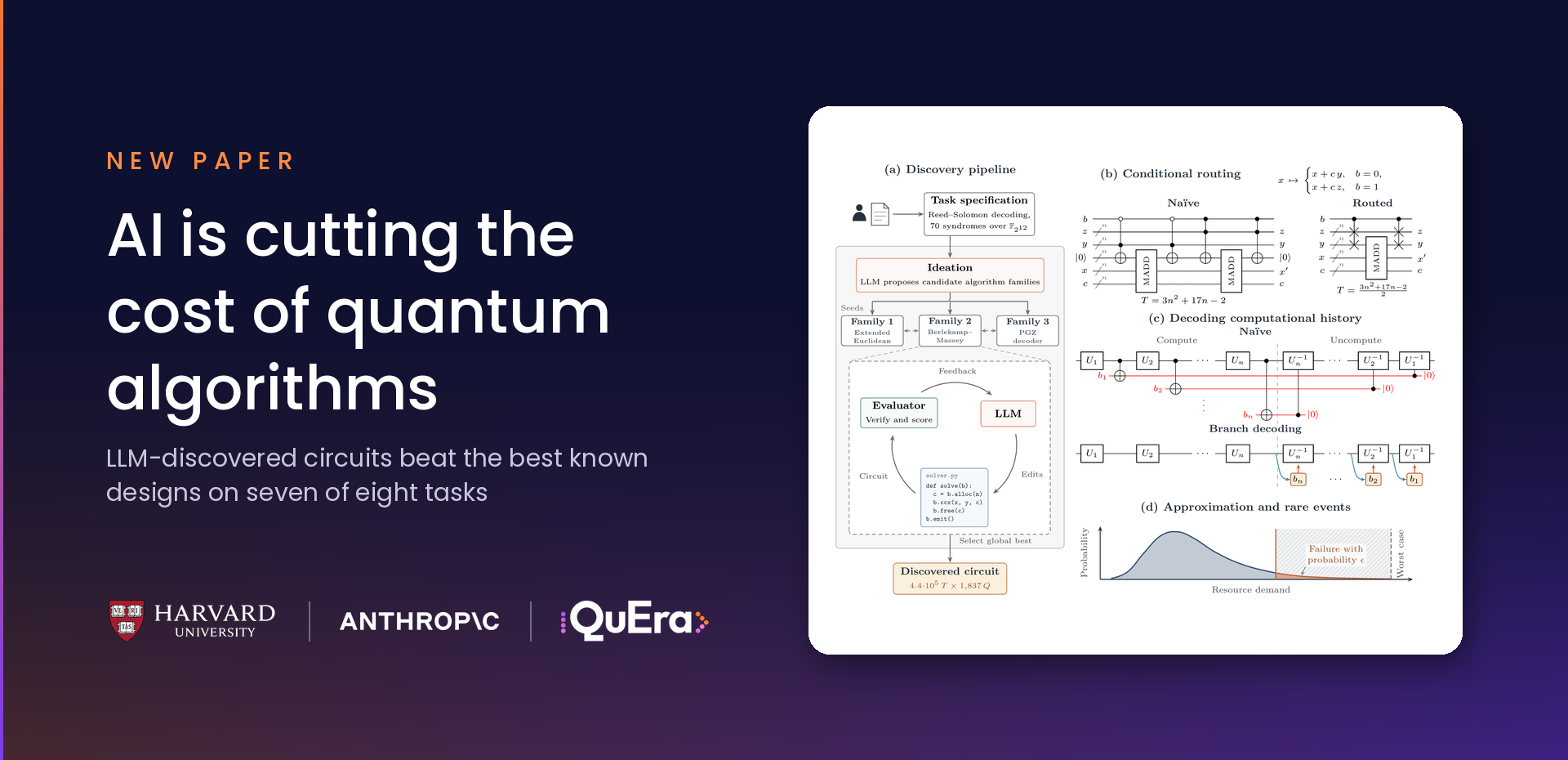


A new preprint from Harvard, Anthropic and QuEra shows an AI system designing quantum circuits that beat the best known designs, including a method for a core arithmetic step that was previously impractical.
Hardware milestones get the headlines, but algorithms have done much of the heavy lifting on the road to useful quantum computing. Take FeMoco, the iron-sulfur cluster that bacteria use to turn nitrogen from the air into ammonia. As Anthropic notes in its post on this work, a 2017 estimate put the cost of simulating it at about 50 trillion Toffoli gates. A series of algorithmic advances has since cut that to about 340 million, roughly 150,000 times fewer, without any change to the hardware. That progress took the field about eight years.
A new preprint suggests that AI can now do this kind of work, and quickly. Andi Gu, Alek Kemeny, Susanne Yelin and Mikhail Lukin of Harvard, Anthropic and QuEra used Anthropic's Claude Mythos 5 to design quantum circuits for eight core tasks. On seven of them, the resulting circuits use fewer gates and fewer qubits than the best known designs.

Why quantum circuits are expensive
Quantum computers must follow two rules that ordinary programs don't. First, a circuit can't take just one branch of an if-then decision, because its input may be in superposition. The circuit has to contain every branch. Second, every step must be reversible. Scratch work can't be deleted. It has to be undone step by step, which costs extra gates, or stored, which costs extra qubits.
These rules can wipe out the advantages of methods that are efficient on classical computers. In future fault-tolerant machines, the ordinary math inside quantum algorithms, such as arithmetic, decoding and division, often accounts for most of the cost.
How the search worked
The researchers gave Claude a short, plain-language description of each task and an independent evaluator. Claude writes each design as a Python program. The evaluator checks that the circuit is correct on every input and scores it on Toffoli count times peak qubit count. Claude explores several different approaches in parallel and improves them based on the scores, with little human input along the way. On the elliptic-curve task described below, a single run lasted 53 hours.
The results
Improvement in Toffoli-times-qubit cost compared with the best known design:
- Reed-Solomon decoder for decoded quantum interferometry: 12x
- HHL rotation angle: 32x
- Coulomb potential: 9.9x
- Fixed-point Gaussian: 39x
- Fe₂S₂ alias-Select (chemistry): 4.1x
- Nonabelian lattice-gauge simulation: 7.7x
A seventh task, a Hermitian decoder, had no prior reversible construction, and Claude's design improves on a naive one. The eighth, modular inversion, produced a new method.
Example 1: a new path for modular inversion
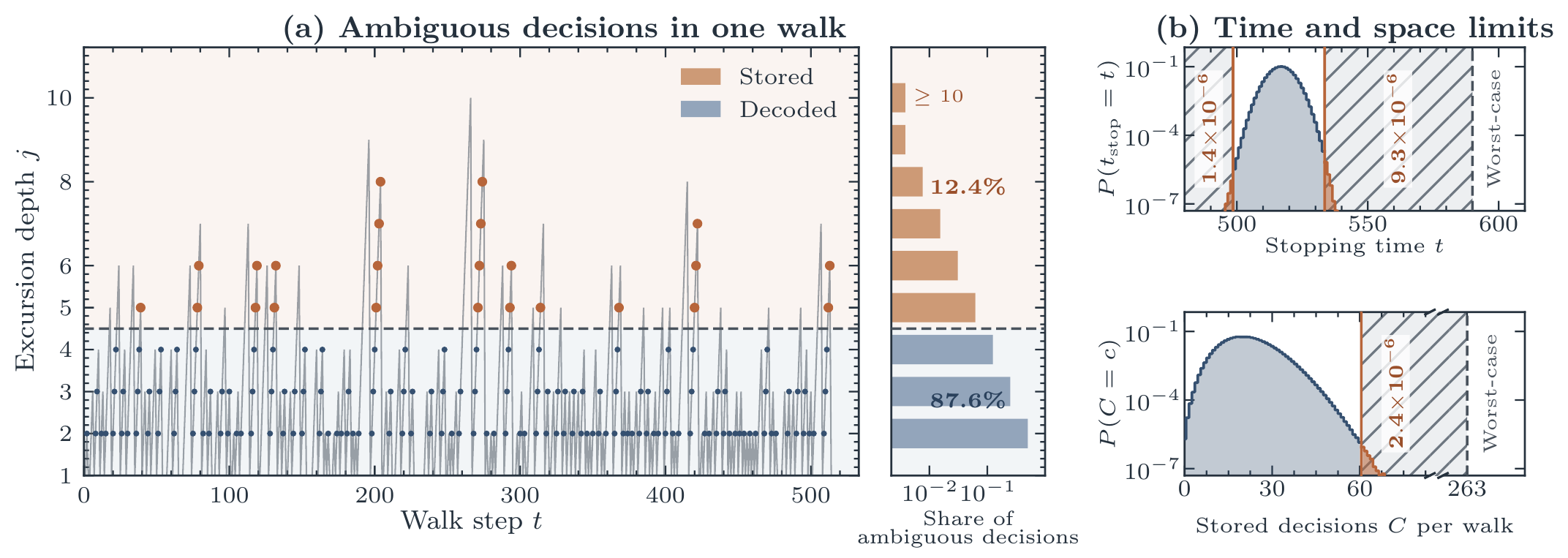
Elliptic-curve point addition is one of the standard benchmarks for quantum arithmetic, and modular inversion accounts for most of its cost. Classical computers do modular inversion quickly with a method called divsteps. Divsteps makes hundreds of small decisions, though, and a quantum circuit would normally have to store a record of every one so it can run backward. That storage made divsteps impractical for quantum computers.
Claude found that the circuit's own numbers carry enough information to reconstruct most of those decisions afterward. It proved why this works, and the key step was formally verified in the Lean proof assistant. It then built a family of designs that trades gates for qubits. Resources for a complete point-addition circuit:
- Best known, fewest gates (Schrottenloher, 2026): 1.9 million Toffolis, 1,446 qubits
- Claude, divsteps: 4.0 million Toffolis, 935 qubits
- Best known, fewest qubits (Luo et al., 2026): 70 million Toffolis, 838 qubits
- Claude, specialized Euclidean: 21 million Toffolis, 843 qubits
The divsteps design uses 35% fewer qubits than the fastest known construction. Compared with the most compact known one, it uses about 17x fewer gates for about 12% more qubits. Hardware designers get options that didn't exist before.
Example 2: a cheaper decoder for quantum optimization
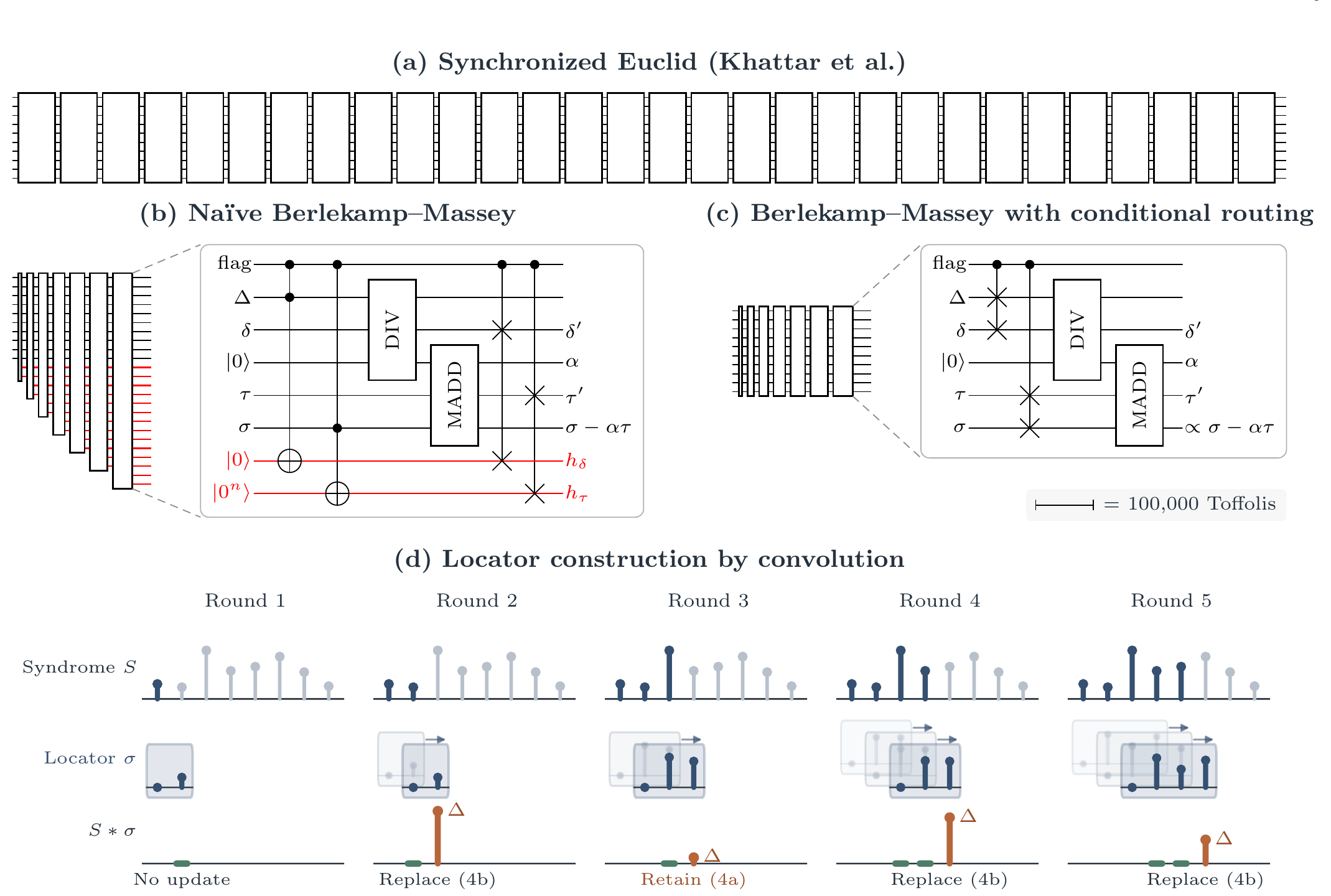
Decoded quantum interferometry (DQI) is one of the leading candidates for a large quantum speedup on optimization problems. According to estimates by Google Quantum AI researchers cited in Anthropic's post, one such problem would take about three months on the Frontier supercomputer, compared with about an hour on a future quantum computer. Most of that hour goes to a single step: Reed-Solomon decoding.
Claude made that step about 12x cheaper by changing three things at once. It swapped in a decoding method better suited to fixed quantum circuits (Berlekamp-Massey). It reconstructed temporary values instead of storing them. And it sized memory to the actual workload: instead of reserving 665 qubits for a worst case that almost never occurs, the circuit reserves 19 and accepts a failure rate of about 1 in 10,000. No one of these changes would have been enough by itself.
What it does and doesn't show
These are verified designs and resource estimates, not runs on hardware, and the Toffoli-times-qubit metric is one reasonable choice among several. The process also needed guidance: according to Anthropic, Claude initially favored familiar approaches, and the researchers had to push it to explore more widely. Still, the pattern across eight different tasks is clear. AI can find structural improvements, not just shave off a few gates.
The view from the hardware side
The deeper opportunity is co-design. Algorithms, error-correcting codes and hardware are usually designed separately, even though each affects the cost of the others. An AI system that can score designs across all three layers could find combinations that no single team would. It could also tell hardware builders which capabilities matter most for a given application. As a company that builds fault-tolerant quantum computers, QuEra sees this as a direct way to make each generation of machines more useful.
Why the timeline is now compressed
The distance to useful quantum computing is closing from two directions. Fault-tolerant hardware is arriving, and AI is now cutting the resources that useful algorithms need. When a key step gets 10x cheaper, a workload that once needed a much larger machine can fit on an earlier one.
That changes the planning calculus. The question is no longer whether to prepare, but whether you'll be ready when the first fault-tolerant systems arrive. Libra, QuEra's first fault-tolerant quantum computer, comes to AWS in 2028 and to HPC centers. Organizations that start now, by choosing target problems, building in-house skills and working out resource estimates, will be the ones getting results on Day One. If that's you, let's start the conversation.