


The Road to Commercially-Valuable Fault Tolerant Quantum Computing
About Our Product Roadmap
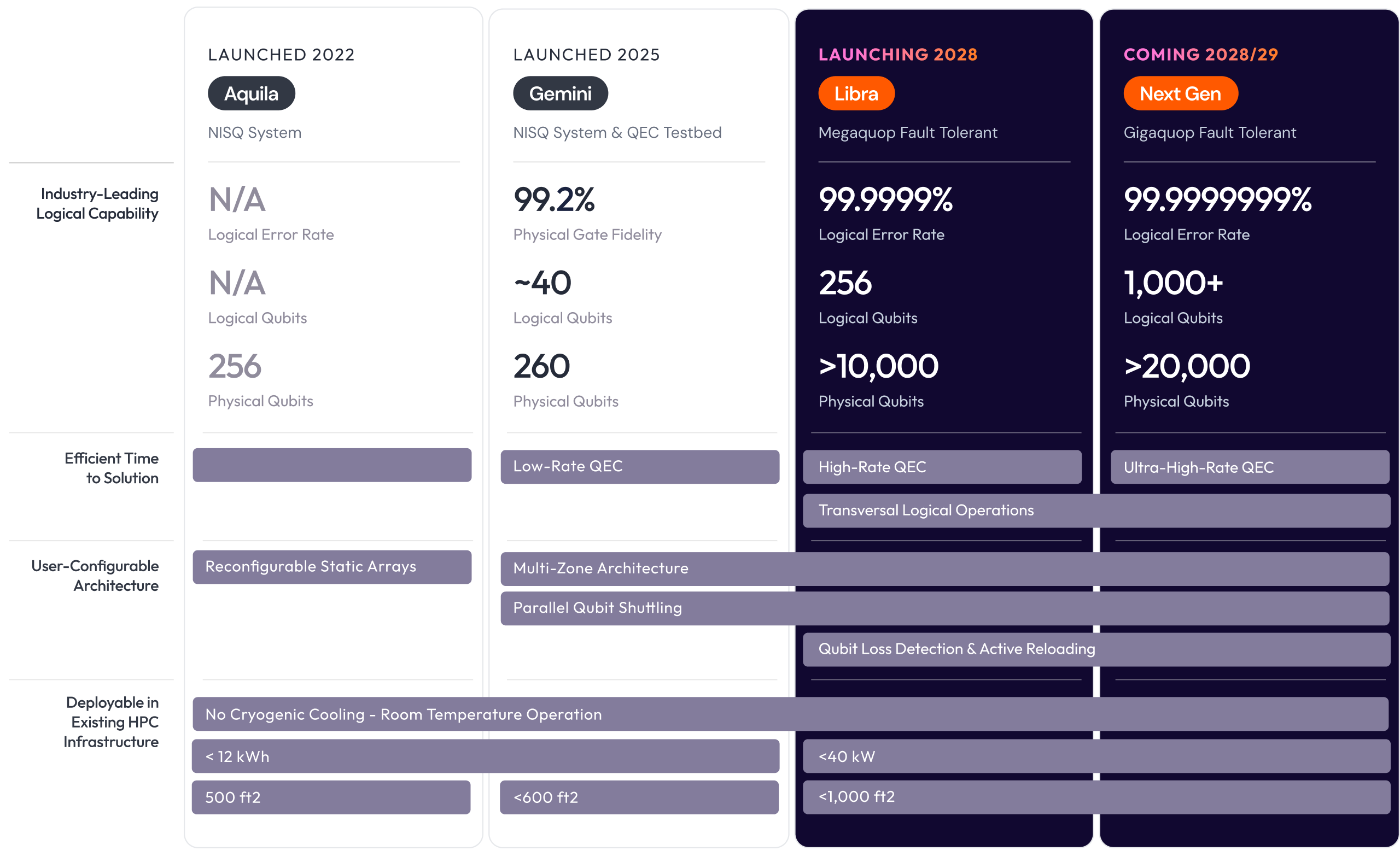
Like any scientific pursuit of this scale and significance, there are questions that must still be answered. Our roadmap recognizes this fact and doesn’t project systems still under development, instead, it outlines the products we feel are scientifically viable based on published, peer-reviewed research.
Our roadmap will be updated on either a bi-annual basis or when our research unlocks all the elements needed for a next gen system, whatever comes first.



Explore Libra’s Fault Tolerant Architecture
Building on previously demonstrated research, Libra combines all the building blocks required for continuous, flexible, logical quantum operation.
1. Physical Qubits
Libra will leverage the same zoned architecture available in QuEra’s current, commercially available system. Without the need for networking, a single node will scale to many thousand physical qubits.
2. Logical Encoding
Libra uses high-rate codes to encode up to 256 logical qubits at a 10−6 logical error rate, making it QuEra’s first Megaquop system capable of a million error-free quantum operations. Customers access this logical layer to run commercially and scientifically relevant applications.
3. Logical Operation
Libra’s massive parallelism enables parallel shuttling and transversal operations, even at the logical layer. Critically, this reduces QEC time, a key factor in whether applications can run practically on Megaquop systems.
4. Hybrid Decoding
Libra’s QEC architecture depends on frequent syndrome measurements, which collect ancillary data about the system’s state. Classical machine learning uses this data to determine which errors occurred so they can be corrected. Libra’s massive parallelism makes syndrome extraction highly efficient, addressing both latency and QEC time challenges.
5. Atom Loss Detection & Reloading
Syndrome data also reveals atom loss. Fresh qubits are then loaded mid-circuit from Libra’s reloading reservoir, enabling the continuous operation that deep circuits require.
6. Logical Teleportation
After rounds of syndrome extraction and qubit reloading, the logical information is teleported to a new, abstracted layer. This removes entropy from Libra’s logical layer and lets the error-corrected logical information feed forward throughout the circuit.
7. QEC & Continuous Reloading Cycle Repeats
These steps (logical operation, syndrome extraction, and atom loss detection and reloading) repeat until the circuit is fully executed.
8. Post-Processing & Application Completion
At the end of the circuit, Libra measures the logical qubits, collapsing the quantum information into classical data. This data is then post-processed in Libra’s quantum error correction engine to produce the final, error-corrected result.
Example Applications Within Reach
Our upcoming systems are designed to enable enterprise, government and academic organizations to execute quantum advantage capable, commercially relevant applications.
1. Material Science
The earliest fault-tolerant systems may deliver their first commercial signal in material science. Strongly-correlated many-body systems of sufficient scale to make accurate predictions of material properties, sit beyond classical reach but inside a quantum computer's natural operating regime. They are built out of interactions on lattices, and their quantum computational resource cost grows gently with system size. Cracking them opens both scientifically and commercially relevant applications.
 High-temperature superconductor design
 Battery materials discovery
 Magnetic materials and spintronics
 Novel phases of matter exploration
 Quantum chemistry
→ Spin-lattice Hamiltonians
Heisenberg, XY, Ising, and related lattice models for quantum magnetism and frustrated systems. Foundational benchmarks where classical methods (DMRG, QMC) hit walls.→ Single-band Fermi-Hubbard
The canonical model of interacting electrons on a square L×L lattice, with on-site repulsion U and nearest-neighbor hopping t. Solving for lattice sizes up to 10×10 is within capability bounds.
→ Single-orbital cuprate model
Adds second- and third-nearest-neighbor hopping to Fermi-Hubbard. Solving for lattice sizes up to 20×20 is within capability bounds.→ Two-orbital pnictide model
Captures iron-based superconductors with intra- and inter-orbital Coulomb interactions across two orbitals. Solving for lattice sizes up to 10×10 is within capability bounds.→ Twisted / nano-graphene Hamiltonians
Moiré superlattices and magic-angle systems are within capability bounds.
2. Nuclear & Quantum Dynamics
Ab-initio simulation of nuclear physics is a long-standing high-value frontier of classical scientific computing — limited today by the exponential cost of tracking many-body nucleon correlations. A Gigaquop-class quantum computer is the first machine credibly positioned to push past classical reach on real nuclear-structure problems and adjacent quantum dynamics workloads.
 High-temperature superconductor design
 Battery materials discovery
 Magnetic materials and spintronics
 Novel phases of matter exploration
→ Nuclear dynamics simulation
Quantum dynamics of nucleon systems (many-body nuclear structure, response functions, scattering kernels) via Quantum Phase Estimation-based methods.
3. Chemistry
Solving ground state energy problems for small-to-medium-scale active spaces of strongly correlated molecules, with ab-initio models tailored to quantum computing hardware through classical pre-processing, is a likely candidate for the first valuable chemistry applications to run on a system on QuEra’s roadmap. A Gigaquop-class system is the first machine credibly positioned to deliver quantitatively accurate mechanistic insights — beyond classical reach — into complex chemical processes.
 Oxygen evolution catalysis
 Metalloprotein active site chemistry
 Drug modeling
 Industrial catalysis
→ Ground state energy estimation of strongly correlated molecules
Ab-initio molecular Hamiltonians at small-to-medium-scale active spaces, tailored to quantum computing hardware through classical pre-processing. Within capability bounds for first quantitatively accurate mechanistic insights into metalloprotein active sites and transition metal chemistry.


Guided by the Latest Research
Progress on our path to fault tolerance has been demonstrated faster than expected when we launched our 2024 roadmap. Neutral atoms continue to lead the industry in quantum error correction (QEC) demonstrations, reinforcing our approach and guiding our path to useful quantum computers. Some of the highlights that are informing our new roadmap are below.