arrow left

Case Study: ABCI-Q, How AIST and QuEra Are Building Japan's Quantum-HPC Testbed

calender icon
October 26, 2026
clock icon
min read
Customers and partners
Share

Most conversations about quantum-HPC integration stay abstract. A national research center that has actually built one has to answer harder questions: which systems go in the building, how users reach them, what the scheduler does when a job needs both a GPU partition and a QPU, and who pays.

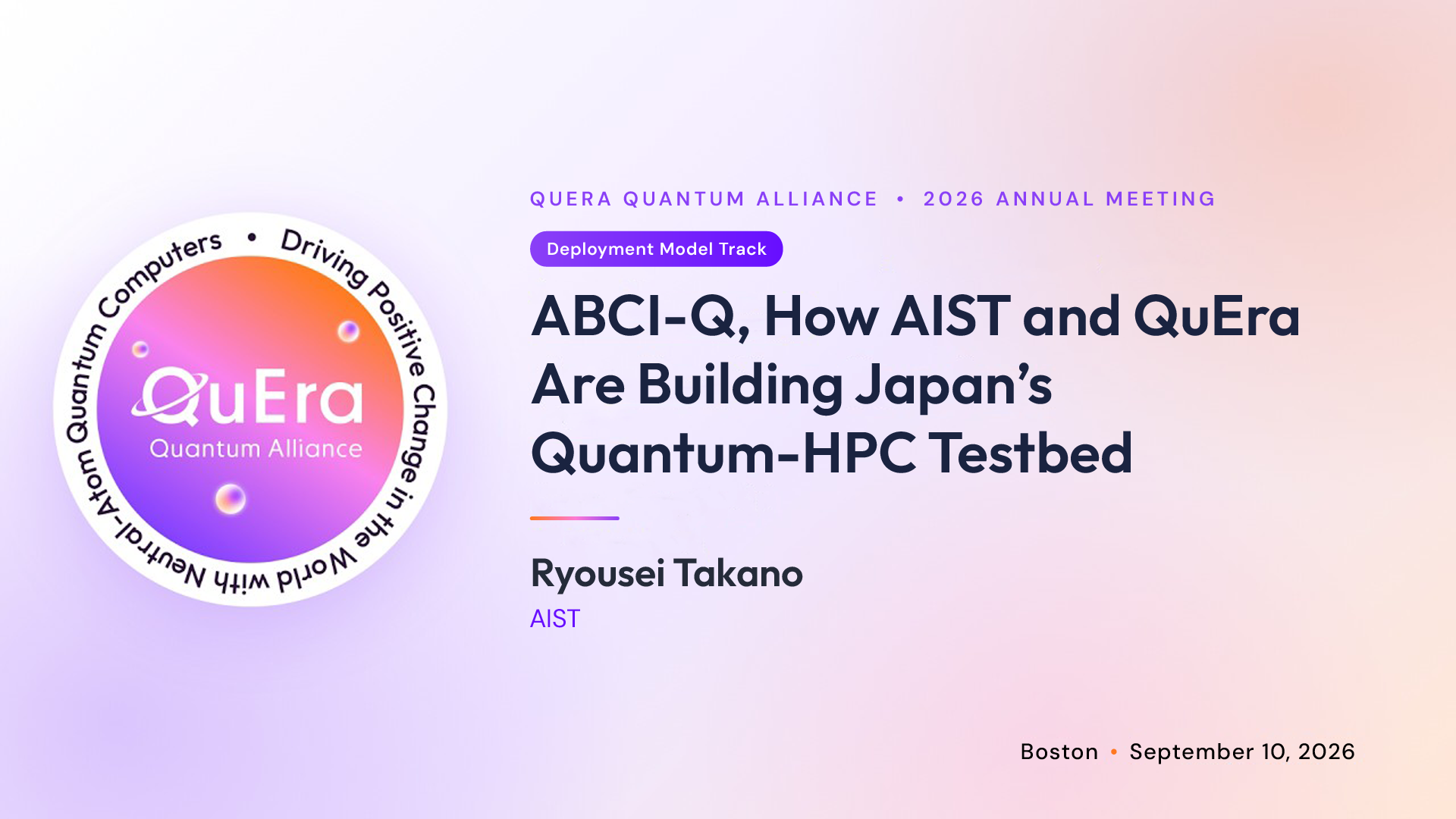
Ryousei Takano of AIST laid out those answers in a talk on ABCI-Q, Japan's quantum-HPC platform and the home of QuEra's Gemini system. What follows is that picture from the customer's side of the table.

This post draws on a talk by Ryousei Takano of the National Institute of Advanced Industrial Science and Technology (AIST) at the QuEra Quantum Alliance 2026 Annual Meeting (QQA 2026).

Why a National Center Decided to Move

Takano opened with a framing that will sound familiar to anyone tracking enterprise quantum sentiment. When AIST's quantum center was established, the industry sat in a phase of expectation and anticipation. Three years later, the emphasis has shifted toward commercialization and comparison.

"Now, not taking action about quantum computing is a risk," said Ryousei Takano of AIST.

Behind that is a specific technical thesis. AIST expects progress on two fronts simultaneously: scale, moving toward fault-tolerant systems, and integration, bringing quantum processors into HPC systems and data center environments. Quantum computers will not run alone. They will run inside application workflows alongside classical and AI systems. ABCI-Q exists because the second front needs a place to be worked out in practice.

A Full-Stack Center, Not a Procurement

ABCI-Q sits inside G-QuAT (the Global Research and Development Center for Business by Quantum-AI technology), which AIST established on July 27, 2023, within Japan's national Quantum Innovation Hub structure. Its main research building opened in May 2025. The public investment behind it covered more than computing hardware. It funded a headquarters building, facility reinforcement for fabrication and hardware component evaluation, and an incubation function to help domestic companies reach international markets.

As of May 2026 the center employs more than 300 researchers, staff, and students, and organizes its work around three pillars: creating business and markets through quantum technologies, establishing world-leading R&D infrastructure for hardware and software, and advancing research while cultivating global talent.

It operates three facilities. ABCI-Q is the QC-HPC integration platform for use-case development and error-correction research. Qubed is a hardware evaluation and measurement testbed. Qufab provides superconducting circuit fabrication. The logic connecting them is deliberate: a domestic supplier can have a component evaluated at Qufab, integrated into the computing facility, and then supported toward international customers through the incubation function. G-QuAT also reports international collaboration agreements with 27 organizations.

Four Systems, One Testbed

ABCI-Q combines a dedicated AI supercomputer with multiple on-premises quantum computers:

  • System H, roughly 505 compute nodes with about 2,020 NVIDIA H100 GPUs on an InfiniBand fabric. It also supports quantum-inspired accelerators, including Fixstars Amplify AE, the Fujitsu Digital Annealer, and Toshiba SQBM+.
  • System F, a 64-qubit superconducting system from Fujitsu, developed through technology transfer from RIKEN. Takano described it as the first deployment of a commercial quantum computer built by a Japanese vendor rather than a foreign one. Users reach it through the QURI SDK and Fixstars Amplify.
  • System Q, QuEra's Gemini, a 260-physical-qubit gate-model neutral-atom system supporting QEC, NISQ, and shuttle modes. Bloqade is the primary SDK. Gemini's installation is backed by a 6.5 billion JPY contract, approximately $41 million USD at the time of the award.
  • System O, a 129-qumode measurement-based optical quantum computer from OptQC, a University of Tokyo spinout, accessed through OptQC's open-source library.

Takano was explicit that co-location is not the point. The goal is an open testbed where four very different machines connect to common software, workflow tooling, data infrastructure, and operational practice.

Geography still matters in ways that reveal how real this is. System H and System F sit in AIST's headquarters building on the Tsukuba campus. Gemini sits about 350 meters away in a separate building, on the second floor, on anti-vibration mounting, connected back to the rest of ABCI-Q over an SD network. A neutral-atom system's room-temperature operation is what makes a deployment like that straightforward: no cryogenic plant, no dedicated facility built around the machine.

The Software Stack Is Where Integration Actually Happens

Above the hardware, AIST runs conventional HPC infrastructure: a job scheduler, workflow orchestration through Covalent and Prefect, and a container engine. Above that sit quantum frameworks including Qiskit, CUDA-Q, Bloqade, and QURI, alongside PyTorch and JAX. Open OnDemand provides a browser-based entry point with Jupyter notebooks, which lowers the barrier for users who are not HPC specialists.

In the current System H to System F integration, a user reaches a compute node by SSH, REST API, or Open OnDemand and submits a task. A component called Octopus manages user jobs and data, while the control system schedules the transfer, generates the pulse sequence, executes on the QPU, and returns results.

Takano's assessment of that design is worth sitting with, because it is the honest version of where the field is. Loosely coupled, batch-oriented workflows work well today. Fault-tolerant operation will not tolerate that pattern. It needs low-latency, stateful communication between front-end systems, the control layer, and the HPC system. ABCI-Q's purpose is to expose that gap before it becomes a production problem, and to serve as a place where emerging integration standards can be validated rather than debated.

The Classical Side Is Already Producing Results

Two large-scale runs show what a dedicated AI supercomputer buys a quantum program on its own, with no QPU in the loop.

With the University of Osaka, AIST ran what Takano described as the world's largest quantum circuit simulation for quantum chemistry, using 1,000 GPUs with strong scalability demonstrated across the run. With Fujitsu, AIST evaluated QompSim, a distributed state-vector simulator that uses block-wise lossy compression and swap-based inter-process communication to cut memory and communication cost. It executed circuits of up to 56 qubits across 1,000 GPUs while holding fidelity above 99% in every case tested.

Both are validation infrastructure. Algorithms get checked at scale now, so that hardware time later goes to the workloads that have already earned it.

From Human-Driven to Agent-Driven Operation

The most forward-looking part of the talk had nothing to do with qubit counts. AIST is rethinking how its facility is operated at all.

Today, humans write scripts, submit them, and debug them. AIST's expectation is that AI agents will increasingly create, execute, and revise jobs through continuous interaction with the system, which means the API surface, the scheduler, and the unified treatment of CPU, GPU, and QPU resources all need to be redesigned for a non-human caller.

There is already a working demonstration. A local LLM and an MCP interface run on ABCI-Q. A plain-language prompt such as "run a 3-qubit GHZ state" is resolved by the model against available tools, then dispatched either to the local scheduler or to a remote cloud API. Takano noted the work was covered in a recent Nature news piece.

For a facility that expects fault-tolerant systems to become practical in the 2030s, agent-driven operation is not a side project. It is the operating model those systems will arrive into.

How Outside Users Get In

Takano closed on complementary strengths. QuEra and the QuEra Quantum Alliance bring neutral-atom hardware, a software ecosystem, quantum science expertise, and global solution partners. G-QuAT brings HPC and AI infrastructure, industrial use cases, a base of hardware component suppliers, and an environment built for testing and integration. Applications, middleware, and benchmarking are the obvious places those meet.

"In short, [G-QuAT] provides a landing zone in Japan," said Ryousei Takano of AIST.

That is a useful description of what ABCI-Q is for QuEra, and of what a co-design relationship looks like when it is running. Not a sale followed by a support contract, but a national facility using a neutral-atom system as one instrument in a larger integration problem, and feeding what it learns back into how the next generation of systems should behave.


machine learning
with QuEra

Listen to the podcast
No items found.
Customers and partners

Case Study: ABCI-Q, How AIST and QuEra Are Building Japan's Quantum-HPC Testbed

October 26, 2026
min read
6 min read
Abstract background with white center and soft gradient corners in purple and orange with dotted patterns.

Most conversations about quantum-HPC integration stay abstract. A national research center that has actually built one has to answer harder questions: which systems go in the building, how users reach them, what the scheduler does when a job needs both a GPU partition and a QPU, and who pays.

Ryousei Takano of AIST laid out those answers in a talk on ABCI-Q, Japan's quantum-HPC platform and the home of QuEra's Gemini system. What follows is that picture from the customer's side of the table.

This post draws on a talk by Ryousei Takano of the National Institute of Advanced Industrial Science and Technology (AIST) at the QuEra Quantum Alliance 2026 Annual Meeting (QQA 2026).

Why a National Center Decided to Move

Takano opened with a framing that will sound familiar to anyone tracking enterprise quantum sentiment. When AIST's quantum center was established, the industry sat in a phase of expectation and anticipation. Three years later, the emphasis has shifted toward commercialization and comparison.

"Now, not taking action about quantum computing is a risk," said Ryousei Takano of AIST.

Behind that is a specific technical thesis. AIST expects progress on two fronts simultaneously: scale, moving toward fault-tolerant systems, and integration, bringing quantum processors into HPC systems and data center environments. Quantum computers will not run alone. They will run inside application workflows alongside classical and AI systems. ABCI-Q exists because the second front needs a place to be worked out in practice.

A Full-Stack Center, Not a Procurement

ABCI-Q sits inside G-QuAT (the Global Research and Development Center for Business by Quantum-AI technology), which AIST established on July 27, 2023, within Japan's national Quantum Innovation Hub structure. Its main research building opened in May 2025. The public investment behind it covered more than computing hardware. It funded a headquarters building, facility reinforcement for fabrication and hardware component evaluation, and an incubation function to help domestic companies reach international markets.

As of May 2026 the center employs more than 300 researchers, staff, and students, and organizes its work around three pillars: creating business and markets through quantum technologies, establishing world-leading R&D infrastructure for hardware and software, and advancing research while cultivating global talent.

It operates three facilities. ABCI-Q is the QC-HPC integration platform for use-case development and error-correction research. Qubed is a hardware evaluation and measurement testbed. Qufab provides superconducting circuit fabrication. The logic connecting them is deliberate: a domestic supplier can have a component evaluated at Qufab, integrated into the computing facility, and then supported toward international customers through the incubation function. G-QuAT also reports international collaboration agreements with 27 organizations.

Four Systems, One Testbed

ABCI-Q combines a dedicated AI supercomputer with multiple on-premises quantum computers:

  • System H, roughly 505 compute nodes with about 2,020 NVIDIA H100 GPUs on an InfiniBand fabric. It also supports quantum-inspired accelerators, including Fixstars Amplify AE, the Fujitsu Digital Annealer, and Toshiba SQBM+.
  • System F, a 64-qubit superconducting system from Fujitsu, developed through technology transfer from RIKEN. Takano described it as the first deployment of a commercial quantum computer built by a Japanese vendor rather than a foreign one. Users reach it through the QURI SDK and Fixstars Amplify.
  • System Q, QuEra's Gemini, a 260-physical-qubit gate-model neutral-atom system supporting QEC, NISQ, and shuttle modes. Bloqade is the primary SDK. Gemini's installation is backed by a 6.5 billion JPY contract, approximately $41 million USD at the time of the award.
  • System O, a 129-qumode measurement-based optical quantum computer from OptQC, a University of Tokyo spinout, accessed through OptQC's open-source library.

Takano was explicit that co-location is not the point. The goal is an open testbed where four very different machines connect to common software, workflow tooling, data infrastructure, and operational practice.

Geography still matters in ways that reveal how real this is. System H and System F sit in AIST's headquarters building on the Tsukuba campus. Gemini sits about 350 meters away in a separate building, on the second floor, on anti-vibration mounting, connected back to the rest of ABCI-Q over an SD network. A neutral-atom system's room-temperature operation is what makes a deployment like that straightforward: no cryogenic plant, no dedicated facility built around the machine.

The Software Stack Is Where Integration Actually Happens

Above the hardware, AIST runs conventional HPC infrastructure: a job scheduler, workflow orchestration through Covalent and Prefect, and a container engine. Above that sit quantum frameworks including Qiskit, CUDA-Q, Bloqade, and QURI, alongside PyTorch and JAX. Open OnDemand provides a browser-based entry point with Jupyter notebooks, which lowers the barrier for users who are not HPC specialists.

In the current System H to System F integration, a user reaches a compute node by SSH, REST API, or Open OnDemand and submits a task. A component called Octopus manages user jobs and data, while the control system schedules the transfer, generates the pulse sequence, executes on the QPU, and returns results.

Takano's assessment of that design is worth sitting with, because it is the honest version of where the field is. Loosely coupled, batch-oriented workflows work well today. Fault-tolerant operation will not tolerate that pattern. It needs low-latency, stateful communication between front-end systems, the control layer, and the HPC system. ABCI-Q's purpose is to expose that gap before it becomes a production problem, and to serve as a place where emerging integration standards can be validated rather than debated.

The Classical Side Is Already Producing Results

Two large-scale runs show what a dedicated AI supercomputer buys a quantum program on its own, with no QPU in the loop.

With the University of Osaka, AIST ran what Takano described as the world's largest quantum circuit simulation for quantum chemistry, using 1,000 GPUs with strong scalability demonstrated across the run. With Fujitsu, AIST evaluated QompSim, a distributed state-vector simulator that uses block-wise lossy compression and swap-based inter-process communication to cut memory and communication cost. It executed circuits of up to 56 qubits across 1,000 GPUs while holding fidelity above 99% in every case tested.

Both are validation infrastructure. Algorithms get checked at scale now, so that hardware time later goes to the workloads that have already earned it.

From Human-Driven to Agent-Driven Operation

The most forward-looking part of the talk had nothing to do with qubit counts. AIST is rethinking how its facility is operated at all.

Today, humans write scripts, submit them, and debug them. AIST's expectation is that AI agents will increasingly create, execute, and revise jobs through continuous interaction with the system, which means the API surface, the scheduler, and the unified treatment of CPU, GPU, and QPU resources all need to be redesigned for a non-human caller.

There is already a working demonstration. A local LLM and an MCP interface run on ABCI-Q. A plain-language prompt such as "run a 3-qubit GHZ state" is resolved by the model against available tools, then dispatched either to the local scheduler or to a remote cloud API. Takano noted the work was covered in a recent Nature news piece.

For a facility that expects fault-tolerant systems to become practical in the 2030s, agent-driven operation is not a side project. It is the operating model those systems will arrive into.

How Outside Users Get In

Takano closed on complementary strengths. QuEra and the QuEra Quantum Alliance bring neutral-atom hardware, a software ecosystem, quantum science expertise, and global solution partners. G-QuAT brings HPC and AI infrastructure, industrial use cases, a base of hardware component suppliers, and an environment built for testing and integration. Applications, middleware, and benchmarking are the obvious places those meet.

"In short, [G-QuAT] provides a landing zone in Japan," said Ryousei Takano of AIST.

That is a useful description of what ABCI-Q is for QuEra, and of what a co-design relationship looks like when it is running. Not a sale followed by a support contract, but a national facility using a neutral-atom system as one instrument in a larger integration problem, and feeding what it learns back into how the next generation of systems should behave.


machine learning
with QuEra

Listen to the podcast
No items found.