arrow left

The Destination is Utility, Our Next Milestone is Fault Tolerance

calender icon
October 2, 2026
clock icon
min read
Events
Share

Quantum World Congress brought together industry leaders, government officials, enterprises, and quantum solution providers spanning the entire quantum stack for three days of keynotes, presentations and panel discussions.

During the conference, QuEra announced an agreement to open an office in the new Discovery Center, part of the State of Maryland's Capitol of Quantum initiative. Maryland's long term, strategic investments in quantum at both the commercial and academic levels, as well as proximity to key federal partners, made the Capitol of Quantum an attractive choice for QuEra.

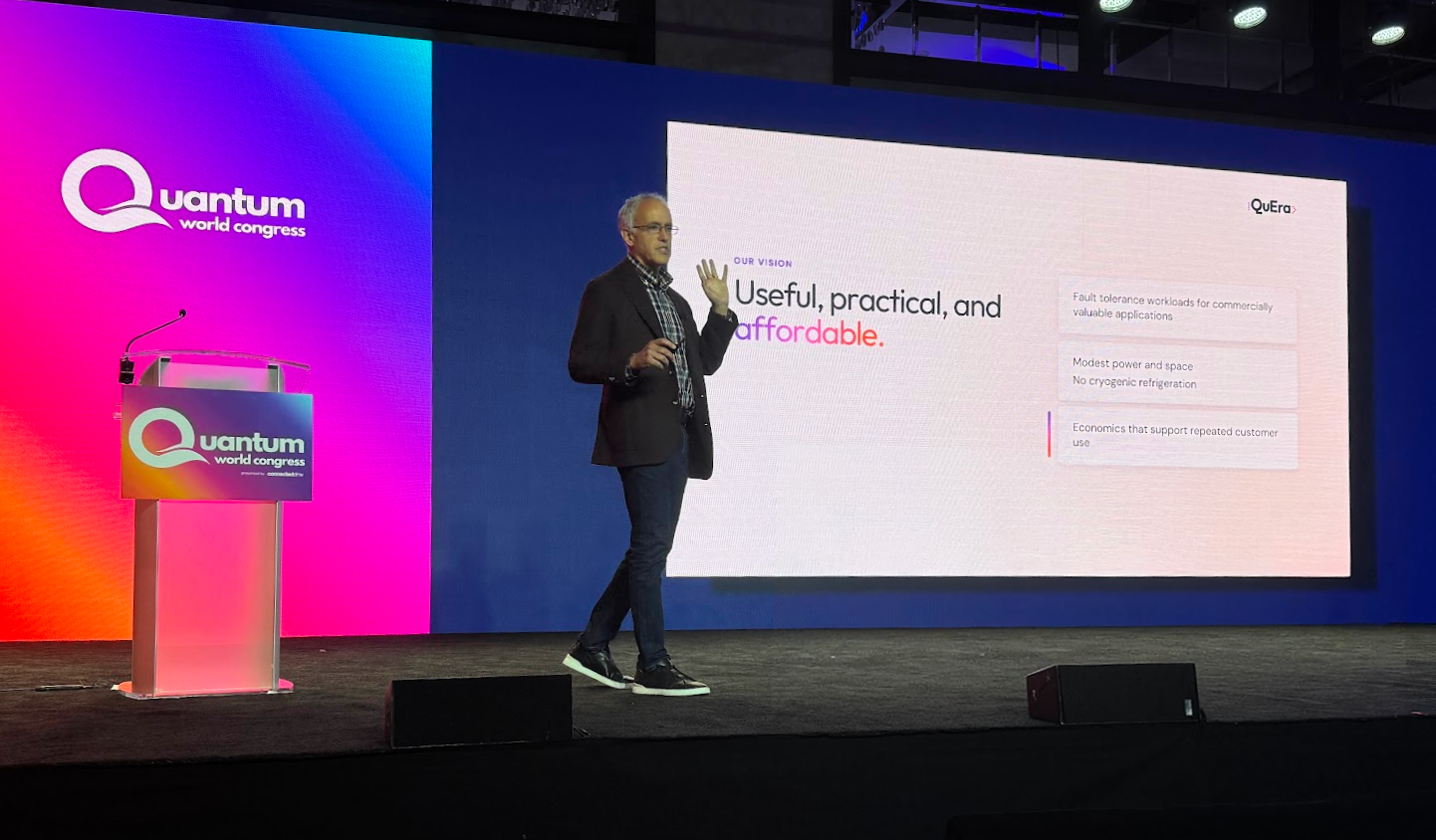
At the conference, QuEra CEO, Andy Ory, delivered a keynote that laid out QuEra's view of the current quantum computing market and how QuEra plans to deliver durable, commercial utility to customers in 2028 with Libra, QuEra's first fault tolerant quantum computer and the first fault tolerant quantum computer on Amazon Braket. A recording of the keynote and a full copy of the presentation is below.

First to Fault Tolerance, First to Utility: A summary of Andy's Keynote

The real quantum computing market hasn't arrived yet. Today no quantum computer delivers quantum utility, and most current use cases can still be done better, faster, and cheaper on classical computers. All of the industry's current activity is about preparing for a future state. QuEra is focused on being the first to usher in this future through fault tolerant neutral atom quantum computing.

QuEra's timeline to fault-tolerant quantum computing has been compressing and is now expected by late 2027 or early 2028, for two reasons. First, key applications need far fewer resources than once thought, thanks to more efficient algorithms, better quantum error correction, and AI. Second, neutral-atom hardware is scaling faster than expected: from 256 qubits a few years ago, to thousands running in QuEra's lab today, to more than 10,000 in a single processor by that window.

AI is a key enabler of this compression in timelines. One example is QuEra's work with Anthropic on agentic laser calibration points toward automating most subsystems of future machines, so they won't need teams of quantum physicists to run them. Another example is work with NVIDIA improved quantum error correction by two orders of magnitude in speed and accuracy.

QuEra's goal is quantum computers that are useful (running fault-tolerant workloads with real quantum advantage), practical (no cryogenics, a compact footprint, autonomous operation), and affordable. Its roadmap runs from Aquila (2022) to Gemini (2025) to Libra (2028), which is designed to perform a million quantum calculations without a single error. The generation after that targets a billion.

QuEra brings neutral-atom technology, a strong scientific team, and a track record that includes nearly four years on Amazon Braket and delivery of the first neutral-atom, gate-based quantum computer to Japan's national labs. Partnerships with Amazon, HPE, and NVIDIA help bring that technology to market and into high-performance computing centers. The next milestone is fault tolerance, and the destination is utility.

Lastly, QuEra's go-to-market strategy is anchored in Amazon Braket. QuEra has worked with Amazon since 2022 and after a months-long evaluation, Amazon selected QuEra as its partner to bring the world's first fault-tolerant quantum computer to market. Amazon and QuEra are now actively engaging with customers to build the first applications that will run on the Libra system.

Andy Ory's Keynote at Quantum World Congress 2026

Andy Ory's Presentation


machine learning
with QuEra

Listen to the podcast
No items found.
Events

The Destination is Utility, Our Next Milestone is Fault Tolerance

October 2, 2026
min read
6 min read
Abstract background with white center and soft gradient corners in purple and orange with dotted patterns.

Quantum World Congress brought together industry leaders, government officials, enterprises, and quantum solution providers spanning the entire quantum stack for three days of keynotes, presentations and panel discussions.

During the conference, QuEra announced an agreement to open an office in the new Discovery Center, part of the State of Maryland's Capitol of Quantum initiative. Maryland's long term, strategic investments in quantum at both the commercial and academic levels, as well as proximity to key federal partners, made the Capitol of Quantum an attractive choice for QuEra.

At the conference, QuEra CEO, Andy Ory, delivered a keynote that laid out QuEra's view of the current quantum computing market and how QuEra plans to deliver durable, commercial utility to customers in 2028 with Libra, QuEra's first fault tolerant quantum computer and the first fault tolerant quantum computer on Amazon Braket. A recording of the keynote and a full copy of the presentation is below.

First to Fault Tolerance, First to Utility: A summary of Andy's Keynote

The real quantum computing market hasn't arrived yet. Today no quantum computer delivers quantum utility, and most current use cases can still be done better, faster, and cheaper on classical computers. All of the industry's current activity is about preparing for a future state. QuEra is focused on being the first to usher in this future through fault tolerant neutral atom quantum computing.

QuEra's timeline to fault-tolerant quantum computing has been compressing and is now expected by late 2027 or early 2028, for two reasons. First, key applications need far fewer resources than once thought, thanks to more efficient algorithms, better quantum error correction, and AI. Second, neutral-atom hardware is scaling faster than expected: from 256 qubits a few years ago, to thousands running in QuEra's lab today, to more than 10,000 in a single processor by that window.

AI is a key enabler of this compression in timelines. One example is QuEra's work with Anthropic on agentic laser calibration points toward automating most subsystems of future machines, so they won't need teams of quantum physicists to run them. Another example is work with NVIDIA improved quantum error correction by two orders of magnitude in speed and accuracy.

QuEra's goal is quantum computers that are useful (running fault-tolerant workloads with real quantum advantage), practical (no cryogenics, a compact footprint, autonomous operation), and affordable. Its roadmap runs from Aquila (2022) to Gemini (2025) to Libra (2028), which is designed to perform a million quantum calculations without a single error. The generation after that targets a billion.

QuEra brings neutral-atom technology, a strong scientific team, and a track record that includes nearly four years on Amazon Braket and delivery of the first neutral-atom, gate-based quantum computer to Japan's national labs. Partnerships with Amazon, HPE, and NVIDIA help bring that technology to market and into high-performance computing centers. The next milestone is fault tolerance, and the destination is utility.

Lastly, QuEra's go-to-market strategy is anchored in Amazon Braket. QuEra has worked with Amazon since 2022 and after a months-long evaluation, Amazon selected QuEra as its partner to bring the world's first fault-tolerant quantum computer to market. Amazon and QuEra are now actively engaging with customers to build the first applications that will run on the Libra system.

Andy Ory's Keynote at Quantum World Congress 2026

Andy Ory's Presentation


machine learning
with QuEra

Listen to the podcast
No items found.