arrow left

What Hyperion Research sees in quantum computing: notes from the SC26 breakfast briefing

calender icon
November 17, 2026
clock icon
7
min read
Opinion
Share
Hyperion survey: quantum market grows from $1.4 billion to $3 billion by 2028

Every year at SC, Hyperion Research opens the conference week with a breakfast briefing on the state of high-performance computing. Most of the 2026 session covered HPC and AI-for-Science, which grew 16.9% in 2025 to more than $70 billion in total spending. Quantum computing had its own segment: Bob Sorensen, Hyperion's Chief Analyst for Quantum Computing, presented results from the firm's sixth annual global QC market survey, titled "Moving From Research Activity to Market Opportunity." Because it repeats each year, the survey gives a year-over-year view of how quantum computing suppliers see their own market.

The survey drew responses from 116 quantum computing experts at 99 supplier companies. 53% of respondents are based in North America, 29% in Europe and 17% in Asia/Pacific. Here are the trends that stood out to us.

1. A $1.4 billion market growing about 30% a year

Hyperion estimates the global quantum computing market at $1.4 billion in 2025. It projects average annual growth of 30%, which would take the market to $3 billion in 2028.

Suppliers expect to grow faster than that. 37% of respondents expect their company's revenue to rise by more than 25% in 2026. The share expecting flat revenue fell from 23% in last year's survey to 7% this year, and no company expects revenue to fall.

2. Hardware is moving on-premises

Hyperion expects a notable shift toward quantum computers installed at customer sites. By 2028, it projects:

  • On-premises QC hardware at $1.2 billion in revenue, the largest single segment at 29% of the market
  • On-premises plus cloud service provider software stack at 25% of the market
  • QC hardware that supports cloud access at 10% of the market

Today, cloud-supported revenue is about 24% of the total. Buying a system outright is a different decision from renting time on one. It means facility planning, integration with existing HPC centers, and multi-year commitments. Hyperion also lists the "costly transition from cloud to on-premises" as one possible source of strain for suppliers, which we come back to below.

On-premises and cloud are not an either-or choice. The 25% segment for on-premises systems plus a cloud provider's software stack points to hybrid deployments, where an organization runs a quantum computer in its own facility and also reaches quantum and classical resources through the cloud.

3. Chemistry and materials lead the application outlook

Asked for the single most promising application area over the next three to five years, respondents put computational chemistry (26%) and materials science (22%) at the top. Together they account for nearly half of the answers. Hyperion notes that both use quantum systems to simulate quantum-level phenomena.
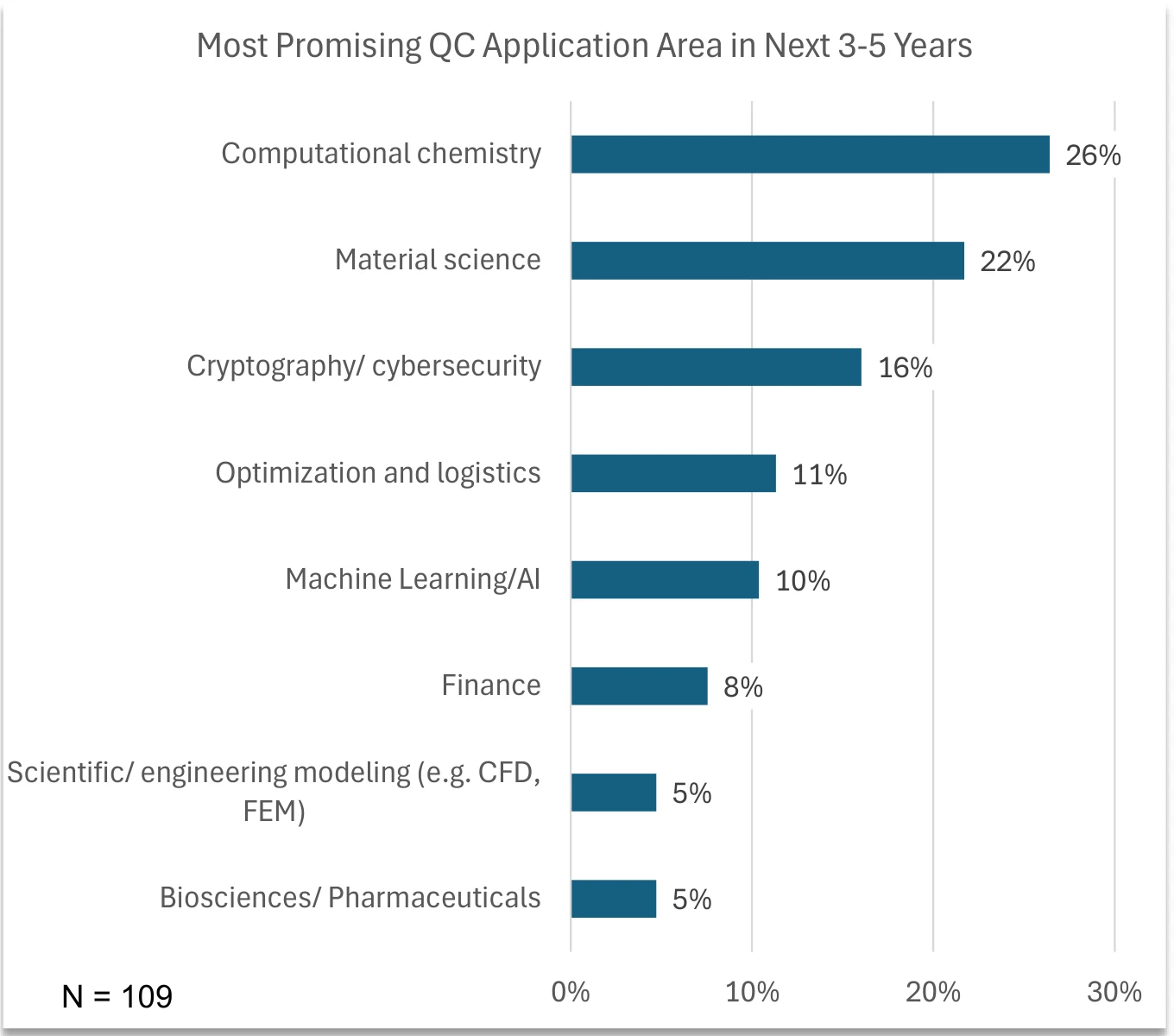
Bar chart: computational chemistry 26%, material science 22%, cryptography 16%, optimization 11%, machine learning 10%, finance 8%, scientific modeling 5%, biosciences 5%

Figure 1: Computational chemistry (26%) and materials science (22%) top respondents' list of the most promising quantum computing applications for the next three to five years. Source: Hyperion Research, SC26 Market Update, November 2026.

A few other points from the chart:

  • Cryptography and cybersecurity came in at 16%. Hyperion asks whether this reflects mindshare, or a view that quantum computers will be needed to verify post-quantum encryption schemes.
  • Machine learning and AI dropped to 10%, down from 23% in the 2022 survey.
  • Finance (8%) is an aggressive early adopter today, but Hyperion sees it increasingly perceived as a niche market, or as a subset of optimization (11%).
  • Scientific and engineering modeling, such as CFD and finite element methods, is at 5%. Hyperion asks whether that reflects a shortage of algorithms or a perception that quantum computers cannot handle traditional classical methods.

By sector, respondents see R&D in quantum technologies and chemicals/chemistry as the most promising end-user markets in 2028, chosen by nearly 40% combined. Government labs and defense together were chosen by 15%.

4. Buyers are exploring and building skills, not just chasing speedups

The survey shows a shift in why end users engage with quantum computing. The leading motivations, each cited by close to half of respondents, are:

  • Exploring use cases with no expectation of near-term advantage (47%)
  • Building in-house familiarity with QC skills with no expectation of near-term deployment (45%)
  • Implementing algorithms not possible on classical systems (44%)

Using quantum computing to address concerns about the future performance of classical systems fell from 51% to 35%. Reducing power, cooling and cost remain minor considerations. About one in five respondents are looking at real-time computing opportunities.

Sorensen's reading is that end users understand the timeframe and are engaging anyway. We read that as a healthy sign: organizations are building teams and testing workflows now so they are ready when systems reach the scale their problems need.

5. Government money still funds most of the industry

Revenue is growing, but quantum computing companies still rely on government R&D funding and venture capital. In 2025, 52% of companies received government R&D funding and 34% received VC funding (respondents chose their top three sources).
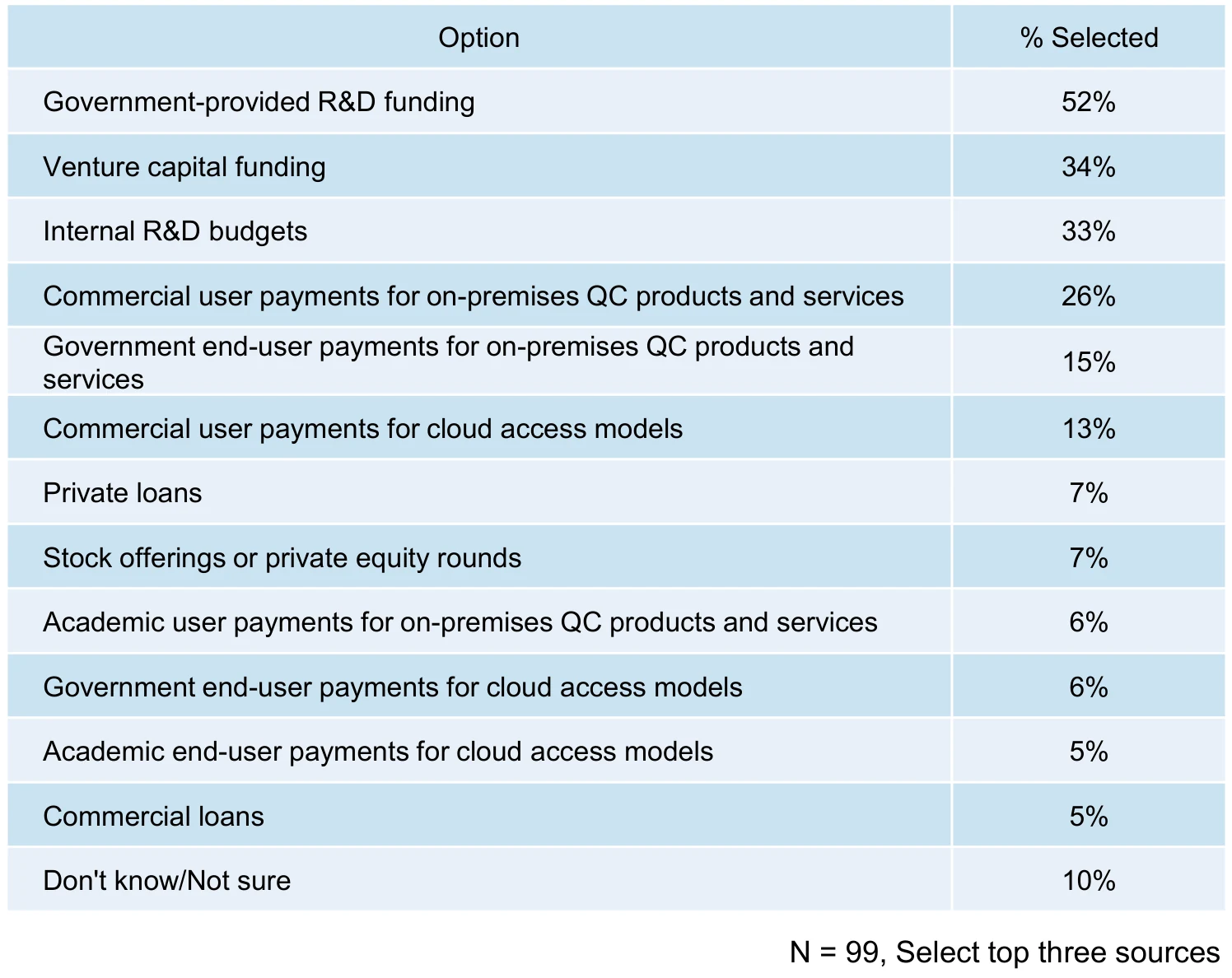
Table of QC companies 2025 funding sources: government R&D 52%, venture capital 34%, internal R&D 33%, commercial on-premises payments 26%

Figure 2: Government R&D funding (52%) and venture capital (34%) were the most common funding sources for quantum computing companies in 2025, ahead of payments from customers. Source: Hyperion Research, SC26 Market Update, November 2026.

Payments from customers are smaller but present: 26% of companies received payments from commercial users for on-premises products and services, 15% from government end users and 6% from academic users.

About three-quarters of the companies surveyed are privately held. More than 40% have no plans to go public, and only 11% expect to become public in the next three years.

6. Partnerships work, especially with government

Hyperion asked companies about partnerships over the past three years.

With government research organizations. 63% of companies have had QC-related government partnerships. The most common reasons were access to government funding (63%), access to government-funded QC research (38%) and access to leading-edge hardware development (37%). Co-design and hybrid quantum-classical systems were each cited by about 30%, which Hyperion reads as integration issues rising in importance. 78% called these partnerships successful, more than half very successful, and none reported an unsuccessful one. More than 60% lasted two years or longer. Budgets centered on $1 million to $10 million, though one in twelve exceeded $50 million.

With end users. 62% of companies have had end-user partnerships. 68% of those set out to explore new sector-specific opportunities, and more than a third looked at QC/HPC integration. 81% called them successful. They tended to be shorter and smaller than government partnerships: 34% lasted a year or less, the most common reported budget was under $500,000, and 42% of respondents treated budget as proprietary.

7. Quantum winter worries are rising

The most notable change from last year is sentiment about a "quantum winter," a period of reduced funding and interest. Hyperion reports that 54% of respondents see some chance of one. The share calling it "somewhat likely" jumped from 22% in 2024 to 34% in 2025, while "somewhat unlikely" fell from 25% to 14%.

That headline number deserves context:

  • The strongest view did not grow. Almost all of the rise is in "somewhat likely." The share calling a winter "highly likely" was 23%, about the same as the year before, and below the 28% recorded in 2020.
  • The worry is about the market, not about themselves. Sorensen noted that respondents are optimistic about their own company's survival. In the same survey, no company expects its revenue to fall in 2026, and 37% expect growth of more than 25%.
  • The causes point to a maturing industry. Several of the reasons Hyperion lists, such as higher budgets as companies move from R&D to production and the cost of delivering systems on site, are costs of growth rather than signs of fading demand.

Read this way, the survey describes an industry that expects consolidation and higher costs, not one that expects customers to walk away.
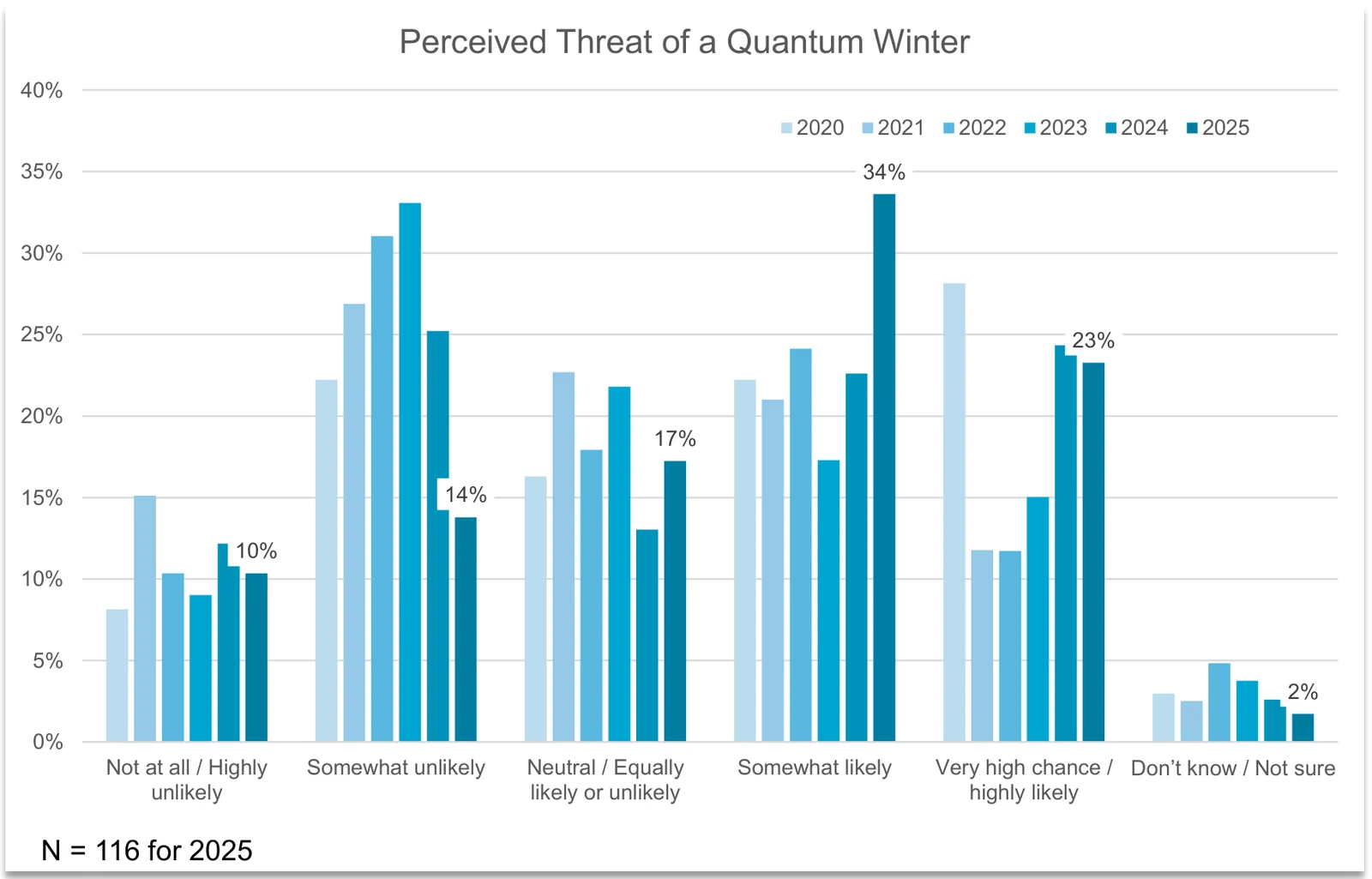
Bar chart of perceived threat of a quantum winter by year, 2020 to 2025; somewhat likely rose to 34% in 2025

Figure 3: How survey respondents rated the chance of a quantum winter each year from 2020 to 2025. "Somewhat likely" rose to 34% in 2025, while "highly likely" held at 23%. Source: Hyperion Research, SC26 Market Update, November 2026.

The possible causes Hyperion lists are:

  • Revenue is coming in, but losses remain high
  • Supplier budgets are growing as companies move from focused R&D to broader production
  • The cost of moving from cloud to on-premises delivery
  • Distraction from generative AI
  • Too many players

What we take from it

Two findings stand out to us. The first is the shift toward on-premises systems. Quantum computers are increasingly being bought by HPC centers and national labs, and much of the partnership effort goes into co-design (working on a customer's problem and the hardware together) and hybrid workflows that pair quantum computers with existing supercomputers. Hyperion's broader conclusions for SC26 noted that new quantum computing systems are being installed around the world.

QuEra supports both ways of buying, and the combination of the two. Aquila has been available on Amazon Braket since 2022, and Gemini runs on premises beside the ABCI-Q supercomputer at AIST in Japan. Libra, our error-corrected system, is planned for Amazon Braket in 2028. For hybrid deployments that combine an on-premises system with cloud access, QuEra works with partners including AWS, HPE and Dell, so a quantum computer can fit into the cloud services and HPC systems an organization already uses.

The second finding is the gap between strong revenue expectations and rising winter concerns. Both can be true: a market can grow 30% a year and still not grow fast enough for every company in it. Buyers in this survey are focused on use cases, skills and integration rather than near-term speedups. That is the work we see customers doing now, and it is what our roadmap to fault-tolerant quantum computers is built for, drawing on peer-reviewed demonstrations of error correction and logical operations.

Planning an on-site system, or looking for the first problems to work on? Talk to our team about an on-premises consultation, or join our co-design program.

The figures and survey results in this post are from Hyperion Research's SC26 Market Update, presented on November 17, 2026. For the full briefing or follow-up questions, contact Hyperion Research at info@hyperionres.com or visit hyperionresearch.com.


machine learning
with QuEra

Listen to the podcast
No items found.
Opinion

What Hyperion Research sees in quantum computing: notes from the SC26 breakfast briefing

November 17, 2026
7
min read
6 min read
Hyperion survey: quantum market grows from $1.4 billion to $3 billion by 2028
Abstract background with white center and soft gradient corners in purple and orange with dotted patterns.

Every year at SC, Hyperion Research opens the conference week with a breakfast briefing on the state of high-performance computing. Most of the 2026 session covered HPC and AI-for-Science, which grew 16.9% in 2025 to more than $70 billion in total spending. Quantum computing had its own segment: Bob Sorensen, Hyperion's Chief Analyst for Quantum Computing, presented results from the firm's sixth annual global QC market survey, titled "Moving From Research Activity to Market Opportunity." Because it repeats each year, the survey gives a year-over-year view of how quantum computing suppliers see their own market.

The survey drew responses from 116 quantum computing experts at 99 supplier companies. 53% of respondents are based in North America, 29% in Europe and 17% in Asia/Pacific. Here are the trends that stood out to us.

1. A $1.4 billion market growing about 30% a year

Hyperion estimates the global quantum computing market at $1.4 billion in 2025. It projects average annual growth of 30%, which would take the market to $3 billion in 2028.

Suppliers expect to grow faster than that. 37% of respondents expect their company's revenue to rise by more than 25% in 2026. The share expecting flat revenue fell from 23% in last year's survey to 7% this year, and no company expects revenue to fall.

2. Hardware is moving on-premises

Hyperion expects a notable shift toward quantum computers installed at customer sites. By 2028, it projects:

  • On-premises QC hardware at $1.2 billion in revenue, the largest single segment at 29% of the market
  • On-premises plus cloud service provider software stack at 25% of the market
  • QC hardware that supports cloud access at 10% of the market

Today, cloud-supported revenue is about 24% of the total. Buying a system outright is a different decision from renting time on one. It means facility planning, integration with existing HPC centers, and multi-year commitments. Hyperion also lists the "costly transition from cloud to on-premises" as one possible source of strain for suppliers, which we come back to below.

On-premises and cloud are not an either-or choice. The 25% segment for on-premises systems plus a cloud provider's software stack points to hybrid deployments, where an organization runs a quantum computer in its own facility and also reaches quantum and classical resources through the cloud.

3. Chemistry and materials lead the application outlook

Asked for the single most promising application area over the next three to five years, respondents put computational chemistry (26%) and materials science (22%) at the top. Together they account for nearly half of the answers. Hyperion notes that both use quantum systems to simulate quantum-level phenomena.

Bar chart: computational chemistry 26%, material science 22%, cryptography 16%, optimization 11%, machine learning 10%, finance 8%, scientific modeling 5%, biosciences 5%

Figure 1: Computational chemistry (26%) and materials science (22%) top respondents' list of the most promising quantum computing applications for the next three to five years. Source: Hyperion Research, SC26 Market Update, November 2026.

A few other points from the chart:

  • Cryptography and cybersecurity came in at 16%. Hyperion asks whether this reflects mindshare, or a view that quantum computers will be needed to verify post-quantum encryption schemes.
  • Machine learning and AI dropped to 10%, down from 23% in the 2022 survey.
  • Finance (8%) is an aggressive early adopter today, but Hyperion sees it increasingly perceived as a niche market, or as a subset of optimization (11%).
  • Scientific and engineering modeling, such as CFD and finite element methods, is at 5%. Hyperion asks whether that reflects a shortage of algorithms or a perception that quantum computers cannot handle traditional classical methods.

By sector, respondents see R&D in quantum technologies and chemicals/chemistry as the most promising end-user markets in 2028, chosen by nearly 40% combined. Government labs and defense together were chosen by 15%.

4. Buyers are exploring and building skills, not just chasing speedups

The survey shows a shift in why end users engage with quantum computing. The leading motivations, each cited by close to half of respondents, are:

  • Exploring use cases with no expectation of near-term advantage (47%)
  • Building in-house familiarity with QC skills with no expectation of near-term deployment (45%)
  • Implementing algorithms not possible on classical systems (44%)

Using quantum computing to address concerns about the future performance of classical systems fell from 51% to 35%. Reducing power, cooling and cost remain minor considerations. About one in five respondents are looking at real-time computing opportunities.

Sorensen's reading is that end users understand the timeframe and are engaging anyway. We read that as a healthy sign: organizations are building teams and testing workflows now so they are ready when systems reach the scale their problems need.

5. Government money still funds most of the industry

Revenue is growing, but quantum computing companies still rely on government R&D funding and venture capital. In 2025, 52% of companies received government R&D funding and 34% received VC funding (respondents chose their top three sources).

Table of QC companies 2025 funding sources: government R&D 52%, venture capital 34%, internal R&D 33%, commercial on-premises payments 26%

Figure 2: Government R&D funding (52%) and venture capital (34%) were the most common funding sources for quantum computing companies in 2025, ahead of payments from customers. Source: Hyperion Research, SC26 Market Update, November 2026.

Payments from customers are smaller but present: 26% of companies received payments from commercial users for on-premises products and services, 15% from government end users and 6% from academic users.

About three-quarters of the companies surveyed are privately held. More than 40% have no plans to go public, and only 11% expect to become public in the next three years.

6. Partnerships work, especially with government

Hyperion asked companies about partnerships over the past three years.

With government research organizations. 63% of companies have had QC-related government partnerships. The most common reasons were access to government funding (63%), access to government-funded QC research (38%) and access to leading-edge hardware development (37%). Co-design and hybrid quantum-classical systems were each cited by about 30%, which Hyperion reads as integration issues rising in importance. 78% called these partnerships successful, more than half very successful, and none reported an unsuccessful one. More than 60% lasted two years or longer. Budgets centered on $1 million to $10 million, though one in twelve exceeded $50 million.

With end users. 62% of companies have had end-user partnerships. 68% of those set out to explore new sector-specific opportunities, and more than a third looked at QC/HPC integration. 81% called them successful. They tended to be shorter and smaller than government partnerships: 34% lasted a year or less, the most common reported budget was under $500,000, and 42% of respondents treated budget as proprietary.

7. Quantum winter worries are rising

The most notable change from last year is sentiment about a "quantum winter," a period of reduced funding and interest. Hyperion reports that 54% of respondents see some chance of one. The share calling it "somewhat likely" jumped from 22% in 2024 to 34% in 2025, while "somewhat unlikely" fell from 25% to 14%.

That headline number deserves context:

  • The strongest view did not grow. Almost all of the rise is in "somewhat likely." The share calling a winter "highly likely" was 23%, about the same as the year before, and below the 28% recorded in 2020.
  • The worry is about the market, not about themselves. Sorensen noted that respondents are optimistic about their own company's survival. In the same survey, no company expects its revenue to fall in 2026, and 37% expect growth of more than 25%.
  • The causes point to a maturing industry. Several of the reasons Hyperion lists, such as higher budgets as companies move from R&D to production and the cost of delivering systems on site, are costs of growth rather than signs of fading demand.

Read this way, the survey describes an industry that expects consolidation and higher costs, not one that expects customers to walk away.

Bar chart of perceived threat of a quantum winter by year, 2020 to 2025; somewhat likely rose to 34% in 2025

Figure 3: How survey respondents rated the chance of a quantum winter each year from 2020 to 2025. "Somewhat likely" rose to 34% in 2025, while "highly likely" held at 23%. Source: Hyperion Research, SC26 Market Update, November 2026.

The possible causes Hyperion lists are:

  • Revenue is coming in, but losses remain high
  • Supplier budgets are growing as companies move from focused R&D to broader production
  • The cost of moving from cloud to on-premises delivery
  • Distraction from generative AI
  • Too many players

What we take from it

Two findings stand out to us. The first is the shift toward on-premises systems. Quantum computers are increasingly being bought by HPC centers and national labs, and much of the partnership effort goes into co-design (working on a customer's problem and the hardware together) and hybrid workflows that pair quantum computers with existing supercomputers. Hyperion's broader conclusions for SC26 noted that new quantum computing systems are being installed around the world.

QuEra supports both ways of buying, and the combination of the two. Aquila has been available on Amazon Braket since 2022, and Gemini runs on premises beside the ABCI-Q supercomputer at AIST in Japan. Libra, our error-corrected system, is planned for Amazon Braket in 2028. For hybrid deployments that combine an on-premises system with cloud access, QuEra works with partners including AWS, HPE and Dell, so a quantum computer can fit into the cloud services and HPC systems an organization already uses.

The second finding is the gap between strong revenue expectations and rising winter concerns. Both can be true: a market can grow 30% a year and still not grow fast enough for every company in it. Buyers in this survey are focused on use cases, skills and integration rather than near-term speedups. That is the work we see customers doing now, and it is what our roadmap to fault-tolerant quantum computers is built for, drawing on peer-reviewed demonstrations of error correction and logical operations.

Planning an on-site system, or looking for the first problems to work on? Talk to our team about an on-premises consultation, or join our co-design program.

The figures and survey results in this post are from Hyperion Research's SC26 Market Update, presented on November 17, 2026. For the full briefing or follow-up questions, contact Hyperion Research at info@hyperionres.com or visit hyperionresearch.com.


machine learning
with QuEra

Listen to the podcast
No items found.