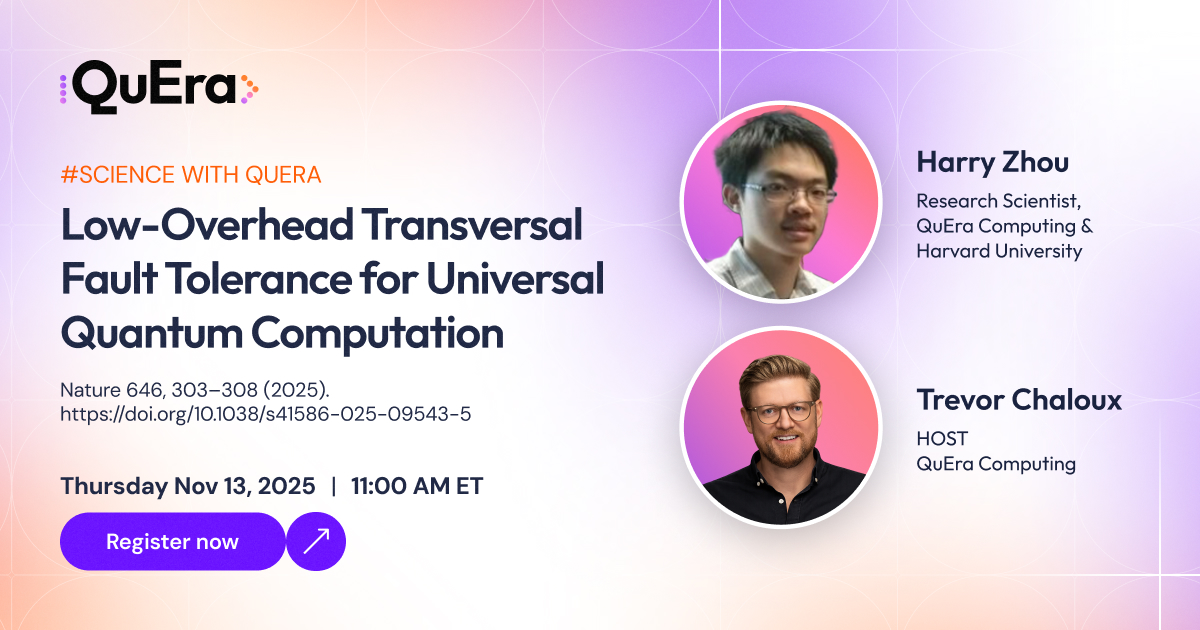
Science with QuEra - Constant-overhead Fault-tolerant Quantum Computation with Reconfigurable Atom Arrays

May 27, 2025

11:00 AM ET

Webinar Registration

your submission has been received

see you soon

Oops! Something went wrong while submitting the form.

Overview

Hosts

  • Harry Zhou

    Research Scientist, QuEra Computing

  • Pablo Bonilla

    PhD Physics at Harvard, Ramsay Scholar

  • Yuval Boger

    Chief Commercial Officer, QuEra Computing

Science with QuEra - Constant-overhead Fault-tolerant Quantum Computation with Reconfigurable Atom Arrays

calender icon
May 27, 2025
clock icon
36:51
min
play video icon

Science with QuEra - Constant-overhead Fault-tolerant Quantum Computation with Reconfigurable Atom Arrays

calendrer icon
May 27, 2025
clock icon
36:51
min

Overview

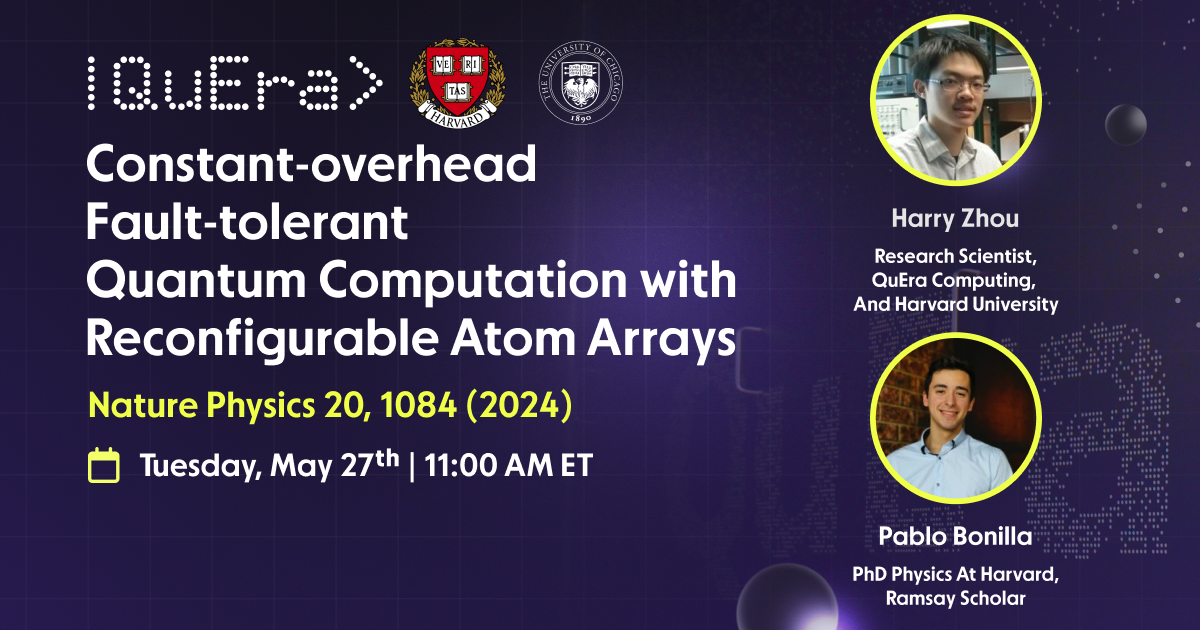
Part of the Science with QuEra webinar series, this presentation covers the Nature Physics 20, 1084 (2024) paper "Constant-overhead Fault-tolerant Quantum Computation with Reconfigurable Atom Arrays", presented by two of the paper's authors.

The research leverages high-rate quantum low-density parity-check (qLDPC) codes, which encode multiple logical qubits using fewer physical qubits. These qLDPC codes have a linear scaling rate, vastly outperforming traditional surface codes.

Watch as Pablo dives into:

  • The theory behind optimizing classical codes to develop qLDPC codes, where encoded logical qubits scale linearly with physical qubits
  • How hypergraph codes, a subset of the qLDPC family, can practically permute atom arrays in neutral-atom systems
  • A proposed algorithm that implements syndrome extraction in orders of magnitude less than coherence time

Hosts

Webinar host
Harry Zhou
Research Scientist, QuEra Computing
Webinar host
Pablo Bonilla
PhD Physics at Harvard, Ramsay Scholar
Webinar host
Yuval Boger
Chief Commercial Officer, QuEra Computing
Webinar host

Science with QuEra - Constant-overhead Fault-tolerant Quantum Computation with Reconfigurable Atom Arrays

May 27, 2025
11:00 AM ET

Hosts

Webinar host
Harry Zhou
Research Scientist, QuEra Computing
Webinar host
Pablo Bonilla
PhD Physics at Harvard, Ramsay Scholar
Webinar host
Yuval Boger
Chief Commercial Officer, QuEra Computing

Webinar Registration

* Please fill your first name
* Please fill your last name
* Wrong email address format
Register

Thank you!
See you soon

Oops! Something went wrong while submitting the form.
arrow left

Schedule a meeting at:

Science with QuEra - Constant-overhead Fault-tolerant Quantum Computation with Reconfigurable Atom Arrays

calender icon
May 27, 2025

Upcoming events

Check back soon
Check back soon
Thank you! Your submission has been received!
Oops! Something went wrong while submitting the form.
Thank you! Your submission has been received!
Oops! Something went wrong while submitting the form.

Overview

Part of the Science with QuEra webinar series, this presentation covers the Nature Physics 20, 1084 (2024) paper "Constant-overhead Fault-tolerant Quantum Computation with Reconfigurable Atom Arrays", presented by two of the paper's authors.

The research leverages high-rate quantum low-density parity-check (qLDPC) codes, which encode multiple logical qubits using fewer physical qubits. These qLDPC codes have a linear scaling rate, vastly outperforming traditional surface codes.

Watch as Pablo dives into:

  • The theory behind optimizing classical codes to develop qLDPC codes, where encoded logical qubits scale linearly with physical qubits
  • How hypergraph codes, a subset of the qLDPC family, can practically permute atom arrays in neutral-atom systems
  • A proposed algorithm that implements syndrome extraction in orders of magnitude less than coherence time
Webinars

Schedule a meeting at:
Science with QuEra - Constant-overhead Fault-tolerant Quantum Computation with Reconfigurable Atom Arrays

May 27, 2025

Schedule a meeting

* Please fill your first name
* Please fill your last name
* Please fill your email
* Please fill your phone number
* Please fill your message
* Please fill your preferred date
* Please fill your preferred time
Thank you!

See you soon!

Oops! Something went wrong while submitting the form.