arrow left

Schrödinger’s Cat

Schrödinger’s Cat

Key Takeaways

A Critique, Not a Theory: Erwin Schrödinger originally devised this scenario to highlight the absurdity of the prevailing "Copenhagen Interpretation" of quantum mechanics.

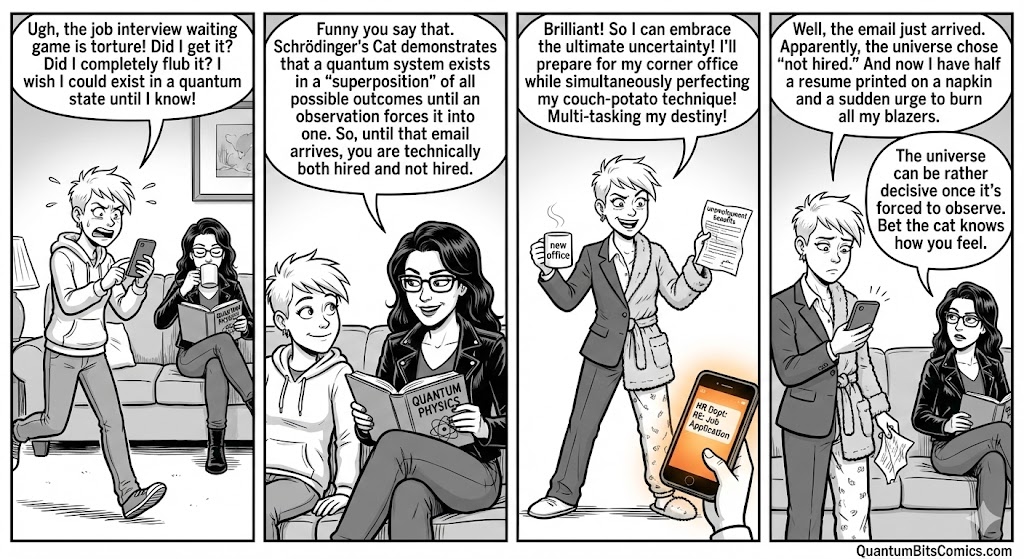
The Scenario: A hypothetical cat is placed in a box with a poison mechanism triggered by a quantum event. Until observed, the cat is theoretically both alive and dead.

Superposition: It illustrates the concept of quantum superposition—where a system exists in multiple states simultaneously—applied to everyday objects.

The Measurement Problem: The paradox forces physicists to confront the question: "When does a quantum possibility become a physical reality?"

Legacy: While meant as a reductio ad absurdum, it has become the defining pop-culture metaphor for quantum mechanics and qubit states.

What is Schrödinger’s Cat?

Schrödinger’s cat is a famous thought experiment (or paradox) devised by Austrian physicist Erwin Schrödinger in 1935. It presents a scenario in which a cat is simultaneously alive and dead, a state known as quantum superposition.

The Setup: Imagine a sealed steel box containing a cat. Inside the box is a "diabolical device" consisting of:

1. A tiny bit of radioactive substance, so small that perhaps one atom might decay within an hour, or perhaps none will.

2. A Geiger counter to detect the decay.

3. A relay that releases a hammer if an atom decays.

4. A flask of hydrocyanic acid (poison) that shatters if the hammer falls.

According to the laws of quantum mechanics, the radioactive atom exists in a superposition of "decayed" and "not decayed." Because the cat's fate is entangled with the atom, the cat is mathematically described as being in a superposition of "dead" and "alive" until someone opens the box.

Why Schrödinger Proposed the Thought Experiment

Contrary to popular belief, Schrödinger did not believe the cat was actually both alive and dead. He created the schrodinger cat experiment to demonstrate the flaw in the Copenhagen Interpretation of quantum mechanics.

At the time, physicists like Niels Bohr argued that a quantum particle effectively has no definite state until it is measured. Schrödinger found this ridiculous when applied to the real world. By linking a microscopic quantum event (atom decay) to a macroscopic event (a cat dying), he showed that the prevailing theory led to absurd conclusions—suggesting that a living, breathing creature could be "smeared" between life and death simply because no one had looked at it yet.

Superposition at the Macroscopic Scale

The core of the paradox is the transition from the micro to the macro. We know that individual atoms can exist in superposition. But can a cat? This concept is known as macroscopic superposition.

In classical physics, objects have definite properties at all times. In the quantum world, the state is defined by a wave function. The paradox asks why the wave function of the atom doesn't just stay small. Instead, it "infects" the Geiger counter, which infects the hammer, which infects the cat.

While we have never seen a cat in superposition, modern experiments have managed to place larger and larger objects—such as molecules of 2,000 atoms or tiny vibrating membranes—into superposition states. This suggests the boundary between the "quantum world" and the "classical world" is not a sharp line, but a gradient defined by isolation.

What the Paradox Reveals About Measurement

The quantum paradox highlights the "Measurement Problem."

The Question: What constitutes a "measurement"? Does it require a human with a PhD? Can the Geiger counter be the observer? Does the cat observe itself?

The Collapse: The standard theory says the wave function "collapses" into a single reality upon Measurement.

However, the theory doesn't define when this collapse happens. If the box stays closed for a year, is the cat still in superposition? Schrödinger argued that the cat is likely dead or alive long before we open the box, implying that there are hidden variables or mechanisms that quantum mechanics (as understood in 1935) was failing to describe.

Modern Interpretations and Misconceptions

Since 1935, physicists have developed new ways to resolve the paradox without assuming the cat is a zombie.

1. Many-Worlds Interpretation: There is no collapse. When the atom decays, the universe splits. In one branch of reality, the cat is alive; in the other, it is dead. Both exist, but they cannot communicate.

2. Decoherence: This is the practical answer. The cat is constantly interacting with air molecules, heat, and light inside the box. These interactions constitute "measurements" by the environment. The information leaks out immediately, destroying the superposition (decoherence) effectively "opening the box" instantly, even if a human hasn't looked.

Timeline of Interpretations

  • 1935: Schrödinger proposes the paradox to criticize the Copenhagen interpretation.
  • 1957: Hugh Everett proposes Many-Worlds, suggesting the cat is both alive and dead in parallel universes.
  • 1970s–90s: Decoherence theory gains traction, explaining why macroscopic objects do not remain in superposition.
  • 2000s: Experiments with “cat states” (superpositions of distinct electromagnetic fields) become standard in quantum computing.

Relevance to Quantum Computing

Today, "Schrödinger's Cat" is no longer just a thought experiment; it is a resource. In quantum computing, we deliberately create "Cat States"—special types of entangled states that are robust against certain errors. We use techniques like Quantum Monte Carlo simulations to model these complex systems.

At QuEra, we deal with this reality daily. Our neutral atoms are isolated in a vacuum to prevent decoherence. We manipulate their Hamiltonian to guide them into complex superpositions. If we fail to shield them, the "environment" opens the box, and our computation collapses—just like the cat.

Frequently Asked Questions (FAQ)

Was Schrödinger’s cat meant to be taken literally?

No. It was a reductio ad absurdum—a logical argument meant to show that a premise leads to a ridiculous conclusion. Schrödinger used it to mock the idea that a quantum system has no defined state until a human observes it.

Does the experiment explain how measurement collapses a wave function?

No, it highlights that we don't fully know how collapse works. It poses the question rather than answering it. The "Measurement Problem" remains one of the biggest unsolved philosophical questions in quantum mechanics, though "Decoherence" provides a practical explanation for why we don't see zombie cats.

Why does the paradox remain relevant in quantum computing?

It is the ultimate analogy for a qubit. A qubit is a "cat" that is both 0 and 1 at the same time. The challenge of building a quantum computer is effectively "keeping the box sealed" (preventing noise/decoherence) long enough to perform a calculation before the state collapses.

Can superposition occur at macroscopic scales in real life?

Generally, no. Macroscopic objects (like cats or keys) interact too strongly with their environment (air, light, heat). These interactions destroy superposition almost instantly (in nanoseconds). However, scientists have achieved superposition in objects visible to the naked eye under extremely controlled laboratory conditions.

How do modern interpretations solve or reframe the paradox?

The "Many-Worlds" interpretation says the cat is alive in one universe and dead in another (no collapse). The "Decoherence" theory says the environment measures the cat instantly, so it is never truly in a macroscopic superposition. Bayesian interpretations suggest the superposition is just in our *knowledge*, not in reality.

No items found.

Schrödinger’s Cat

Key Takeaways

A Critique, Not a Theory: Erwin Schrödinger originally devised this scenario to highlight the absurdity of the prevailing "Copenhagen Interpretation" of quantum mechanics.

The Scenario: A hypothetical cat is placed in a box with a poison mechanism triggered by a quantum event. Until observed, the cat is theoretically both alive and dead.

Superposition: It illustrates the concept of quantum superposition—where a system exists in multiple states simultaneously—applied to everyday objects.

The Measurement Problem: The paradox forces physicists to confront the question: "When does a quantum possibility become a physical reality?"

Legacy: While meant as a reductio ad absurdum, it has become the defining pop-culture metaphor for quantum mechanics and qubit states.

What is Schrödinger’s Cat?

Schrödinger’s cat is a famous thought experiment (or paradox) devised by Austrian physicist Erwin Schrödinger in 1935. It presents a scenario in which a cat is simultaneously alive and dead, a state known as quantum superposition.

The Setup: Imagine a sealed steel box containing a cat. Inside the box is a "diabolical device" consisting of:

1. A tiny bit of radioactive substance, so small that perhaps one atom might decay within an hour, or perhaps none will.

2. A Geiger counter to detect the decay.

3. A relay that releases a hammer if an atom decays.

4. A flask of hydrocyanic acid (poison) that shatters if the hammer falls.

According to the laws of quantum mechanics, the radioactive atom exists in a superposition of "decayed" and "not decayed." Because the cat's fate is entangled with the atom, the cat is mathematically described as being in a superposition of "dead" and "alive" until someone opens the box.

Why Schrödinger Proposed the Thought Experiment

Contrary to popular belief, Schrödinger did not believe the cat was actually both alive and dead. He created the schrodinger cat experiment to demonstrate the flaw in the Copenhagen Interpretation of quantum mechanics.

At the time, physicists like Niels Bohr argued that a quantum particle effectively has no definite state until it is measured. Schrödinger found this ridiculous when applied to the real world. By linking a microscopic quantum event (atom decay) to a macroscopic event (a cat dying), he showed that the prevailing theory led to absurd conclusions—suggesting that a living, breathing creature could be "smeared" between life and death simply because no one had looked at it yet.

Superposition at the Macroscopic Scale

The core of the paradox is the transition from the micro to the macro. We know that individual atoms can exist in superposition. But can a cat? This concept is known as macroscopic superposition.

In classical physics, objects have definite properties at all times. In the quantum world, the state is defined by a wave function. The paradox asks why the wave function of the atom doesn't just stay small. Instead, it "infects" the Geiger counter, which infects the hammer, which infects the cat.

While we have never seen a cat in superposition, modern experiments have managed to place larger and larger objects—such as molecules of 2,000 atoms or tiny vibrating membranes—into superposition states. This suggests the boundary between the "quantum world" and the "classical world" is not a sharp line, but a gradient defined by isolation.

What the Paradox Reveals About Measurement

The quantum paradox highlights the "Measurement Problem."

The Question: What constitutes a "measurement"? Does it require a human with a PhD? Can the Geiger counter be the observer? Does the cat observe itself?

The Collapse: The standard theory says the wave function "collapses" into a single reality upon Measurement.

However, the theory doesn't define when this collapse happens. If the box stays closed for a year, is the cat still in superposition? Schrödinger argued that the cat is likely dead or alive long before we open the box, implying that there are hidden variables or mechanisms that quantum mechanics (as understood in 1935) was failing to describe.

Modern Interpretations and Misconceptions

Since 1935, physicists have developed new ways to resolve the paradox without assuming the cat is a zombie.

1. Many-Worlds Interpretation: There is no collapse. When the atom decays, the universe splits. In one branch of reality, the cat is alive; in the other, it is dead. Both exist, but they cannot communicate.

2. Decoherence: This is the practical answer. The cat is constantly interacting with air molecules, heat, and light inside the box. These interactions constitute "measurements" by the environment. The information leaks out immediately, destroying the superposition (decoherence) effectively "opening the box" instantly, even if a human hasn't looked.

Timeline of Interpretations

  • 1935: Schrödinger proposes the paradox to criticize the Copenhagen interpretation.
  • 1957: Hugh Everett proposes Many-Worlds, suggesting the cat is both alive and dead in parallel universes.
  • 1970s–90s: Decoherence theory gains traction, explaining why macroscopic objects do not remain in superposition.
  • 2000s: Experiments with “cat states” (superpositions of distinct electromagnetic fields) become standard in quantum computing.

Relevance to Quantum Computing

Today, "Schrödinger's Cat" is no longer just a thought experiment; it is a resource. In quantum computing, we deliberately create "Cat States"—special types of entangled states that are robust against certain errors. We use techniques like Quantum Monte Carlo simulations to model these complex systems.

At QuEra, we deal with this reality daily. Our neutral atoms are isolated in a vacuum to prevent decoherence. We manipulate their Hamiltonian to guide them into complex superpositions. If we fail to shield them, the "environment" opens the box, and our computation collapses—just like the cat.

Frequently Asked Questions (FAQ)

Was Schrödinger’s cat meant to be taken literally?

No. It was a reductio ad absurdum—a logical argument meant to show that a premise leads to a ridiculous conclusion. Schrödinger used it to mock the idea that a quantum system has no defined state until a human observes it.

Does the experiment explain how measurement collapses a wave function?

No, it highlights that we don't fully know how collapse works. It poses the question rather than answering it. The "Measurement Problem" remains one of the biggest unsolved philosophical questions in quantum mechanics, though "Decoherence" provides a practical explanation for why we don't see zombie cats.

Why does the paradox remain relevant in quantum computing?

It is the ultimate analogy for a qubit. A qubit is a "cat" that is both 0 and 1 at the same time. The challenge of building a quantum computer is effectively "keeping the box sealed" (preventing noise/decoherence) long enough to perform a calculation before the state collapses.

Can superposition occur at macroscopic scales in real life?

Generally, no. Macroscopic objects (like cats or keys) interact too strongly with their environment (air, light, heat). These interactions destroy superposition almost instantly (in nanoseconds). However, scientists have achieved superposition in objects visible to the naked eye under extremely controlled laboratory conditions.

How do modern interpretations solve or reframe the paradox?

The "Many-Worlds" interpretation says the cat is alive in one universe and dead in another (no collapse). The "Decoherence" theory says the environment measures the cat instantly, so it is never truly in a macroscopic superposition. Bayesian interpretations suggest the superposition is just in our *knowledge*, not in reality.

Abstract background with white center and soft gradient corners in purple and orange with dotted patterns.