
arrow left

Aquila’s Latest Nature Publication: Operating in Discovery Mode

calender icon
November 18, 2026
clock icon
min read
Customers and partners
Share

Aquila was developed in the early 2020s, shortly after QuEra was founded. It is QuEra’s first commercially available system, and at 256 qubits, it offers the scientific community a scale previously available only in academic settings. QuEra’s founding team knew that an accurate analog simulator would be a powerful tool for studying how systems evolve over time, and committed to bringing the device to Amazon Braket, the quantum computing service from AWS. When the system came online in the fall of 2022, few on the team could have anticipated the range of applications to come.

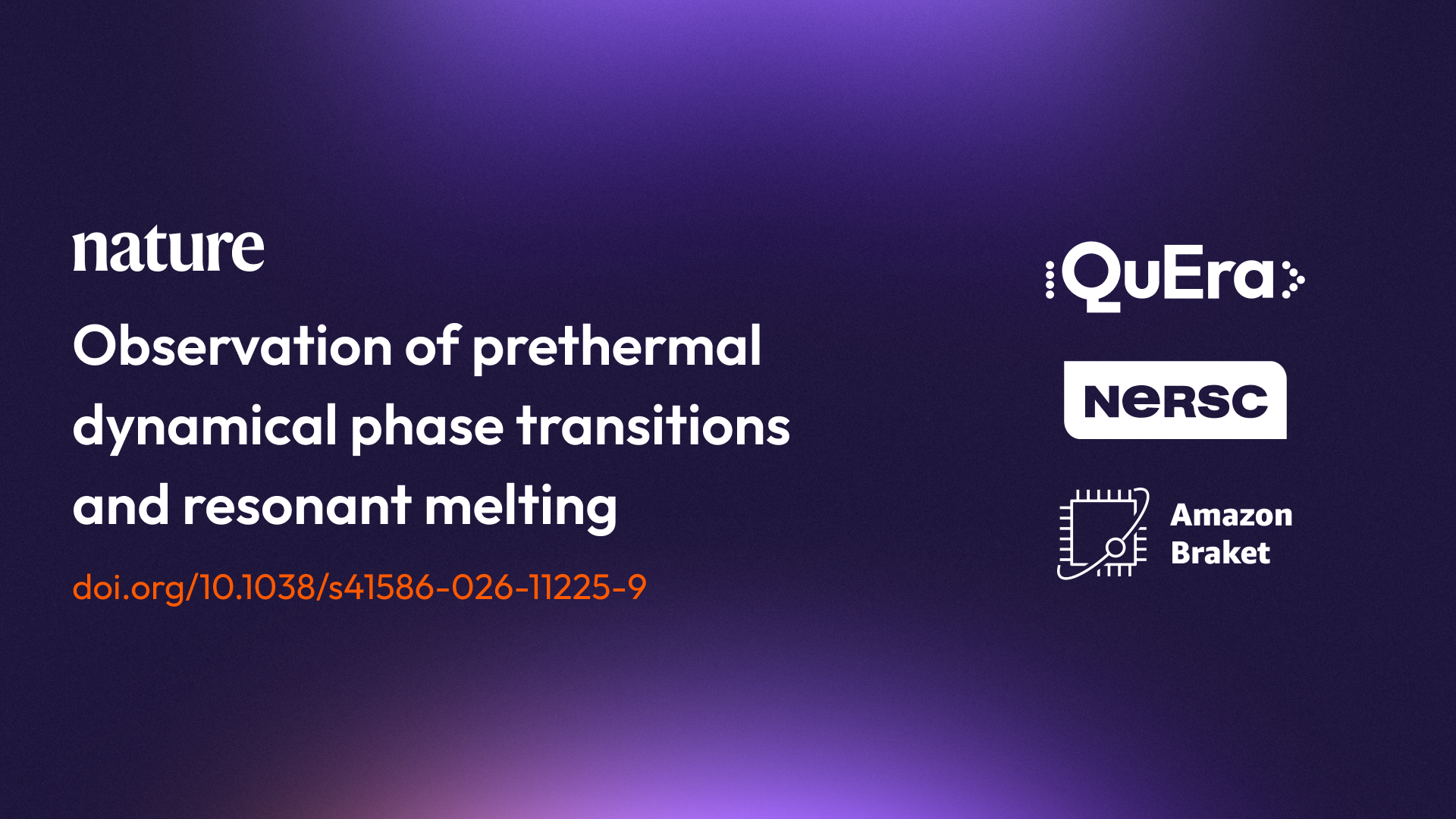
Research on Aquila has since led to a corpus of 60 papers, many of them peer-reviewed and published in leading scientific journals. The latest is a new study in Nature from a team at NERSC at Lawrence Berkeley National Laboratory and QuEra, with collaborators at Harvard University and Boston University.

The research team accessed Aquila through Amazon Braket to study how interacting quantum particles behave after being pushed far from equilibrium. Probing problems like this can help scientists build more accurate models of the quantum behavior that governs the physical world.

The team used Aquila as one tool in a broader scientific computing stack that included NERSC’s Perlmutter supercomputer for classical computation. Together, these resources let the researchers operate in discovery mode: using Aquila’s programmability to investigate unfamiliar behavior, while subjecting the results to the same scrutiny as any other scientific experiment. Reliable conclusions come from reproducible measurements, comparisons across parameters and system sizes, and quantitative tests of the proposed explanations. The NERSC-QuEra collaboration shows how this approach can turn unexpected observations into new physical understanding.

This approach departs from the pattern of most quantum simulation research to date. The researchers were not looking to reproduce already understood phenomena to a desired accuracy. Aquila’s scientific mode, paired with Perlmutter’s classical numerical computation, reached regimes otherwise hard to reach with classical methodologies alone. The experiments revealed long-lived prethermal regimes, resonances that cause them to “melt,” and a first-order dynamical phase transition that is not inherited from the system’s known equilibrium phase diagram.

This work demonstrates that, with careful programming and post-processing, Aquila can be used to produce scientific results that shed light on previously hidden regimes of dynamical systems. For the full scientific walkthrough, read the post on the AWS Quantum Technologies Blog. The paper is available in Nature.

‍


machine learning
with QuEra

Listen to the podcast
No items found.
Customers and partners

Aquila’s Latest Nature Publication: Operating in Discovery Mode

November 18, 2026
min read
6 min read
Abstract background with white center and soft gradient corners in purple and orange with dotted patterns.

Aquila was developed in the early 2020s, shortly after QuEra was founded. It is QuEra’s first commercially available system, and at 256 qubits, it offers the scientific community a scale previously available only in academic settings. QuEra’s founding team knew that an accurate analog simulator would be a powerful tool for studying how systems evolve over time, and committed to bringing the device to Amazon Braket, the quantum computing service from AWS. When the system came online in the fall of 2022, few on the team could have anticipated the range of applications to come.

Research on Aquila has since led to a corpus of 60 papers, many of them peer-reviewed and published in leading scientific journals. The latest is a new study in Nature from a team at NERSC at Lawrence Berkeley National Laboratory and QuEra, with collaborators at Harvard University and Boston University.

The research team accessed Aquila through Amazon Braket to study how interacting quantum particles behave after being pushed far from equilibrium. Probing problems like this can help scientists build more accurate models of the quantum behavior that governs the physical world.

The team used Aquila as one tool in a broader scientific computing stack that included NERSC’s Perlmutter supercomputer for classical computation. Together, these resources let the researchers operate in discovery mode: using Aquila’s programmability to investigate unfamiliar behavior, while subjecting the results to the same scrutiny as any other scientific experiment. Reliable conclusions come from reproducible measurements, comparisons across parameters and system sizes, and quantitative tests of the proposed explanations. The NERSC-QuEra collaboration shows how this approach can turn unexpected observations into new physical understanding.

This approach departs from the pattern of most quantum simulation research to date. The researchers were not looking to reproduce already understood phenomena to a desired accuracy. Aquila’s scientific mode, paired with Perlmutter’s classical numerical computation, reached regimes otherwise hard to reach with classical methodologies alone. The experiments revealed long-lived prethermal regimes, resonances that cause them to “melt,” and a first-order dynamical phase transition that is not inherited from the system’s known equilibrium phase diagram.

This work demonstrates that, with careful programming and post-processing, Aquila can be used to produce scientific results that shed light on previously hidden regimes of dynamical systems. For the full scientific walkthrough, read the post on the AWS Quantum Technologies Blog. The paper is available in Nature.

‍


machine learning
with QuEra

Listen to the podcast
No items found.