


.webp)
For most of its history, quantum computing has been a research problem. The question was whether the machines could work at all.
That question is changing. As quantum computers move from the lab toward real-world utility, a different kind of challenge comes into view: can the industry reliably source the lasers, optics, cryogenics and specialized materials it needs to build machines on a schedule and at scale?
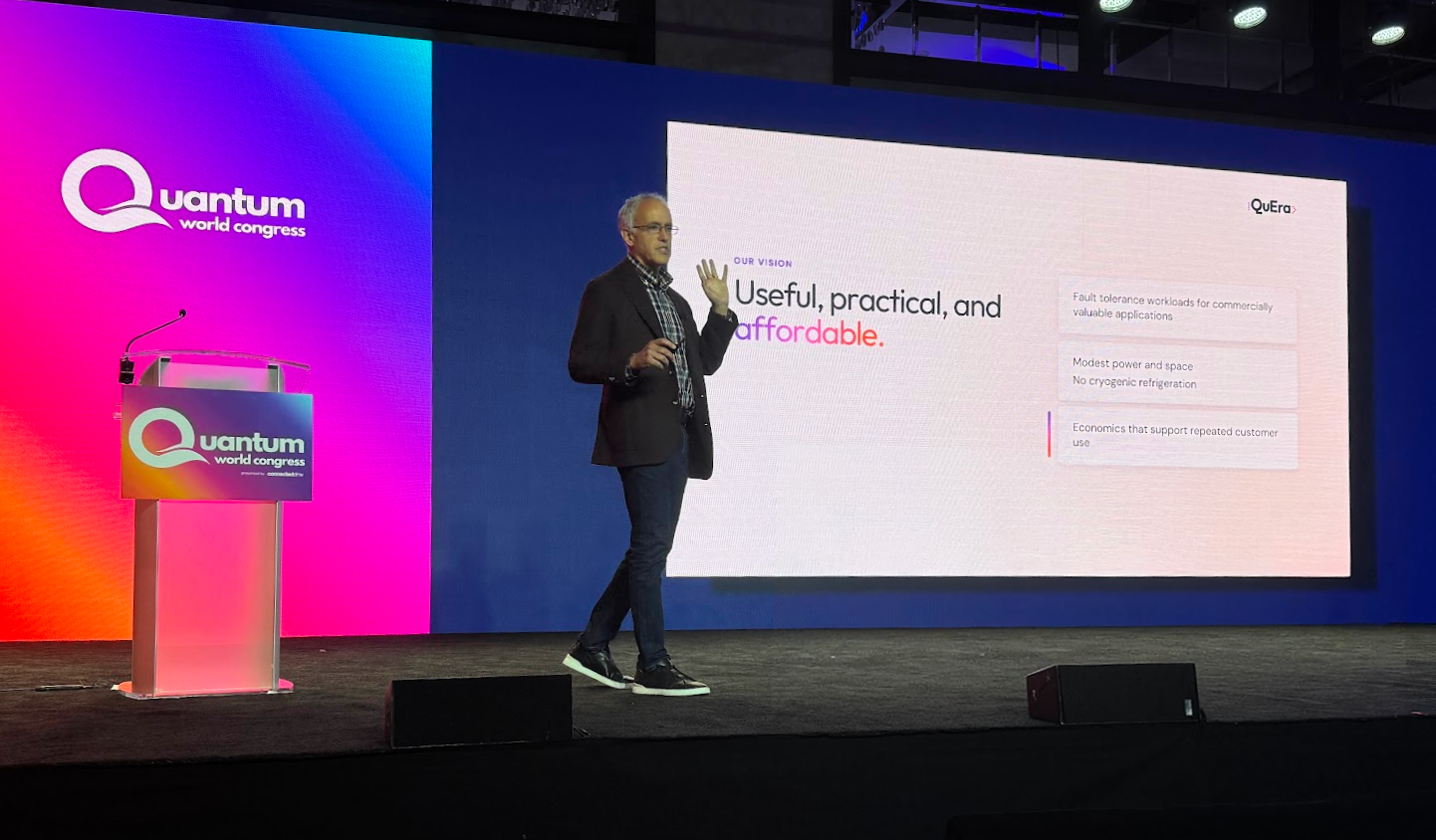
That was the focus of a Quantum World Congress 2026 panel moderated by Constanza M. Vidal Bustamante of the Center for a New American Security (CNAS), whose recent report maps vulnerabilities across quantum’s enabling technologies. She was joined by Nate Gemelke, co-founder of QuEra Computing; Joseph Broz of IBM Quantum; Sara O’Rourke of JPMorganChase; and Melissa LaReau of the U.S. Department of Commerce.
Lasers, crystals and the physics of supply
QuEra builds quantum computers from neutral atoms. Each atom is laser-cooled and held in an optical tweezer inside a vacuum chamber, and that process is repeated until there are thousands of qubits. Blocks of those physical qubits are then combined into error-corrected logical qubits.
As Nate put it, if you count how often the word “laser” appears in that description, you understand where QuEra’s supply chain concerns begin.
A quantum computer’s performance has two axes: how many qubits it has, and how many gate operations each qubit can perform before an error occurs. Lasers drive both. Brighter lasers and narrower linewidths push a neutral-atom system further along each axis.
The vulnerabilities sit several layers below the laser itself:
- Optical fiber. Many lasers are built from optical fiber pulled in draw towers, and a large share of that production capacity sits in China.
- Specialized crystals. Optics and photonics depend on crystals that grow slowly. “The world’s production rate of certain optical crystals is limited by the physics of crystal growth,” Gemelke said.
- Raw materials. The ovens used to grow those crystals require materials such as iridium, which are in limited global supply and carry their own trade exposure.
IBM’s Joseph Broz described a parallel picture for superconducting qubits: dilution refrigerators, helium-3, and cables and connectors that often lack performance specifications at millikelvin temperatures. Longer term, he argued, the biggest obstacle is reducing the cost, size, weight and power per qubit channel, likely by integrating today’s discrete components into monolithic blocks, as electronics did decades ago.
From enabling technology to auto parts
The most interesting part of Nate's argument is that progress in quantum error correction is changing the supply chain question itself.
Over the past year, error correction has improved so quickly that the bar for a useful quantum computer has moved down. Requirements that once pointed to a million physical qubits now point to perhaps a hundred thousand, or even tens of thousands. That means the lasers do not need to be quite as extreme as once thought.
It does not mean the problem goes away. It changes shape. “We used to think that we needed to produce really very, very bright lasers,” Nate said. “Now we’re realizing maybe we also need to be making reliable lasers.”
He described this as becoming a victim of your own success. When a technology becomes useful, more people want it. Components that were once exotic enabling technologies now have to be sourced the way a carmaker sources parts: on a schedule, with predictable quality, in volume.
Nate named the biggest gap plainly: intelligence into the supply chain. A single company can push hard on its direct suppliers, but it is difficult to see several layers deep, to the fiber, the crystal and the iridium. Understanding those dependencies, and choosing the right interventions, is work that takes years.
“Even if you say, ‘Well, utility is years away,’ you have to get started working on those problems now.”
He also pointed out that Broz’s view complemented his own. If the supply chain is a literal chain, Nate had focused on the links, while Broz focused on what connects them: testing, standards and interfaces. Investing in those connections, not only in individual companies, may be one of the most effective policy levers available.
Demand signals, prizes and people
The second half of the panel turned to policy. The moderator noted that a June executive order on quantum innovation dedicated a full section to supply chains, directing Commerce to analyze them and asking agencies to plan partnerships with industry on domestic enabling components.
Sara O’Rourke, who spent two years at the CHIPS Program Office before joining JPMorganChase’s Security and Resiliency Initiative, drew on the semiconductor experience. The U.S. now has fabs going up but still lacks suppliers building out matching capacity, partly because the manufacturing tax credit does not extend to suppliers. Her conclusion for quantum: fund the picks and shovels that serve multiple modalities, while also pushing toward utility scale. Do both, and iterate.
Melissa LaReau of the International Trade Administration outlined two tools named in the executive order. Prize challenges reward whoever reaches a goal first or within a set time. Advance market commitments guarantee future demand. Both reduce risk for suppliers.
Nate said each tool speaks to a different half of him: the business person and the scientist.
Advance market commitments are good business. For a company on the cusp of usefulness, guaranteed demand is a major help. Government also has many real problems to solve, and the right problem is what turns a capability into value.
Prizes speak to the scientist. Nate recalled choosing physics as a teenager after reading a quantum mechanics textbook, and the story of the 1714 Longitude Act, when Britain offered a prize for a clock accurate enough for navigation at sea. The idea that a nation would care enough about a technical problem to offer a prize is inspiring. Prizes may not always pencil out in a boardroom, since winning might require building a $100 million machine and splitting the award. But the reputation that comes with winning has its own value.
The common thread, he said, is that “the most important thing in the supply chain are the people and the passion that they come in with.”
Broz and O’Rourke both backed advance market commitments. O’Rourke described a chicken-and-egg problem across supply chains: private capital needs long-term demand commitments before it flows, and with multiple quantum modalities still competing, government is best placed to send that first demand signal.
Success is the starting point
To close, each panelist named one thing that should happen in the next year. LaReau pointed to regional quantum ecosystems. Broz and O’Rourke called for advance market commitments and the reauthorization of the National Quantum Initiative Act.
Nate's answer was about mindset: “Internalize the fact that success is the starting point, it’s not the ending point.” Reaching utility is not the finish line. It is the beginning of a new chapter in an accelerating pace of technology development, one in which components have to be built, delivered and relied on like any other industrial product.
For quantum’s supply chain, that chapter is already starting. Crystals grow slowly. Supplier capacity takes years to build. The time to map the dependencies and close the gaps is before demand arrives, not after.
Watch the full panel below.