




.webp)
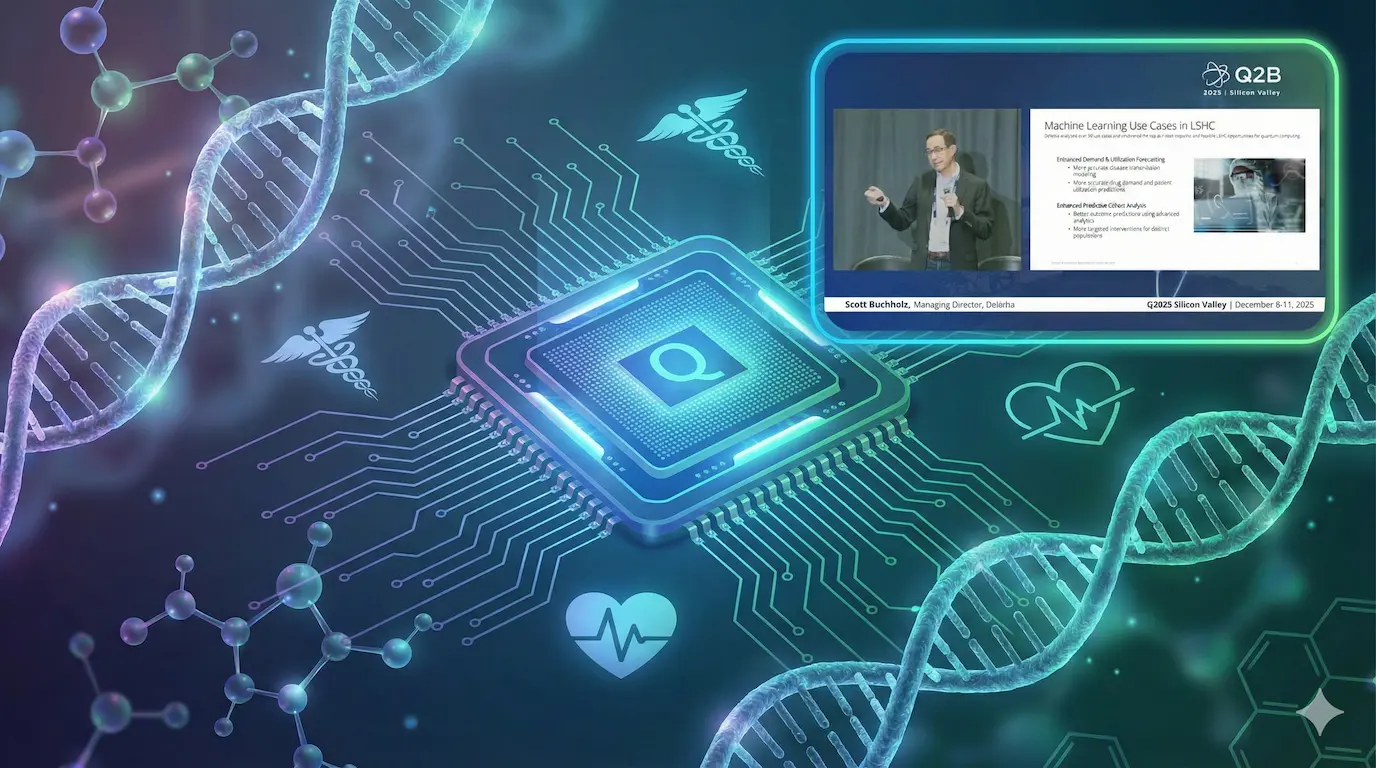
At Q2B Silicon Valley 2025, Scott Buchholz, who leads Deloitte's quantum computing efforts, presented findings from their comprehensive analysis of quantum use cases in life sciences and healthcare. The insights challenge some common assumptions about where quantum will have the biggest impact.
Deloitte is a QuEra partrner and we are delighted to share their perspective.
Beyond the Obvious: It's Not Just Drug Discovery
When most people think quantum computing and healthcare, they think molecular simulation for drug discovery. That's valid—but it's not the whole picture.
"I think that in many cases what we find is people assume that the use cases all fall in pharmaceuticals, that they all fall in quantum chemistry," Buchholz noted. "Interestingly enough, there are lots of different ways to solve problems in pharmaceuticals... and quantum is one of them, and it has a particular place."
Deloitte's weighted ranking analysis—scoring use cases across dimensions like speed impact, accuracy requirements, and business value—surfaced three distinct categories where quantum computing shows promise: optimization, machine learning, and simulation.
Optimization: The Unexpected Heavyweight
The analysis revealed far more optimization problems in life sciences and healthcare than Buchholz himself expected going in.
Consider clinical trial design. As pharmaceutical companies increasingly target rare conditions, finding the right patient population becomes a complex optimization challenge.
"In order to get your approval to actually use your drug and sell your drug in the market, you have to run tests to validate the efficacy," Buchholz explained. "You need to find a population that has the condition, that is near a set of medical centers that can actually administer the drugs, that can collect the data to the level that you need in order to prove to the drug administrations that the drug is actually safe and effective. And so that actually winds up becoming a very complex optimization problem."
Workforce scheduling in hospitals and manufacturing plants also emerged as a key use case—problems complicated by vacations, sick days, seasonal demand spikes, and the need for predictive planning.
Machine Learning: Accuracy Over Speed
Quantum machine learning's potential advantage lies in achieving higher accuracy with less training data. This makes it particularly relevant for problems where precision matters more than real-time results.
Two applications stood out:
Demand estimation — Hospitals need to predict patient volumes for staffing. Pharmaceutical manufacturers need to forecast condition prevalence to plan supply chains. Better predictions ripple through entire operations.
Cohort analysis for clinical trials — Determining optimal patient selection criteria, testing duration, and disease progression thresholds involves complex decisions that accumulate learning over time. "Many of those are learned over time," Buchholz said, "and therefore there are a number of places where machine learning becomes an interesting tool in the toolkit."
Simulation: The Precision Challenge
This is where quantum's original promise—solving chemistry problems—comes into focus. But the framing matters.
Modern drug development isn't just about finding molecules that work. It's about finding molecules that work precisely.
"What you're trying to do is actually say a protein has a very complex three-dimensional shape," Buchholz explained. "And I want my drug to be able to attack a particular protein in a particular way, in a particular spot in the body, and only that protein, in only that spot, at only that time."
The alternative? "Dirty" drugs with side effects that get compounds rejected by regulators.
Advanced approaches now combine quantum simulation with AI techniques—using machine learning to narrow search spaces, running exact quantum calculations, then feeding results back into models for further refinement.
Risk Modeling: A Uniquely American Use Case
For U.S. audiences, Deloitte also highlighted insurance applications. Life and health insurers manage complex financial models for underwriting and risk assessment. Many of these fit Monte Carlo analysis techniques that larger quantum computers will eventually accelerate.
The Bottom Line
Deloitte's analysis distilled more than 50 use cases down to the highest-potential applications. The full study runs about two dozen pages for those who want the details.
What's clear: quantum's healthcare impact won't be limited to computational chemistry. Optimization and machine learning applications may arrive just as quickly—and in some cases, sooner.
Scott Buchholz leads Deloitte's quantum computing practice. This summary is based on his presentation at Q2B Silicon Valley 2025.
Watch the full video here:
.jpg)