


.webp)
At Q2B Silicon Valley 2025, QuEra's Trevor Chaloux walked attendees through the fundamentals of neutral atom quantum computing—and why this platform is uniquely positioned for large-scale fault tolerance.
Here's what you need to know.
How Neutral Atom Quantum Computers Work
QuEra's systems use individual rubidium atoms as qubits, trapped and manipulated by precisely controlled lasers. The rubidium atom has a single outer electron—and it's the energy state of that electron that encodes quantum information.
Trevor highlighted two key mechanisms:
Single-qubit operations use the atom's hyperfine ground states. These states are exceptionally stable, resulting in coherence times measured in seconds—a distinctive property of atomic qubits.
Two-qubit entangling operations work by driving atoms into a high-energy Rydberg state. When two atoms are positioned within each other's "blockade radius" and driven into this state together, only one can reach it—but both become entangled.
The breakthrough: these atoms can be physically moved. Optical tweezers shuttle qubits into position for gate operations, enabling highly parallel execution. Multiple entangling gates happen simultaneously across the array, with precise control over which qubits participate.
A video demonstration showed this choreography in action—qubits flowing through coordinated movements, executing circuits with remarkable efficiency.
Why This Architecture Excels at Error Correction
Fault-tolerant quantum computing demands three things: high-quality qubits, high-quality multi-qubit gates, and massive parallelization. Neutral atoms deliver all three.
The stability of hyperfine ground states protects data. The Rydberg-based entangling operations achieve the fidelities error correction requires. And the parallelization—in both movement and gate operations—accelerates the repeated cycles that logical operations demand.
The key differentiator: transversal gates. In many error-correcting codes, underlying physical qubits must interact in correlated patterns. Fixed architectures typically require complex lattice surgery. Neutral atoms can move entire blocks of physical qubits on top of each other and run a single operation—dramatically reducing time and space overhead.
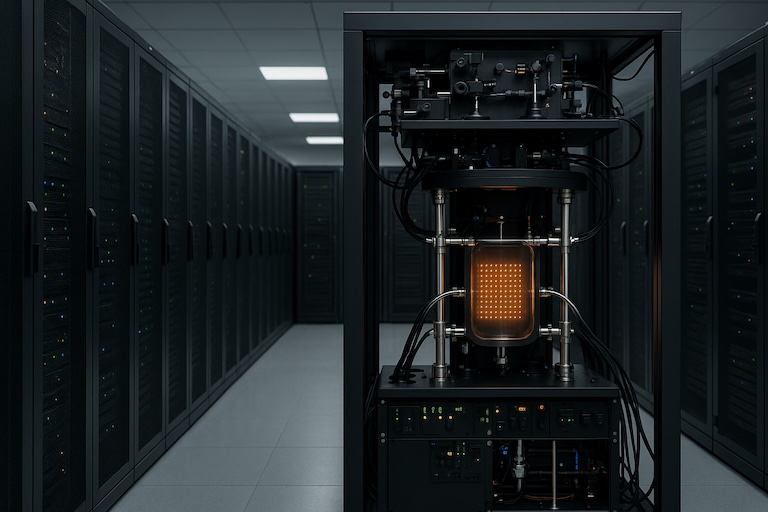
Beyond computation, Trevor noted deployment advantages. The atoms themselves are ultra-cold, but the surrounding hardware operates at room temperature. This means smaller physical footprint, lower energy consumption, and easier co-location with classical computing resources.
Experimental Demonstrations: Building the Case
Trevor walked through the progression of published work that has systematically proven each building block of fault-tolerant operation:
Zoned architecture for logical operations: A landmark demonstration, led by collaborators at Harvard on Harvard hardware, showed how neutral atoms with reconfigurable zones can execute logical operations. This set the foundation for QuEra's error-correction-focused system design.
Magic state distillation: The first experimental demonstration of high-quality T-gates from a logical layer—essential for universal quantum computation. This work was performed on QuEra hardware in collaboration with Harvard researchers.
Scaling analysis: A theoretical paper from QuEra and Harvard teams showed how this error-corrected architecture scales to very large problems, using Shor's algorithm as the benchmark application.
Reducing overhead (2025): Two recent Nature papers addressed the practical challenges of scale. One demonstrated transversal operations for highly parallel logical gates. The other introduced algorithmic fault tolerance—applying syndrome extraction at the algorithmic level rather than individual operations. A third paper tackled classical overhead with ML-based decoders to reduce error correction latency.
Recent Research: Scaling the Platform
Trevor closed by highlighting three papers that have been widely discussed across the quantum computing community:
Continuous operation with 3,000 qubits: Research from Misha Lukin's group at Harvard demonstrated that atoms can be continuously reloaded during computation. Atom loss from shuttling was a known bottleneck—this work showed the path to the deep circuits real applications require.
6,000 qubits in a single array: Work from Caltech demonstrated atoms held coherently for over 12 seconds, with the field of view for optical tweezers continuing to expand.
Universal fault-tolerant architecture: The most recent paper from Harvard brought all the pieces together—magic state distillation, qubit reuse, continuous reloading, and teleportation across dozens of logical qubits operating in a single system. As Trevor described it: "a culmination of the work over the last two years, showing that on the neutral atom platform, these pieces can work not just in isolation, but all together."
Applications on Aquila Today
QuEra's analog system, Aquila, has been available on Amazon Braket for three years. Built from pioneering research in Misha Lukin's lab at Harvard—which demonstrated a 256-qubit analog system—QuEra completed the commercial transfer and deployed to the cloud within a year.
Over 20 papers have been published by customers using the system, exploring optimization (including max independent set problems), quantum phase transitions, quantum reservoir computing for machine learning, and quantum dynamics simulations.
The Bloqade SDK supports this work with analog mode for Hamiltonian simulations, Kirin for digital circuit compilation, and Bloqade-Shuttle for optimizing qubit movement sequences.
Looking Ahead
QuEra was founded by scientists from Harvard and MIT's lab for ultra-cold atoms, and continues to collaborate closely with those research groups. Earlier this year, the company completed a Series B round with investment from SoftBank, NVIDIA, and Google.
The experimental demonstrations Trevor presented point to a clear conclusion: neutral atoms have the architectural properties fault-tolerant quantum computing requires. High-quality atomic qubits. Reconfigurable arrays. Massively parallel operations. Transversal gates. Room-temperature deployment.
As Trevor put it: "We think it's a very clear and promising path forward to continue to push neutral atoms towards delivering what we think will be the first large-scale fault-tolerant quantum computer."
Watch the full tutorial here: