

-compressed.jpg)


.webp)
Quantum computers are moving from laboratory curiosities to practical accelerators that can slot alongside CPUs, GPUs, and AI ASICs. For HPC managers, the question is no longer if but how to integrate quantum resources without disrupting mission-critical workflows. This deep-dive outlines the technical, operational, and organizational considerations you should address now to ensure a smooth, value-driven adoption path.
1 | Clarify the Integration Goal
Before allocating budget or rack space, pinpoint why you are adding quantum capability. Common drivers include:
- Targeted optimization acceleration (supply-chain, portfolio risk modeling, scheduling), where quantum can offer advantages for specific, carefully selected problems.
- Higher-fidelity simulations (materials, chemistry, energy)
- Strategic R&D positioning (keeping pace with peer institutions)
Each goal implies different hardware modalities, software stacks, and success metrics.
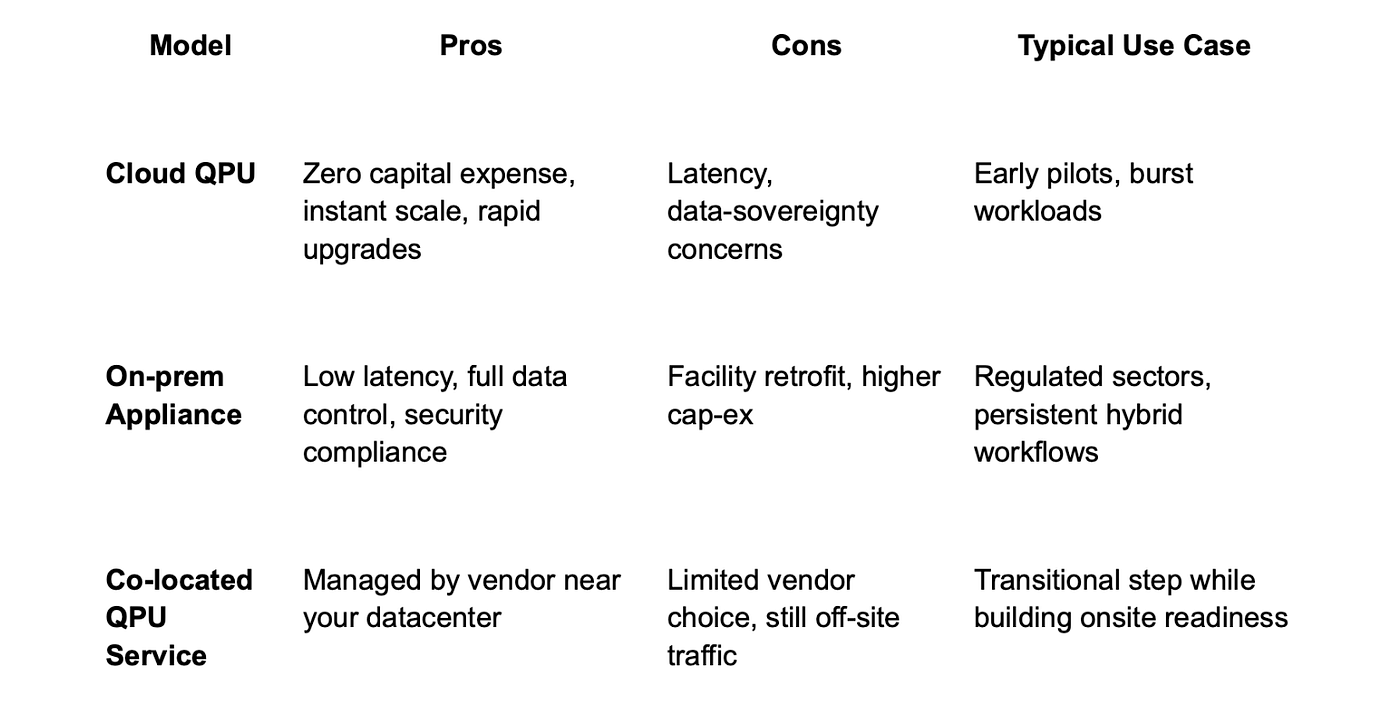
2 | Choose Your Access Model
3 | Hardware & Facility Readiness
Power & Cooling Quantum systems span liquid-helium cryostats (superconducting), UHV glass cells (neutral-atom), and room-temperature photonics. Identify:
- Power density vs. existing rack allocation.
- Thermal budget — cryogenic plants can draw tens of kW; neutral-atom rigs <5 kW.
- Vibration & EMI isolation requirements.
Networking Aim for low-latency networking (<10 µs optimal, <100 µs acceptable) between classical HPC nodes and QPU controllers for efficient hybrid iterations. Dual-home QPU controllers on both management and high-speed fabrics (InfiniBand/NVLink) when possible.
Security & Compliance Map QPU rooms into existing badge, camera, and fire-suppression zones. For cloud access, ensure the provider’s SOC 2/ISO 27001 scope covers quantum resources.
4 | Software Stack Alignment
- SDK & Language Python still dominates (Qiskit, Cirq, Braket, Bloq). Ensure containerized builds and CI pipelines mirror your HPC module system.
- Compiler & Optimizer Look for hardware-aware transpilers that minimize depth and gate count.
- Simulator Tier Allocate GPU nodes for tensor-network or state-vector simulation to unit-test circuits at scale.
- Workflow Orchestration Expose QPU as a Slurm Gres or PBS resource so batch jobs request gpu=8,qpu=1seamlessly.
Practical tip: Adopt an abstraction layer (e.g., OpenQASM 3 or QuEra Bloq) to future-proof against vendor lock-in.
5 | Hybrid Workflow Blueprint
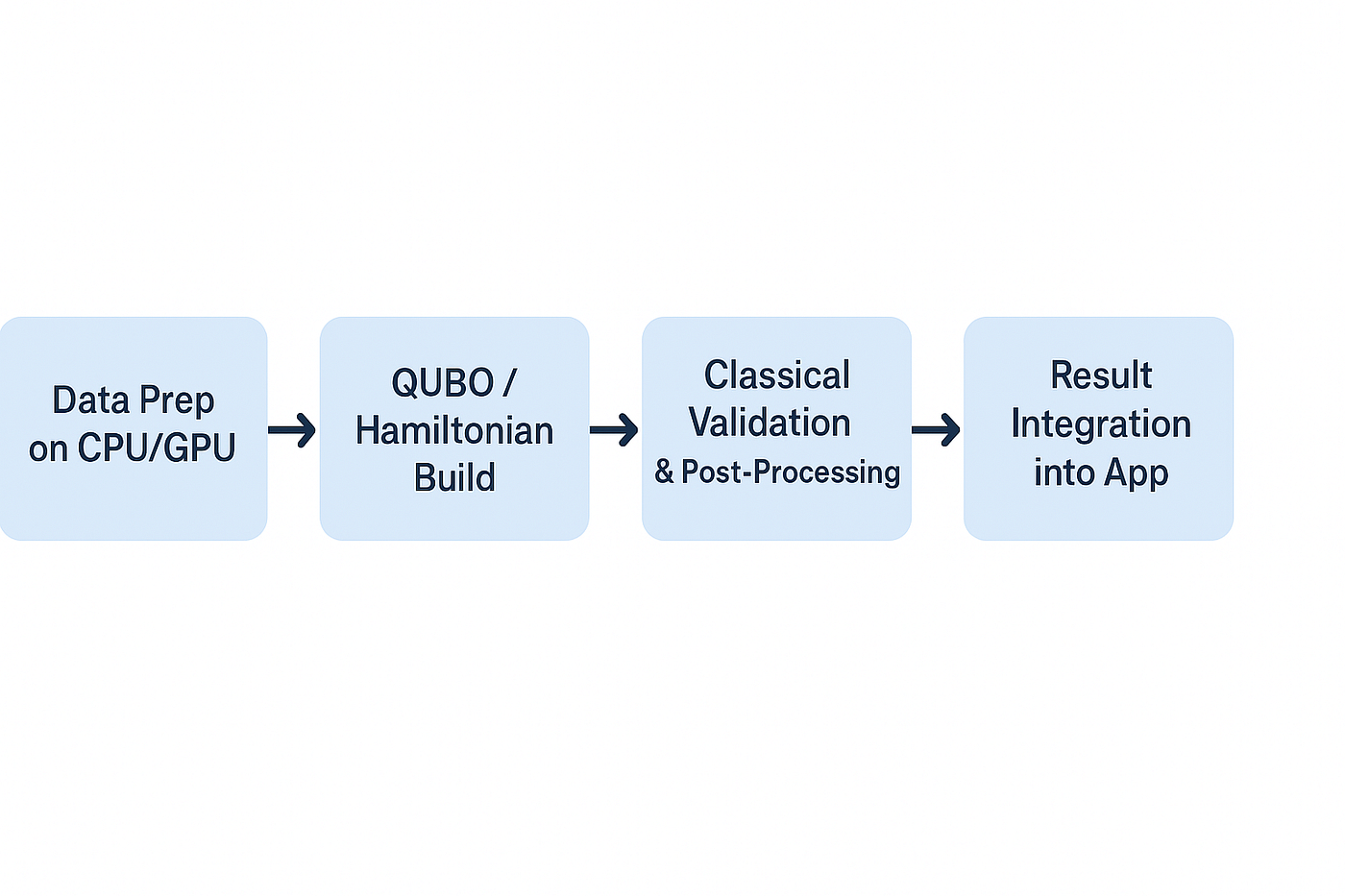
Key checkpoints:
- Chunk sizes — quantum kernel runtimes should typically remain <100 ms to minimize decoherence, scheduling overhead, and system-level latency.
- State hand-off — serialize intermediate data in Apache Arrow or HDF5 for zero-copy moves between CPU/GPU nodes and the QPU controller.
6 | Performance & Benchmark KPIs

7 | People & Process Readiness
- Skill Uplift Upskill at least two HPC engineers in quantum SDKs; pair them with domain scientists for pilot ownership.
- Change Management Incorporate QPU outages into maintenance windows; update incident runbooks for cross-team triage.
- Vendor Governance Establish quarterly roadmap reviews with the quantum provider; tie milestones to SLA credits.
8 | Procurement & Risk Mitigation
- Phase 0 — Discovery Free cloud sandbox; define KPIs.
- Phase 1 — Pilot $25 k–$100 k cloud spend; prove hybrid acceleration ≥2× classical baseline.
- Phase 2 — Pre-Production Annual commit or co-located appliance; secure budget for facility upgrades.
- Phase 3 — Production On-prem QPU cluster; multi-vendor redundancy.
Risk levers: hedged subscription terms, exit clauses, and shared-IP agreements on co-developed algorithms.
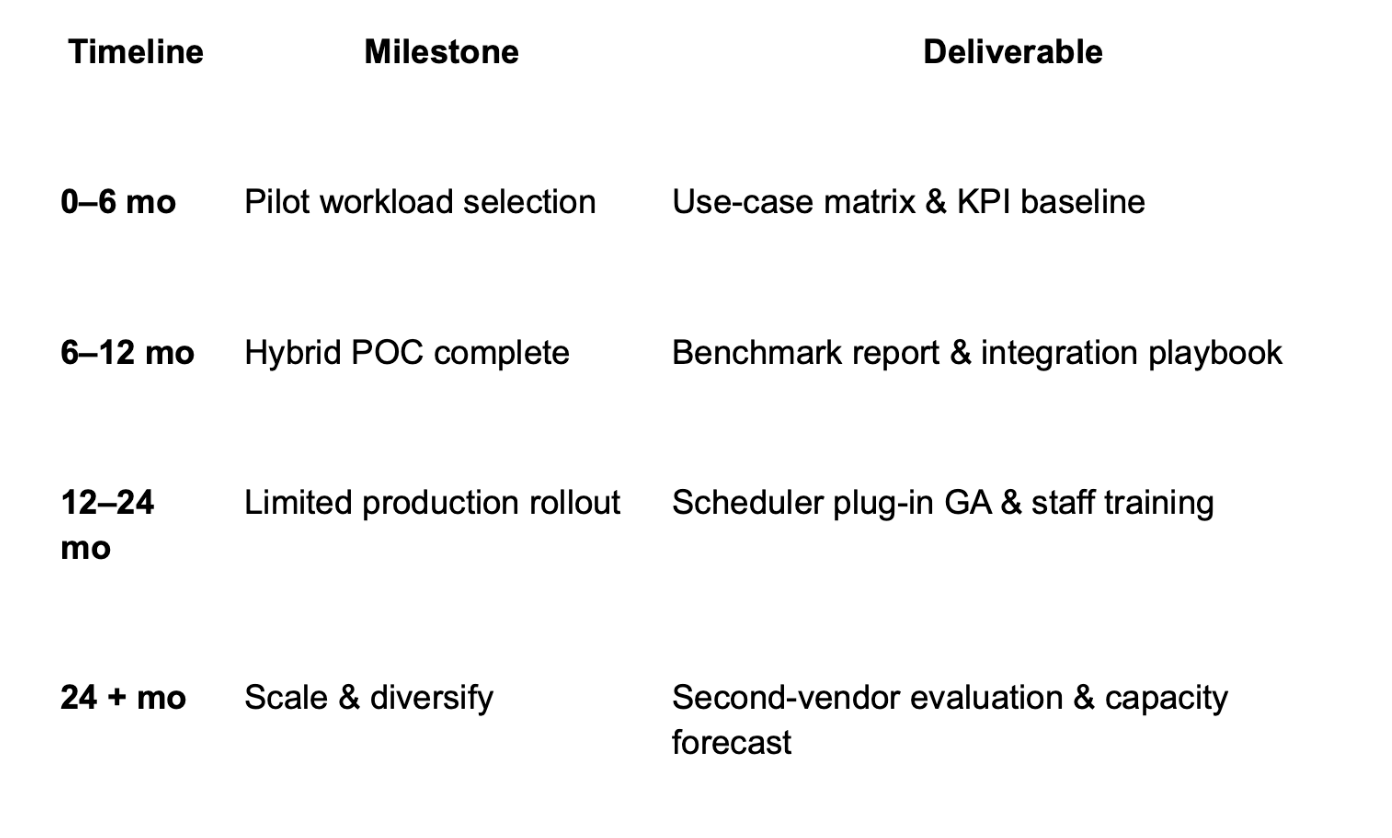
9 | Roadmap & Next Steps
10 | Key Takeaways
- Start with small, clearly scoped pilots in the cloud; move on-prem only when value > cost.
- Judge hardware on quality (fidelity, coherence) not just qubit count.
- Integrate QPUs into existing schedulers for minimal workflow disruption.
- Build a cross-functional team early — operators, domain scientists, security, finance.
QuEra’s neutral-atom quantum processors are designed specifically for smoother HPC integration, featuring compact, rack-compatible footprints, stable laser-controlled qubits with high coherence and fidelity, and flexible SDK integrations supporting standard HPC schedulers such as Slurm, PBS Pro, and Kubernetes. Reach out for a tailored readiness assessment.
For further reading:
- “Quantum Computing for HPC Centers — A Concise Buyer’s Guide” — InsideHPC (2024)