arrow left

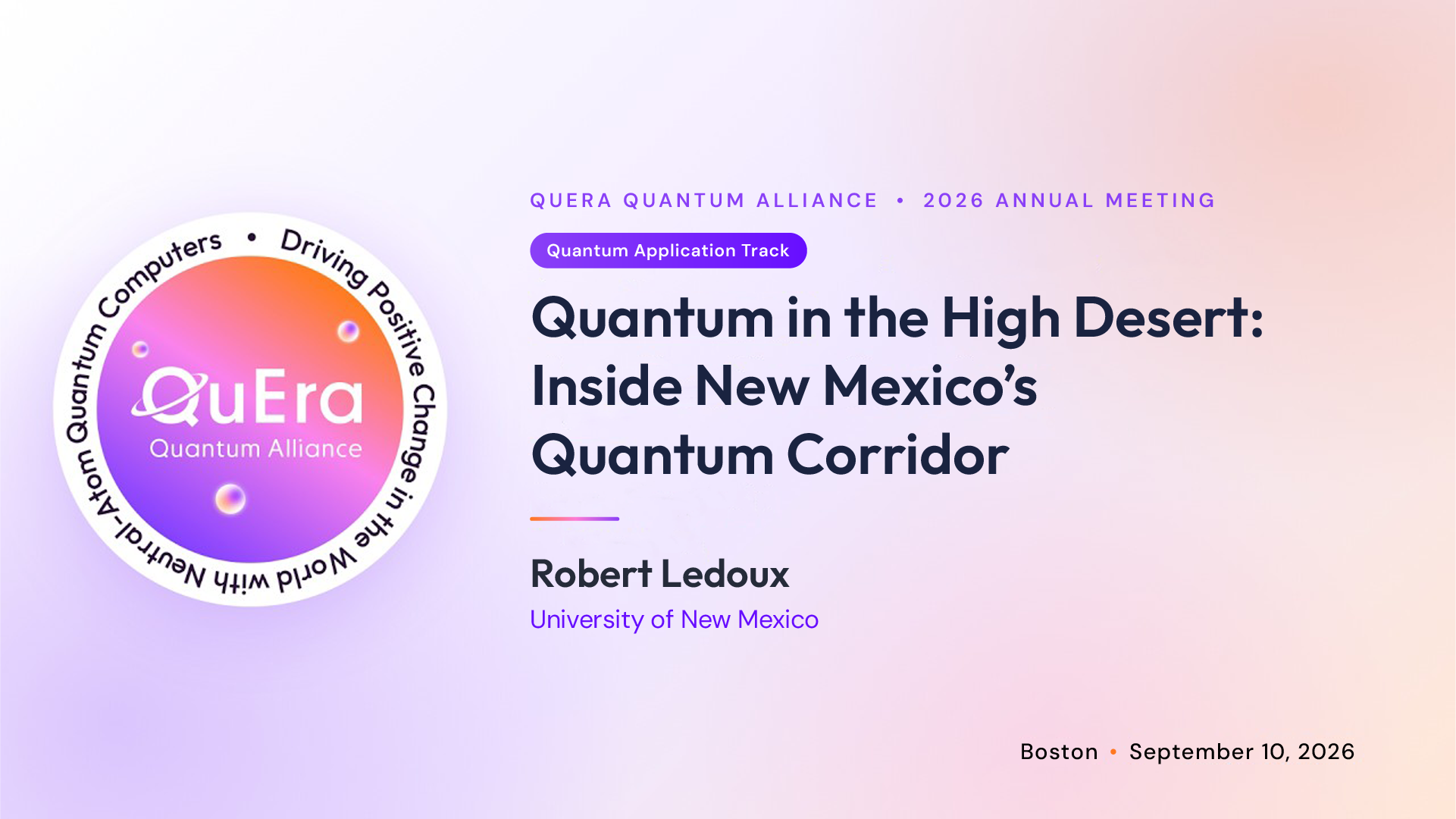
Quantum in the High Desert: Inside New Mexico's Quantum Corridor

calender icon
November 19, 2026
clock icon
min read
Customers and partners
Share

The University of New Mexico's foundation asked a reasonable question: why should we give money to the quantum program? To answer it, the program did something it had never done in 26 years of existence. It counted its own alumni.

More than 100 PhDs and postdocs have come out of the theory group since it was founded. The first finding surprised the faculty: the large majority went into industry, not into academia and not into the two national laboratories sitting an hour up the road. The second finding is the one that reframed the conversation.

"It's not that we don't have the talent, it's not that we don't produce ideas, it's just that people go elsewhere," said Robert Ledoux, Director of the Quantum New Mexico Institute (QNM-I).

Almost none of them stayed in New Mexico. That single slide, presented at a recent QuEra Quantum Alliance gathering, is the clearest statement of what the state is now spending against. New Mexico has never had a talent problem. It has had a retention problem, and it is trying to buy its way out of one with public dollars.

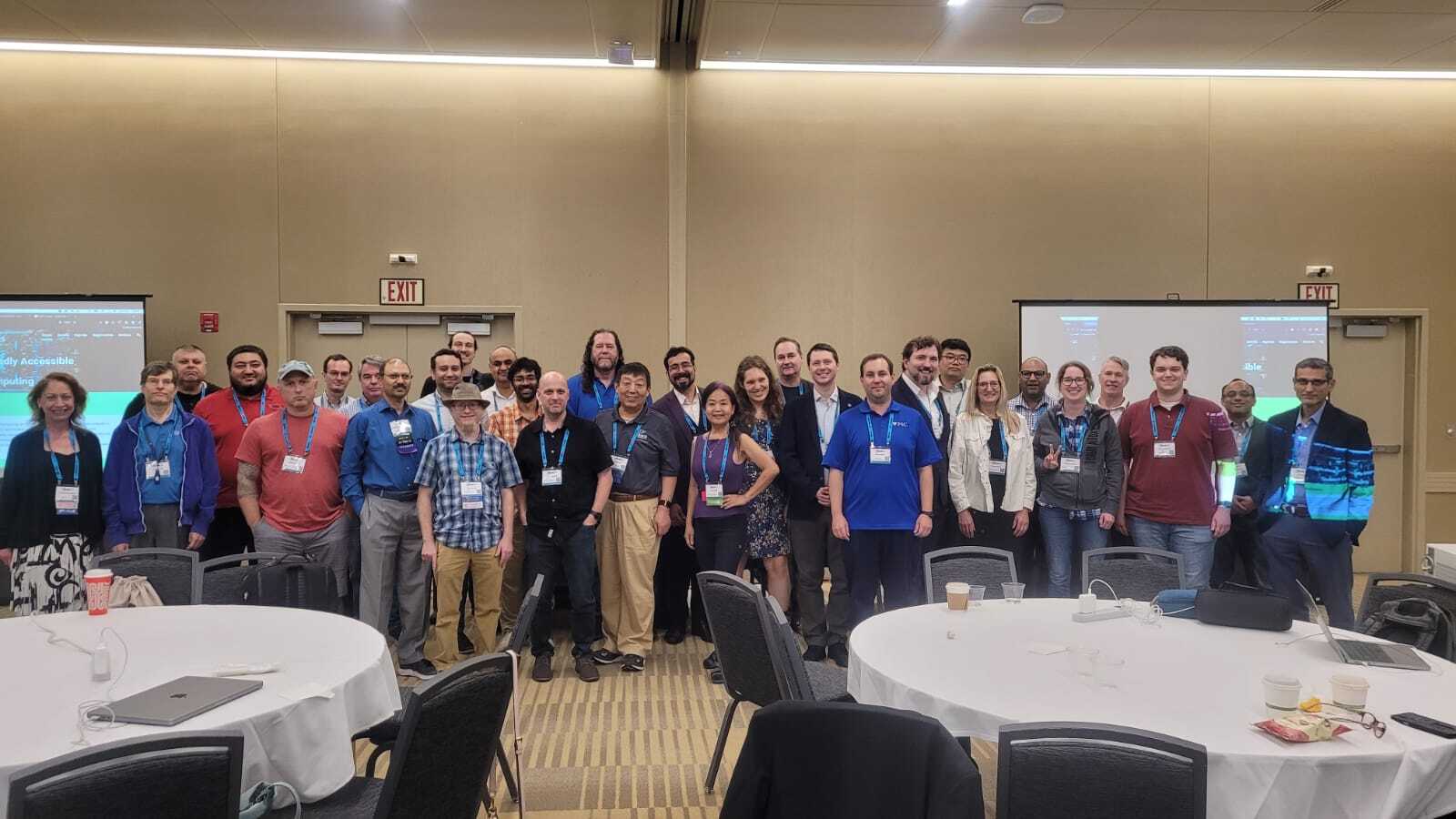
This post draws on a talk by Robert Ledoux, Director of the Quantum New Mexico Institute, and remarks from Nate Gemelke, co-founder and Chief Technology Strategist at QuEra, at the QuEra Quantum Alliance 2026 Annual Meeting (QQA 2026).

A Structure the University Had Not Tried Before

The Quantum New Mexico Institute, QNM-I, is a partnership between the University of New Mexico and both national laboratories in the state, Los Alamos and Sandia. Ledoux described the arrangement as a first for UNM and noted that it is uncommon nationally. Universities partner with a lab. Partnering with two, formally, is a different structure.

The practical effect is that QNM-I spans two domains at once, the purely commercial and the national security side, and Ledoux argued the overlap between what each wants from quantum computing is close to total. Some work happens behind the fence, but there is almost always a surrogate problem on the open side. The institute also sits in a state with an unusual concentration of quantum information science professionals, by Ledoux's account more than any other state in the country, with roughly 300 research scientists associated with QNM-I.

What makes QNM-I's mandate distinctive is that the state, the university, and the labs all wanted the same thing from it, and it was not a research engine. They wanted economic development.

Three Pillars, All of Them Funded

QNM-I is organized around three funded pillars.

Research and development, conducted with the two national labs and with companies joining the ecosystem. UNM's own strength here is foundational QIS and quantum materials. Los Alamos, in Ledoux's framing, is the strongest of the labs on applications and is working to push as much of that work outside the fence as it can. Sandia brings hardware depth and the Quantum Performance Laboratory, with testbeds spanning trapped ions, superconducting qubits, and neutral atoms.

Education and workforce, deliberately built at every level rather than at the top. New Mexico stood up what Ledoux described as the country's first technician training program specific to atomic, molecular, and optical physics. Above that sit undergraduate pathways, PhD programs, and what may be the largest reeducation effort in the ecosystem: several hundred lab scientists who did not start their careers in quantum information science and are now working in it.

Translation, which Ledoux called the piece that is genuinely new to UNM. Getting ideas out of a university or a national lab is, in his experience running programs at ARPA-E, extremely difficult: the mechanisms are thin and the incentives rarely line up. UNM's answer includes a new nonprofit, Global Catalyst, set up specifically to develop IP collaboratively, hold it outside the university's own structures, and keep it in the state. The ambition for the shared lab facility is an accelerator rather than an incubator. Bring a developed idea, move it faster, and build it where you are.

Where the Money Is

The pillars are not aspirational line items. Ledoux walked through the funding directly, and the numbers are worth seeing in one place.

Commitment Amount Purpose
Quantum Ventures Studio and Quantum Lab $25 million Shared user facility with cryogenic cooling, substantial power, and vibration-controlled rooms
QuEra quantum demonstration facility $4 million QuEra's own build-out inside the Quantum Lab
Matched R&D funding ~$150 million Matching money available between the federal government and companies
State match for quantum benchmarking at Sandia $60 million Paired with federal benchmarking work
Sovereign wealth fund allocation $50 million Earmarked specifically for quantum investment
QNM-I operating funding $5 million The institute itself

Two features of that table matter more than the totals. The first is speed: proposals against the matched R&D pool get a decision in under a month, which is not how most public research money moves. The second is that a meaningful share of it is aimed at applications rather than hardware, a gap Ledoux has spent years arguing the federal government leaves unfilled. A separate one-year, $10 million pool is currently open for quantum computing proposals, and Ledoux offered a back-of-envelope case for what that buys: if roughly $40,000 of compute time supports a frontline paper, the pool is 25 papers.

The state's decision-making style is part of the pitch, too. New Mexico does not work by committee, Ledoux said, but by convincing the right people. For companies used to multi-year public procurement cycles, that is either a feature or a risk, depending on temperament.

Why QuEra Went West

QuEra is based in Boston, roughly 2,000 miles from Albuquerque, and every state now has a quantum initiative. Nate Gemelke, QuEra co-founder and chief technology strategist, was direct about the constraint: the company cannot be everywhere, so the regional bets have to be deliberate.

New Mexico was an easy one. QuEra has worked with Los Alamos for years, and engages heavily with Sandia through QNM-I. And Ivan Deutsch, one of the field's foundational neutral-atom theorists, has been at UNM and in contact with QuEra's team for years. The relationships predated the investment by a long stretch; the state money made acting on them straightforward.

Gemelke framed QuEra's regional strategy in both of its home states as the same exercise applied to different strengths. In Massachusetts, that means a dense university system and a supply chain accelerator spinning up in the western part of the state. In New Mexico, it means the labs, the venture studio work aimed at seeding supply-chain companies, and proximity to national-security programs. In both, it means moving down the education ladder from PhD hiring toward the technicians who build, assemble, and operate machines. QuEra now operates from Boston, New Mexico, Tokyo, and the United Kingdom.

Half an Industry Across Two States

New Mexico does not stand alone in this. Elevate Quantum, the federally designated quantum tech hub spanning Colorado and New Mexico, ties the two states into a single cluster that its founder, Zachary Yerushalmi, estimates accounts for roughly half of the US quantum industry. The division of labor between them is clean: Colorado's strength is concentrated in industry, New Mexico's in the national laboratories and the national-security mission.

New Mexico's contribution to the hub's shared infrastructure is a photonics packaging facility aimed at rapid, low-volume work such as connecting fiber to an integrated circuit. That is a specific and unglamorous gap. Rapid prototyping for heterogeneous photonic components barely exists in the United States outside restricted lab environments, and integrated photonics is where both states have decided to push hardest.

Around all of this, Albuquerque is assembling the density that Ledoux thinks any ecosystem requires: the venture studio, both labs, the ABQ open quantum network linking them, and a growing set of companies with QuEra among them.

The Part Nobody Has Solved Yet

Here is where the story gets less tidy.

The workforce pipeline programs work, as far as they go. QCamp trains high school teachers through a boot camp and then brings a cohort of their students through as well; it is consistently oversubscribed, and 2026 high school demand was, in Ledoux's word, unbelievable. QReach places undergraduates in internships and is oversubscribed to the point that the program has turned people away for lack of funding. UNM's new provost and president have made reworking the QIS curriculum a top priority.

But the constraints are real, and Ledoux named them without much cushioning. Most federal money for the education pipeline has dried up. High school teachers, the people expected to introduce students to the field, often do not know what quantum is, which is exactly why QCamp starts with teachers rather than students. And the labor market on the other end is brutally tight.

"If you said, 'I want five applications people,' good luck," Ledoux said of hiring in the current market.

The deeper problem is that none of these programs has yet produced evidence on the question that motivated them. The alumni study measured 26 years of the past. Whether a technician program, a teacher boot camp, an accelerator, and a $50 million sovereign wealth fund allocation are enough to keep the next 100 graduates in the state is a question that cannot be answered for another decade. Ledoux is candid that the sustainability model is still being designed: what a user center actually is, what members pay for, whether they contribute cash or work in kind, and what holds it together through 2028 to 2030 once the initial capital is spent.

The honest status is that New Mexico has solved the funding problem, is midway through the infrastructure problem, and has not yet solved the retention problem. What has changed is that the state now knows precisely which problem it is trying to solve, and has put public money behind the attempt rather than a strategy document. For companies weighing where to build, the offer is unusually concrete: matched funding with a one-month answer, a shared facility already under construction, two national labs with deep QIS benches, and a state that would rather move fast than move by consensus.

Ledoux's own ask to the room was simpler than any of that. Come look, and bring a problem worth solving.
machine learning
with QuEra

Listen to the podcast
No items found.
Customers and partners

Quantum in the High Desert: Inside New Mexico's Quantum Corridor

November 19, 2026
min read
6 min read
Abstract background with white center and soft gradient corners in purple and orange with dotted patterns.

The University of New Mexico's foundation asked a reasonable question: why should we give money to the quantum program? To answer it, the program did something it had never done in 26 years of existence. It counted its own alumni.

More than 100 PhDs and postdocs have come out of the theory group since it was founded. The first finding surprised the faculty: the large majority went into industry, not into academia and not into the two national laboratories sitting an hour up the road. The second finding is the one that reframed the conversation.

"It's not that we don't have the talent, it's not that we don't produce ideas, it's just that people go elsewhere," said Robert Ledoux, Director of the Quantum New Mexico Institute (QNM-I).

Almost none of them stayed in New Mexico. That single slide, presented at a recent QuEra Quantum Alliance gathering, is the clearest statement of what the state is now spending against. New Mexico has never had a talent problem. It has had a retention problem, and it is trying to buy its way out of one with public dollars.

This post draws on a talk by Robert Ledoux, Director of the Quantum New Mexico Institute, and remarks from Nate Gemelke, co-founder and Chief Technology Strategist at QuEra, at the QuEra Quantum Alliance 2026 Annual Meeting (QQA 2026).

A Structure the University Had Not Tried Before

The Quantum New Mexico Institute, QNM-I, is a partnership between the University of New Mexico and both national laboratories in the state, Los Alamos and Sandia. Ledoux described the arrangement as a first for UNM and noted that it is uncommon nationally. Universities partner with a lab. Partnering with two, formally, is a different structure.

The practical effect is that QNM-I spans two domains at once, the purely commercial and the national security side, and Ledoux argued the overlap between what each wants from quantum computing is close to total. Some work happens behind the fence, but there is almost always a surrogate problem on the open side. The institute also sits in a state with an unusual concentration of quantum information science professionals, by Ledoux's account more than any other state in the country, with roughly 300 research scientists associated with QNM-I.

What makes QNM-I's mandate distinctive is that the state, the university, and the labs all wanted the same thing from it, and it was not a research engine. They wanted economic development.

Three Pillars, All of Them Funded

QNM-I is organized around three funded pillars.

Research and development, conducted with the two national labs and with companies joining the ecosystem. UNM's own strength here is foundational QIS and quantum materials. Los Alamos, in Ledoux's framing, is the strongest of the labs on applications and is working to push as much of that work outside the fence as it can. Sandia brings hardware depth and the Quantum Performance Laboratory, with testbeds spanning trapped ions, superconducting qubits, and neutral atoms.

Education and workforce, deliberately built at every level rather than at the top. New Mexico stood up what Ledoux described as the country's first technician training program specific to atomic, molecular, and optical physics. Above that sit undergraduate pathways, PhD programs, and what may be the largest reeducation effort in the ecosystem: several hundred lab scientists who did not start their careers in quantum information science and are now working in it.

Translation, which Ledoux called the piece that is genuinely new to UNM. Getting ideas out of a university or a national lab is, in his experience running programs at ARPA-E, extremely difficult: the mechanisms are thin and the incentives rarely line up. UNM's answer includes a new nonprofit, Global Catalyst, set up specifically to develop IP collaboratively, hold it outside the university's own structures, and keep it in the state. The ambition for the shared lab facility is an accelerator rather than an incubator. Bring a developed idea, move it faster, and build it where you are.

Where the Money Is

The pillars are not aspirational line items. Ledoux walked through the funding directly, and the numbers are worth seeing in one place.

Commitment Amount Purpose
Quantum Ventures Studio and Quantum Lab $25 million Shared user facility with cryogenic cooling, substantial power, and vibration-controlled rooms
QuEra quantum demonstration facility $4 million QuEra's own build-out inside the Quantum Lab
Matched R&D funding ~$150 million Matching money available between the federal government and companies
State match for quantum benchmarking at Sandia $60 million Paired with federal benchmarking work
Sovereign wealth fund allocation $50 million Earmarked specifically for quantum investment
QNM-I operating funding $5 million The institute itself

Two features of that table matter more than the totals. The first is speed: proposals against the matched R&D pool get a decision in under a month, which is not how most public research money moves. The second is that a meaningful share of it is aimed at applications rather than hardware, a gap Ledoux has spent years arguing the federal government leaves unfilled. A separate one-year, $10 million pool is currently open for quantum computing proposals, and Ledoux offered a back-of-envelope case for what that buys: if roughly $40,000 of compute time supports a frontline paper, the pool is 25 papers.

The state's decision-making style is part of the pitch, too. New Mexico does not work by committee, Ledoux said, but by convincing the right people. For companies used to multi-year public procurement cycles, that is either a feature or a risk, depending on temperament.

Why QuEra Went West

QuEra is based in Boston, roughly 2,000 miles from Albuquerque, and every state now has a quantum initiative. Nate Gemelke, QuEra co-founder and chief technology strategist, was direct about the constraint: the company cannot be everywhere, so the regional bets have to be deliberate.

New Mexico was an easy one. QuEra has worked with Los Alamos for years, and engages heavily with Sandia through QNM-I. And Ivan Deutsch, one of the field's foundational neutral-atom theorists, has been at UNM and in contact with QuEra's team for years. The relationships predated the investment by a long stretch; the state money made acting on them straightforward.

Gemelke framed QuEra's regional strategy in both of its home states as the same exercise applied to different strengths. In Massachusetts, that means a dense university system and a supply chain accelerator spinning up in the western part of the state. In New Mexico, it means the labs, the venture studio work aimed at seeding supply-chain companies, and proximity to national-security programs. In both, it means moving down the education ladder from PhD hiring toward the technicians who build, assemble, and operate machines. QuEra now operates from Boston, New Mexico, Tokyo, and the United Kingdom.

Half an Industry Across Two States

New Mexico does not stand alone in this. Elevate Quantum, the federally designated quantum tech hub spanning Colorado and New Mexico, ties the two states into a single cluster that its founder, Zachary Yerushalmi, estimates accounts for roughly half of the US quantum industry. The division of labor between them is clean: Colorado's strength is concentrated in industry, New Mexico's in the national laboratories and the national-security mission.

New Mexico's contribution to the hub's shared infrastructure is a photonics packaging facility aimed at rapid, low-volume work such as connecting fiber to an integrated circuit. That is a specific and unglamorous gap. Rapid prototyping for heterogeneous photonic components barely exists in the United States outside restricted lab environments, and integrated photonics is where both states have decided to push hardest.

Around all of this, Albuquerque is assembling the density that Ledoux thinks any ecosystem requires: the venture studio, both labs, the ABQ open quantum network linking them, and a growing set of companies with QuEra among them.

The Part Nobody Has Solved Yet

Here is where the story gets less tidy.

The workforce pipeline programs work, as far as they go. QCamp trains high school teachers through a boot camp and then brings a cohort of their students through as well; it is consistently oversubscribed, and 2026 high school demand was, in Ledoux's word, unbelievable. QReach places undergraduates in internships and is oversubscribed to the point that the program has turned people away for lack of funding. UNM's new provost and president have made reworking the QIS curriculum a top priority.

But the constraints are real, and Ledoux named them without much cushioning. Most federal money for the education pipeline has dried up. High school teachers, the people expected to introduce students to the field, often do not know what quantum is, which is exactly why QCamp starts with teachers rather than students. And the labor market on the other end is brutally tight.

"If you said, 'I want five applications people,' good luck," Ledoux said of hiring in the current market.

The deeper problem is that none of these programs has yet produced evidence on the question that motivated them. The alumni study measured 26 years of the past. Whether a technician program, a teacher boot camp, an accelerator, and a $50 million sovereign wealth fund allocation are enough to keep the next 100 graduates in the state is a question that cannot be answered for another decade. Ledoux is candid that the sustainability model is still being designed: what a user center actually is, what members pay for, whether they contribute cash or work in kind, and what holds it together through 2028 to 2030 once the initial capital is spent.

The honest status is that New Mexico has solved the funding problem, is midway through the infrastructure problem, and has not yet solved the retention problem. What has changed is that the state now knows precisely which problem it is trying to solve, and has put public money behind the attempt rather than a strategy document. For companies weighing where to build, the offer is unusually concrete: matched funding with a one-month answer, a shared facility already under construction, two national labs with deep QIS benches, and a state that would rather move fast than move by consensus.

Ledoux's own ask to the room was simpler than any of that. Come look, and bring a problem worth solving.


machine learning
with QuEra

Listen to the podcast
No items found.