



.webp)
By Yuval Boger, Chief Commercial Officer, QuEra Computing
Every June, Hyperion Research uses its ISC breakfast briefing to take the temperature of advanced computing. This year, the subtitle carried the message: the quantum computing market is moving from research activity to market opportunity. Hyperion now sizes the global QC market at $1.4 billion in 2025, growing roughly 30% a year toward $3 billion in 2028. Those are modest numbers next to the broader HPC and AI-for-science market, which Hyperion expects to pass $135 billion by 2030.
So why does a small market forecast matter? Because the shifts underneath the top-line number line up closely with the strategy QuEra has been executing in the open. Let me read the report from a neutral-atom vantage point.
The share of on-premises dollars is growing
The most consequential finding for hardware companies is Hyperion's call that the QC hardware market is starting a notable shift toward on-premises installations. By 2028, Hyperion expects on-premises hardware to be the single largest segment at 29%, reaching $1.2 billion, with cloud-access hardware at 10% and on-premises plus cloud software stacks at another 25%. Of course, on-premises deals are much larger than cloud commitments, so I'm sure the number of cloud contracts substantially outweighs the number of on-premises deals.
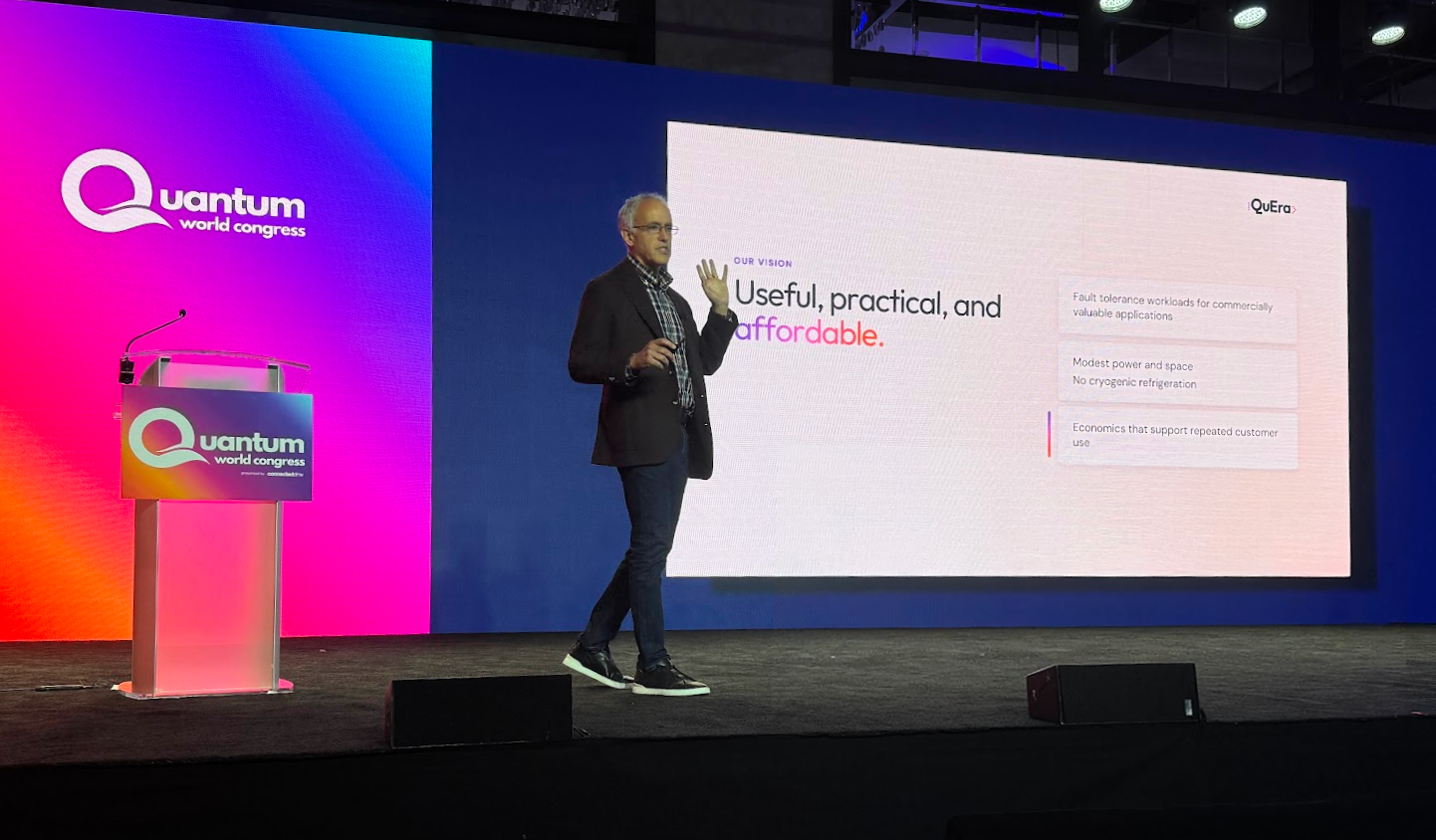
On-prem is another instance where neutral atoms have a physical advantage. Neutral-atom systems operate at room temperature. The atomic qubits are cooled with lasers, not dilution refrigerators, which removes the power draw, footprint, and facility complexity of cryogenic infrastructure. For an HPC center or a government lab weighing how a quantum system will sit on the floor next to classical racks, that is a real difference.
We already have a reference point for this model. Gemini, our neutral-atom system with logical qubit testbed capabilities, is co-located with the ABCI-Q classical supercomputer at AIST in Japan. On-premises deployment matters most for sovereign programs, HPC centers, and customers with data locality or security requirements, exactly the buyers Hyperion sees driving the 2028 mix. As the market tilts toward systems that customers deploy on site, the question changes. It is no longer "can I call a quantum computer in the cloud." It is "can this system live in my environment and connect to my workflows." Neutral atoms are well suited to answer both questions.
On-premises is not the only option. Our Aquila system has been available on Amazon Braket since 2022, and our new strategic AWS partnership extends that cloud relationship toward the fault-tolerant systems arriving in 2028. For most customers, Braket remains the fastest and most viable way to start, with no facility to prepare and no capital commitment up front. For customers who do deploy on-premises, the cloud does not go away. It becomes elastic capacity expansion, a diverse hybrid computing environment, a way to burst beyond the local system for larger jobs, parallel experiments, or peak demand, while the on-premises machine handles the sovereign work it was chosen for. The two models complement each other rather than compete, and the AWS relationship is what lets a customer move along that path without changing platforms.
Error correction is the hinge
Hyperion is candid that the steep part of the growth curve has not arrived. The report describes a market awaiting a hockey stick when quantum advantage is clearly demonstrated, and openly asks whether that inflection lands in 2028, 2029, or 2030. NISQ approaches still lead the 2028 forecast at 38% of revenue, but the universal error-corrected gate model already accounts for 22%, nearly twice its prior share and roughly the size of the entire digital-simulator segment.
This is the transition QuEra has been building toward, and the timing is not a coincidence. Since 2023, we have been a leader in quantum error correction. With Harvard and MIT collaborators, we have published peer-reviewed results demonstrating logical qubits, below-threshold error correction where errors shrink as the system scales, transversal logical operations, fast real-time decoding, and sustained operation of thousands of qubits across multiple rounds of error correction. Those are the building blocks of a fault-tolerant machine.
QuEra published a public roadmap to deliver a 256-logical-qubit fault-tolerant quantum computer on Braket in 2028, designed for a one-in-a-million logical error rate, with a core architecture validated across eight peer-reviewed papers The field has earned its skepticism about quantum timelines, and customers are right to discount vendor projections. The distinction worth drawing is simple. This roadmap has been executed in the open, milestone by milestone, with named strategic partners rather than private promises. If Hyperion's hockey stick arrives around 2028, the organizations positioned to benefit are the ones that treated error correction as the destination all along.
Co-design is where near-term value gets built
Two of Hyperion's data points reinforce each other. First, government labs are the leading vertical for AI-for-science and a top sector for quantum, which tells you where serious quantum-HPC work is concentrated. Second, among companies with government research partnerships, co-design and hybrid quantum-classical exploration were each cited by 30% of respondents, and more than a third of end-user partnerships aimed at working through QC and classical integration issues. The market is not asking quantum to replace HPC. It is asking how quantum fits inside the HPC environments customers already run.
That is precisely our commercial thesis. We treat quantum processors as accelerators within broader classical workflows, not as standalone curiosities. Our partnership with classical computer vendors targets integrated fault-tolerant quantum and classical/HPC solutions. Our long-standing AWS relationship extends Braket toward fault-tolerant systems, and our NVIDIA collaboration covers CUDA-Q integration, real-time quantum-classical interfaces, and AI-accelerated decoding and calibration. Hybrid quantum-classical is the practical path for connecting quantum processors to the simulation, optimization, and orchestration systems already in production.
The co-design signal deserves particular attention. The algorithms that will fully harness fault-tolerant systems at scale do not yet exist, and NISQ-era techniques will not extract that value on their own. Our co-design model gives HPC centers, government programs, and enterprise teams a structured way to identify quantum-relevant workloads, benchmark them against classical baselines, emulate before spending scarce hardware time, and build the internal capability to be operational on Day One when fault-tolerant systems arrive. Waiting until 2028 to start that work is itself a competitive risk.
The application picture points where neutral atoms are strong
Hyperion's respondents put computational chemistry at 26% and material science at 22% at the top of the most-promising-applications list, nearly half the total between them, both because they use quantum systems to simulate quantum-level phenomena. Optimization and logistics followed at 11%, while AI/ML continued a multi-year decline to 10%, down from 23% in 2022.
Chemistry, materials, and optimization are exactly the domains our 2028 fault-tolerant system targets. The early evidence is already accumulating in life sciences: two of the six Phase 3 finalists in Wellcome Leap's Quantum for Bio Challenge are powered by QuEra. When near-term demand concentrates in quantum simulation, a platform built natively on programmable arrays of interacting atoms is working with the grain of the problem, not against it.
The takeaway
Hyperion's ISC26 update is a measured document. It forecasts healthy growth, names real concerns about cost, power, and supply chains, and refuses to declare quantum advantage before it has been demonstrated. Read alongside where QuEra has placed its bets, cloud access on Amazon Braket that extends to on-premises and HPC-integrated deployment, error correction as the path to fault tolerance, and co-design as the way customers get ready, the report reads less like a surprise and more like confirmation.
Different platforms will lead on different metrics, and neutral atoms are one credible path, perhaps the most credible, among several. But the shifts Hyperion is tracking are the shifts we have been preparing for. The question the report leaves for customers is no longer whether fault-tolerant quantum computing will arrive. It is whether they will be ready when it does.