



.webp)
Executive summary
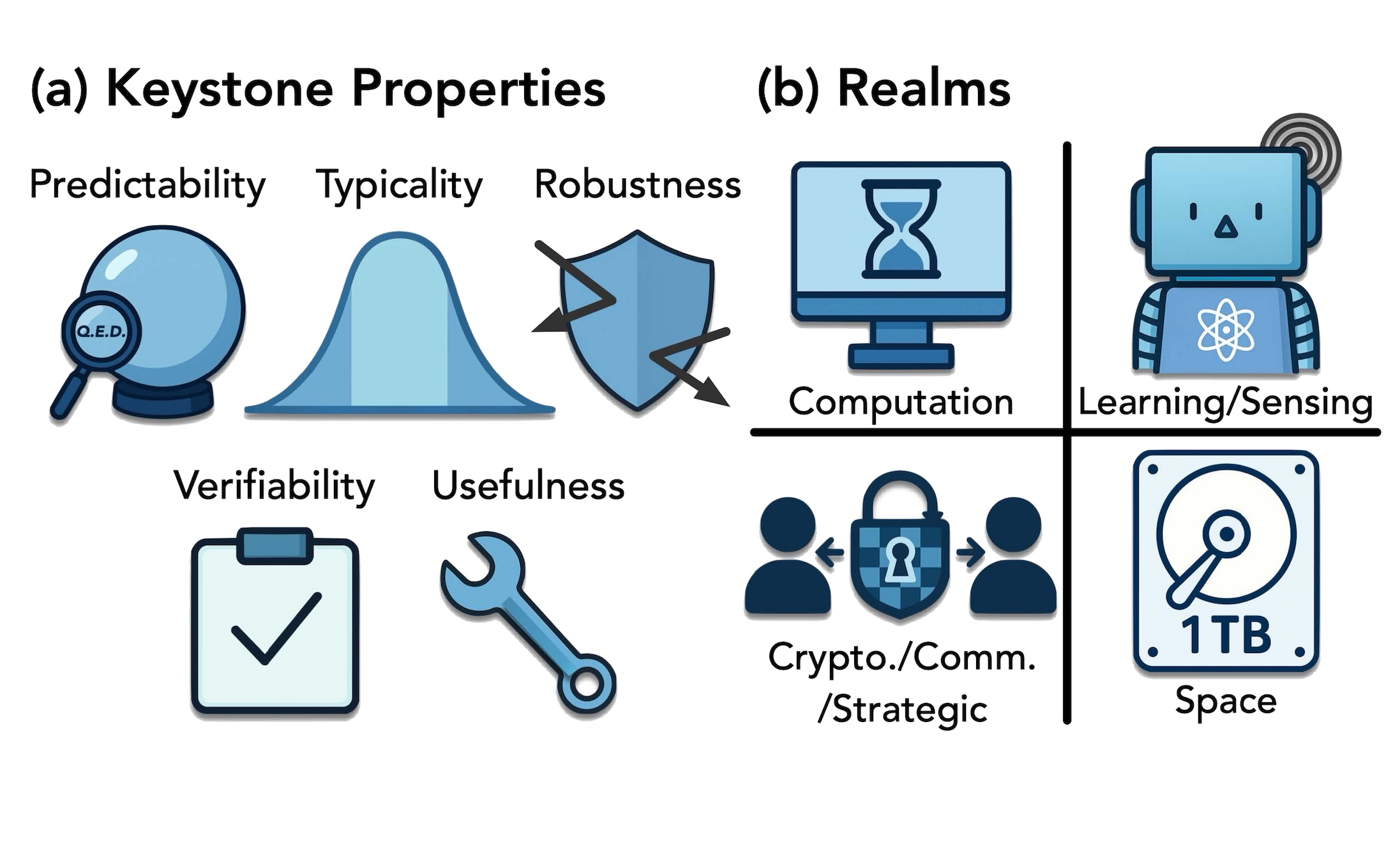
A new perspective paper by H.-Y. Huang, S. Choi, J.R. McClean, and J. Preskill surveys where quantum advantage is real, where it’s illusory, and how to tell the difference. The authors propose five “keystones” for assessing any claimed advantage—Predictability, Typicality, Robustness, Verifiability, and Usefulness—and argue that advantages will span multiple realms: computation, learning/sensing, cryptography/communication/strategic games, and memory efficiency (“space”). They also prove a striking meta-result: deciding whether a given circuit has a quantum advantage over a leading classical simulator can itself be quantumly easy and classically hard (assuming BPP ≠ BQP)—implying that some advantages won’t be discoverable without running quantum hardware.
What the paper says (in plain language)
- Five keystones for credible advantage. Compelling claims should be (1) predictable by strong theory or evidence, (2) typical across a broad family of instances, (3) robust to noise/imperfections, (4) verifiable efficiently, and (5) useful in practice—not just asymptotically elegant.
- Realms of advantage. The landscape is broader than “faster algorithms.” The paper organizes advantages across computation, learning/sensing, crypto/communication/strategic interactions, and memory efficiency. Expect different evidentiary standards across these areas (e.g., complexity assumptions vs. physics-guaranteed separations).
- Why “pseudo-advantages” keep appearing. Many eye-catching speedups fade once better classical baselines, I/O costs (e.g., QRAM), or verification overheads are accounted for. The paper revisits well-known examples and emphasizes rigorous comparisons to evolving classical methods.
- Unpredictable advantages are a feature, not a bug. The authors show (via a meta-complexity style argument) that predicting whether a particular circuit beats a strong classical method (Pauli-propagation simulation) is itself a task with quantum advantage; practically, that means some wins will only surface by experimenting on quantum devices.
Why this matters for decision-makers
1) Evaluate programs against the five keystones.
When prioritizing use cases, insist on:
- Predictability: evidence beyond hype—e.g., reductions to standard assumptions or physics-backed separations.
- Typicality: performance across instance distributions you actually care about, not cherry-picked cases.
- Robustness: sustained advantage under realistic noise, calibration drift, and resource limits.
- Verifiability: scalable checks (statistical tests, cross-checks against surrogates, or structure-exploiting proofs).
- Usefulness: wall-clock, energy, cost, and integration metrics—not just asymptotic complexity.
2) Expect discovery to be empirical.
Because some advantages are provably hard to predict classically, hardware-in-the-loop exploration is not optional—it’s the path to finding where quantum genuinely moves the needle.
3) Broaden the aperture beyond “compute.”
Advantages in sensing/learning, communication/security, and memory efficiency may reach “useful first” before large-scale fault tolerance, and often demand different benchmarks than algorithmic speedups.
A practical checklist for pilots in HPC, government, and industry
- Define the benchmark family (Typicality): distributions, sizes, graph geometries, or Hamiltonian ensembles you care about.
- Lock a classical baseline: include modern surrogates (tensor networks, ML-assisted solvers, specialized heuristics). Update baselines as they improve.
- Design for robustness: sweep noise levels, device sizes, and calibration frequencies; report sensitivity.
- Plan verification: pre-specify statistical tests, cross-checks on smaller instances, and backstops (e.g., conserved quantities in simulations).
- Quantify usefulness: wall-clock, cost per solution, energy, queue time, and integration overhead into existing pipelines.
- Iterate in hardware: schedule exploration phases that deliberately probe problem families where theory suggests promise and where unpredictability means only experiments can decide.
Key takeaways
- The field is moving from isolated “speedup claims” to multi-criteria advantage grounded in five keystones.
- Some wins will be hardware-discovered, not desk-predicted—plan for empirical discovery loops.
- Advantage is plural: look to sensing/learning, communication, and memory efficiency alongside computation.
Source
- H.-Y. Huang, S. Choi, J.R. McClean, J. Preskill, “The vast world of quantum advantage,” arXiv (Aug 11, 2025).
- The cover image is also sourced from this paper

e%201437254775.png)